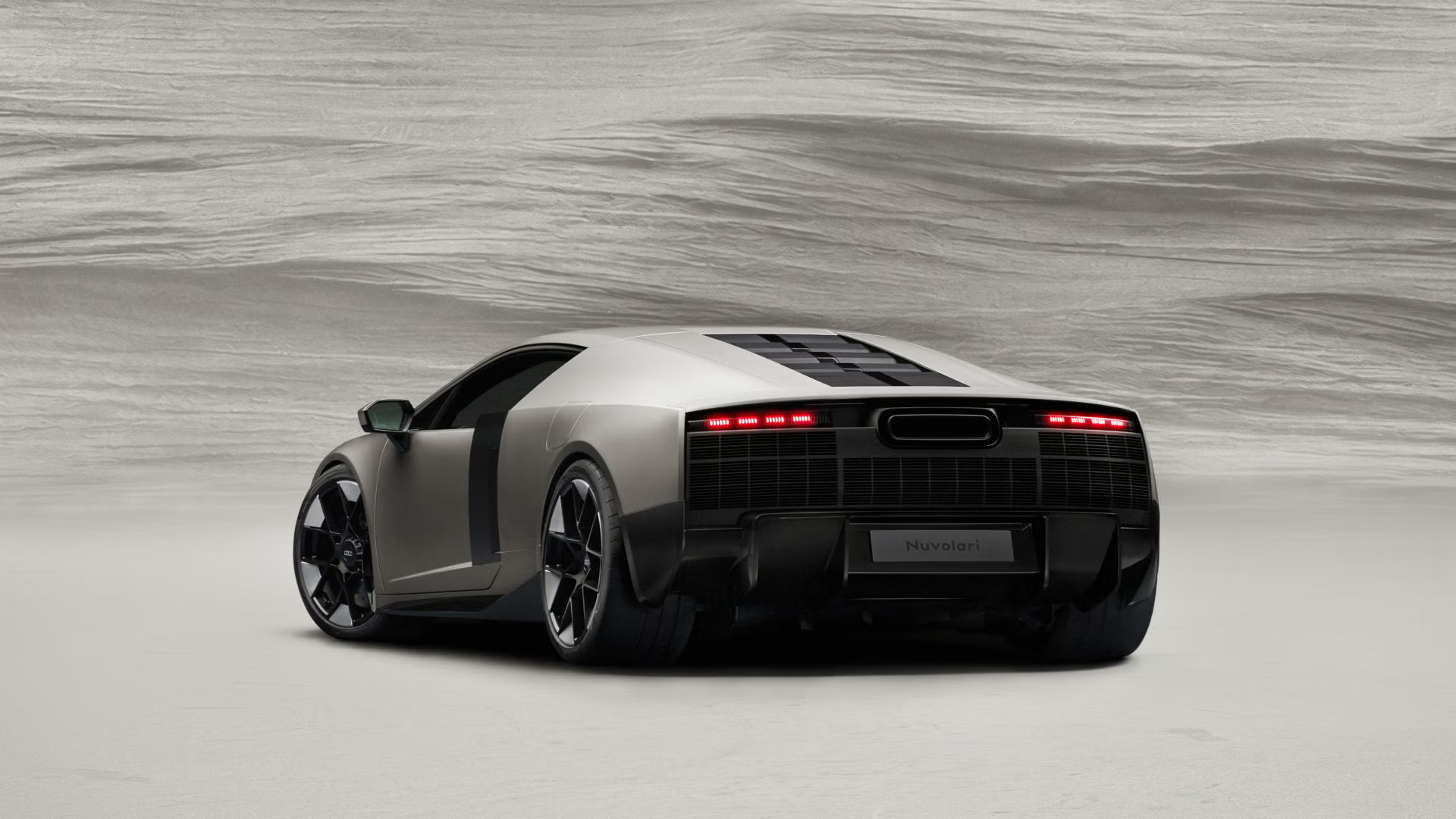
Monterey Car Week attracts a specific kind of car person: the one who already owns the vintage Alfa and the modern Bugatti and is now window-shopping for whatever comes next. That’s precisely who Audi was courting on August 25, when the Nuvolari, its 1,001-PS hybrid supercar, made its first appearance in North America not at a drag strip or a track day, but parked on the Concept Lawn at the Pebble Beach Concours d’Elegance and on the manicured grass of The Quail.
The timing wasn’t an accident. Audi rolled the Nuvolari onto the Monterey Peninsula just 17 days after the Q9 SUV’s world premiere in New York City, pairing a volume-selling family hauler with a 499-unit halo car in back-to-back U.S. reveals. It’s a two-pronged pitch to the world’s second-largest auto market: one car to fund the company, one car to make people fall for the brand again.
Audi CEO Gernot Döllner framed the pairing as deliberate, noting the Q9 was built for American customers while the Nuvolari serves as “a technology and design flagship” for the brand’s broader reinvention. Audi of America president Vito Paladino was more direct about the venue choice, describing Monterey Car Week as the ideal stage for introducing the brand’s first true halo supercar to serious collectors.
Beyond the show lawns, the Nuvolari also logged its first American road miles this month, driven along the coastal switchbacks near Carmel-by-the-Sea. That drive followed the car’s track debut at the Monaco Grand Prix in May and its world premiere near Antibes, France, back in June, meaning the Nuvolari completed its two most important auditions, racetrack and public road, on two continents in under three months.
Why Pebble Beach, Not a Quarter-Mile
Audi didn’t send the Nuvolari to a drag strip or a road course for its U.S. coming-out party, and that choice says something about who’s actually going to buy this car. With only 499 units built worldwide and pricing still unannounced, Audi is selling to a collector base that cross-shops at concours events, not enthusiasts cross-shopping lap times. Parking a hybrid halo car next to pre-war coachbuilt classics on the Pebble Beach lawn does more for resale value and brand cachet than any quarter-mile number ever could.
Under the Skin: F1 Hardware Wearing License Plates
Strip away the show-lawn polish and the Nuvolari’s spec sheet reads like a Formula 1 team’s wish list. A 4.0-liter twin-turbo V8 producing 800 hp anchors a hybrid system that adds three electric motors, two at the front axle and one sandwiched between the engine and transmission, for a combined 1,001 PS (987 hp, or 736 kW) routed through a quattro all-wheel-drive system. Audi quotes 0-100 km/h (62 mph) in 2.6 seconds, 0-200 km/h in 6.8 seconds, and a top speed beyond 350 km/h (217 mph), though the quickest numbers only apply once the 7.3-kWh battery is warmed above 28°C and charged past 80 percent, a reminder that plug-in hybrid supercars perform on their own schedule, not the driver’s.
The front motors are worth pausing on: they’re axial-flux units, a motor design that arranges its magnets and windings like a disc rather than the more common cylindrical layout. Axial-flux motors pack more torque into a smaller, lighter housing, which is exactly why they’re showing up in performance and aerospace applications before trickling down to mainstream EVs. Here, they double as an active torque-vectoring system, shoving power side to side across the front axle faster than a mechanical differential ever could.
The chassis is a new take on Audi’s Space Frame, this time wrapped almost entirely in carbon fiber body panels, a first for a production Audi, built using the same prepreg autoclave process the brand’s motorsport programs rely on. Behind it sits an active rear wing that shifts between low-drag and high-downforce positions on its own, plus a steering-wheel-mounted Drag Reduction System button lifted straight from F1 rulebooks. In its most aggressive setting, Audi claims over 400 kg (roughly 880 lbs) of downforce, which matters far more at Nardò’s high-speed bowl than it will on the road to Carmel.
The braking system deserves its own line item for anyone actually considering ownership. Ten-piston front calipers grip 420mm carbon discs derived from F1 material science, paired with a brake-by-wire system that electronically decouples pedal feel from where the stopping power actually comes from. Audi says the setup can absorb 2.8 megawatts of energy, supercar-speak for track-day durability, but carbon-ceramic and carbon-carbon brake packages like this one are notoriously expensive to service once they wear out, often running into five figures per corner on limited-production exotics. Buyers should budget accordingly, and insurers will likely treat this one closer to a competition car than a daily driver once real claims data exists.
The Man Behind the Name
Audi named its fastest-ever production car after Tazio Nuvolari, the Italian driver who spent the 1930s embarrassing better-funded teams in inferior machinery, most famously out-driving Mercedes’ state-backed Silver Arrows in a private Alfa Romeo at the 1935 German Grand Prix. Nuvolari also drove for Auto Union, Audi’s own motorsport ancestor, which makes the naming less of a marketing reach and more of a direct lineage claim. Fittingly, Audi’s AAuto Union Lucca tribute car made its own first public appearance in motion at the Goodwood Festival of Speed alongside the Nuvolari this July, tying the brand’s 1930s racing history directly to its 2026 halo car.
What’s Missing: A Price Tag
Audi still hasn’t published pricing for the Nuvolari, European presales don’t open until the fourth quarter of 2026, and first deliveries aren’t scheduled until the first half of 2027, meaning the car that just drove past Pebble Beach’s lawns won’t reach a single customer’s garage for at least another year. Audi has also declined to say how many of the 499 units are earmarked for North America, which matters more than it sounds: allocation, not sticker price, is usually what determines resale premiums on limited-run exotics before they’ve even shipped. When Backfire first covered this car’s specs in June, we flagged its rarity and output as the two numbers that would matter most, and nothing Audi has said since changes that math.
A Bigger Signal for Audi
The Nuvolari isn’t an isolated flex. It’s the first production car wearing Audi’s new design language, the same Titanium paint finish debuting on the Concept C roadster, and it arrives the same year Audi joins the Formula 1 grid as a full works team, with Nuvolari prototype testing duties handled by Audi’s own grand prix drivers, Nico Hülkenberg and Gabriel Bortoleto. Read together, the SUV volume play, the electric roadster, the F1 program, and now a 217-mph hybrid halo car all point at the same strategy: Audi is trying to prove its next decade is as technically serious as its last five were profitable. Whether 499 collectors agree enough to sign purchase agreements before those Q4 presales open will be the first real test.
About the Author