Photo: MrWalkr via Wikimedia Commons, CC BY-SA 4.0
Most companies announce an investment round with a stage, a slide deck, and somebody saying the word “ecosystem.” Delage announced its newest shareholder by editing a web page.
Tucked into the French marque’s own investor roster, somewhere between a Madagascar-based telecoms billionaire and a Geneva multifamily office, there is now an entry for Antoine Arnault. There was no embargo and no press conference, just a name added to a list that happens to be the most revealing document this company publishes.
Who Antoine Arnault is
LVMH’s own governance page lays out his CV, and it’s an operator’s résumé: born in France in June 1977, HEC Montreal, a domain-name registration startup of his own in 2000, then Louis Vuitton, then CEO of Berluti in 2011, chairman of Loro Piana from 2013 to 2025, Director of Image and Environment since 2020, CEO and vice-chairman of Christian Dior SE since December 2022, and a seat on the LVMH executive committee since February 2026. As chairman of Agache Sport he was also named a director of Paris Football Club in November 2024.
Delage’s own description of him adds the detail that matters here: he collects cars, with a stated appetite for the 1980s and 1990s, the era of mechanically hostile machinery that has since gone blue chip. That taste explains the appeal of a naturally aspirated French V12 better than any luxury-sector logic does.
LVMH and Kering money, same page
The same shareholder page that now lists Antoine Arnault also lists Francois and Francois-Henri Pinault. So the two dynasties whose rivalry is effectively the organizing principle of European luxury, the ones who compete over maisons, auction lots, football clubs and Paris real estate, are co-investors in a French company that builds eight cars a year.
Around them sit Xavier Niel, Carmignac co-founder Frederic Leroux, whose collection Delage puts at more than a hundred cars including a Countach Periscopio, former Cap Gemini chief Georges Cohen, Madagascar-based conglomerate builder Hassanein Hiridjee, cloud-telecom self-made man Kevin Polizzi, the Abchee twins from a family automotive import group, a Geneva multifamily office, and two Dubai investment funds. Re-founder and CEO Laurent Tapie holds the majority.
Look past the two luxury dynasties and most of that list is telecom, software, cloud, fintech and asset-management money, Arnault’s own first venture included. Delage has become a place where French tech-era fortunes park a car habit.
Delage says it never needed the cash, so ask why the list keeps growing
The company states on that same page that financing “has never been an issue for DELAGE since its resurrection” in 2019. Take that at face value. A shareholder register can still do things for a 30-car manufacturer that money can’t.
Delage’s own press releases show how. Menas Global, the Dubai fund on the shareholder list, is also the partner behind the Delage of UAE operation announced in August 2023. Negma Group, another shareholder, is also based in Dubai. Christian Boyer appears on the same page as both an early investor and the first French customer to order a D12. Investors, distributors and customers are largely the same people.
That’s efficient, and it matters if you’re a buyer. When the cap table doubles as the dealer network and the order book, allocation runs on relationships rather than a queue, and there’s no independent dealer body to take a warranty or parts dispute to. On a car powered by a bespoke in-house V12, that matters more than anything printed on the spec sheet.
The spec sheet
Delage publishes full technical data for both D12 versions:
- 6,635 cc naturally aspirated V12, 66-degree bank angle, 95 x 78 mm bore and stroke, four valves per cylinder, variable inlet and exhaust cam timing, dry sump, direct injection
- 850 hp at 8,600 rpm and 549 lb-ft at 7,000 rpm from the engine, 150 hp and 186 lb-ft from the electric motor, 1,000 hp and 735 lb-ft combined
- Rear-wheel drive, eight forward gears and an electric reverse
- Carbon fiber central monocoque with a front crash box and a rear aluminium frame, contractile suspension front and rear
- Carbon-ceramic discs, 380 mm front and 360 mm rear, six-piston front calipers and four-piston rears
- 4,645 mm long, 2,063 mm wide, 2,800 mm wheelbase, 80-litre fuel tank
- 1,360 kg dry for the GT and 1,320 kg for the Club, 360 km/h claimed, 0-100 km/h in 2.5 and 2.4 seconds respectively
Start with the engine. A 60-degree vee is the textbook answer for a twelve because it hands you even firing intervals for free. Delage went to 66 degrees, which means packaging and induction routing won the argument and the crankshaft has to do the work of keeping combustion evenly spaced. The 95 by 78 mm dimensions are heavily oversquare, and at 8,600 rpm mean piston speed lands around 22 metres per second, right at the ceiling for a road-going engine and squarely in racing-hardware territory. Expect valvetrain and rotating-assembly service intervals to reflect that, and budget for a dry-sump system that holds a lot of oil and relies on a scavenge circuit no independent shop will enjoy meeting.
The hybrid layout is the cleverest decision here. Rather than sandwiching a motor against the crank to fill in torque, Delage bolts the 150 hp unit to the gearbox and leaves the V12 to answer the throttle on its own terms. That preserves engine character, and it explains the transmission line: eight speeds forward, reverse handled electrically. There’s no mechanical reverse gear at all. That saves weight and complexity, but it’s also an ownership quirk: a car with a dead high-voltage system can only go forwards.
Then there’s traction. A thousand horsepower and 735 lb-ft through the rear tires alone, at a dry weight of 1,320 to 1,360 kg, works out to about 0.74 hp per kilogram, which is why the claimed 0-100 km/h times start with a two rather than a one. All-wheel-drive hybrids win the traffic-light drag race. The D12 is built for the exit of the corner.
A world-first claim for the suspension
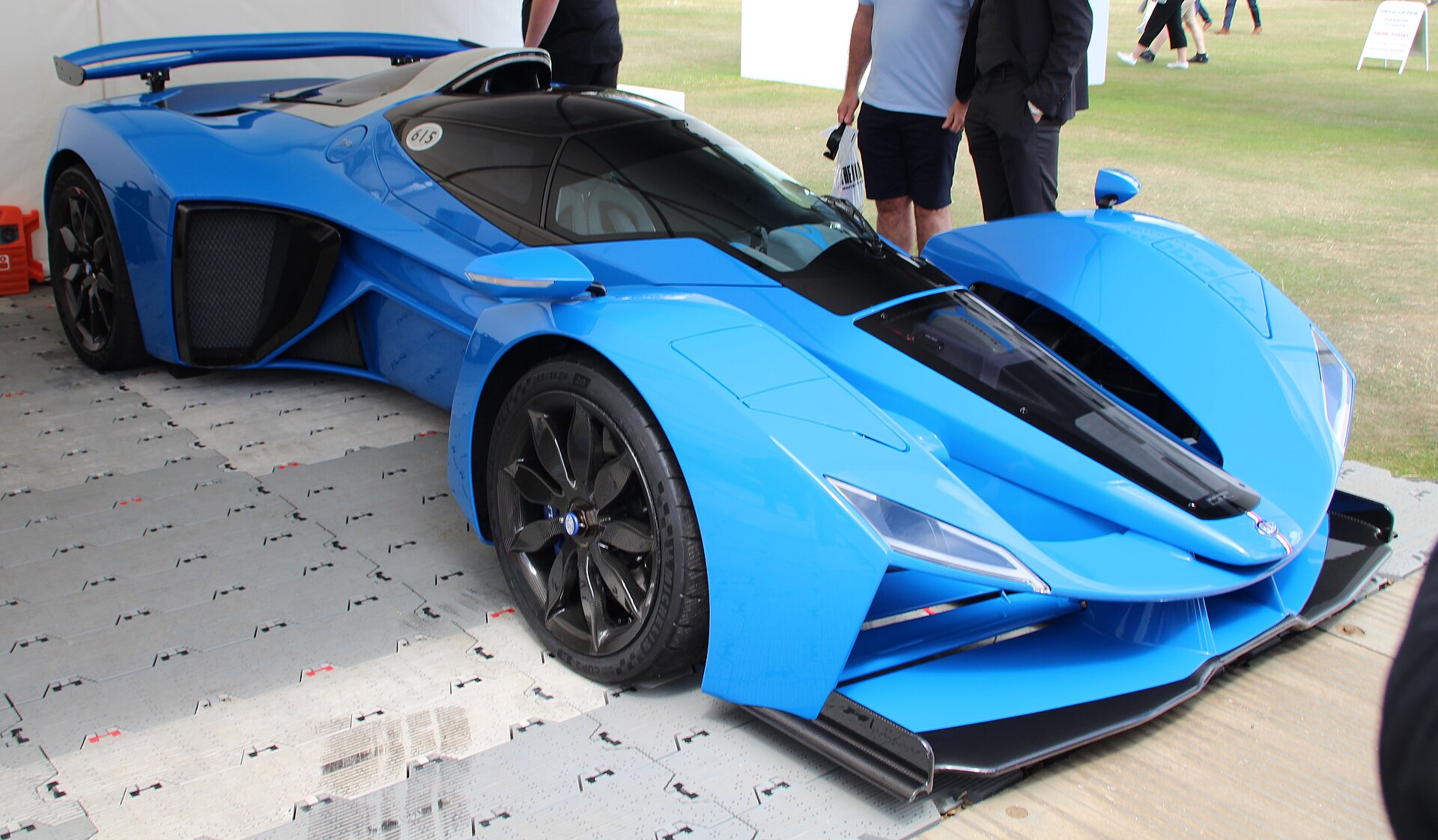
Delage fits what it calls contractile suspension at both ends and bills it as the first road-homologated application of the idea. In practice it means struts that shorten to change ride height, and the published figures show what that buys: 1,140 mm tall in city mode, 1,115 mm on the road, 1,090 mm on track, plus a nose lift on the GT. A 50 mm ride-height window is a cheap and powerful aero tool, and changing rake by that much alters downforce and balance more than most wing adjustments will. Active front flaps, aerobrakes and a rear wing handle the rest, hydraulically on the GT and electrically on the lighter Club, which is a neat inversion of the usual weight-saving logic.
The flip side arrives a decade from now. Height-adjustable, actuator-dependent suspension is the component that ages worst on low-volume exotics, and carbon wheels with integrated brake-cooling ducting are magnificent right up until a Parisian kerb finds one. If you ever buy one of these used, ask about lead times and pricing on struts and rims first.
Delage also targets a sub-6:40 Nurburgring lap for the GT and sub-6:35 for the Club. Those are the company’s own estimates rather than timed results, and until somebody hangs a transponder on the car they belong in the same drawer as every other pre-production Nordschleife promise. Chasing lap-time headlines has a patchy record of making cars better to drive.
No doors, tandem seats, and a paperwork problem
The D12 seats two in tandem under a canopy that opens like a fighter jet, driver on the centerline, passenger behind. Aerodynamically that is the correct answer: minimal frontal area and near-perfect symmetry. Legally it is a minefield. Centre seating and a doorless canopy raise questions about occupant egress, mirror fields of view, glazing, lighting heights and restraint geometry that a conventional two-door supercar never has to answer.
Europe has small-series approval routes built for exactly this. The United States does not, in any affordable sense, because a 30-car run cannot amortise full federal compliance. That is why cars in this class tend to arrive via homologation workarounds, narrow exemptions, or as track-only machines. The same arithmetic has stranded entire limited editions outside US borders for 25 years, and even a motorcycle can trip over the same rulebook. Delage has been pointed at America from the start, with its own releases recording the first two D12s going to a Newport Beach group in 2020 and a Florida representative appointed in 2022, so exactly how a car gets titled stateside is the detail a prospective owner should nail down in writing before wiring a deposit.
It will also be loud. A 6.6-litre V12 revving to 8,600 rpm sits inches behind two people inside a sealed canopy, and there’s a reason Fernando Alonso wears a headset in his Valkyrie.
Thirty cars, eight a year
Delage builds at the Magny-Cours F1 Technopole in a facility of roughly 1,000 square metres, with stated capacity for eight D12s per year. The run is capped at 30 cars. Run the arithmetic and the entire production programme amounts to about three years and nine months of work at full tilt.
No car company survives on that, which is why Delage’s release history reads the way it does: licensing operations in Qatar and the UAE, a boutique and an online shop, artist and brand collaborations, and an October 2024 announcement of both a next hypercar and a second sportscar brand. The D12 is the proof of concept and the trademark is the asset, so anyone writing an equity cheque is really buying the name.
Putting the factory at Magny-Cours was a smart, unglamorous call. The Technopole is where French motorsport engineering labour already lives, and hiring fabricators and race engineers 15 minutes from Nevers is far easier than trying to do it in Paris.
Why the badge was worth buying in the first place
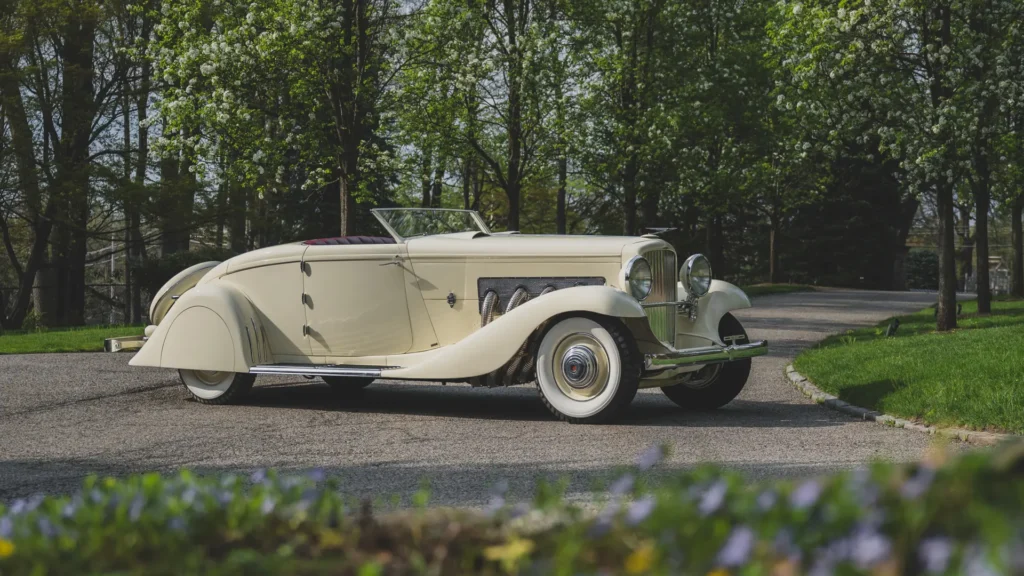
This is not a nameplate somebody found in a trademark database. Louis Delage started the company in 1905 with a single-cylinder De Dion voiturette, won the Coupe des Voiturettes as early as 1908, and took both drivers’ and constructors’ honours in the 1927 World Grand Prix Championship, the title that predated Formula 1. The four-litre D8 landed at the 1929 Paris Motor Show and became a canvas for Figoni et Falaschi, Chapron, Pourtout and De Villars. The 1937 D6-70, with a 2,729 cc overhead-valve straight-six and an electrically operated four-speed gearbox, won the 1938 Tourist Trophy at Donington and finished second at Le Mans twice. The last car left the factory in 1953.
Those cars still set the market’s benchmark for the name. One of them, a 1937 D8-120 S bodied by Pourtout, carried a multi-million-dollar estimate at Monterey this summer on the strength of a Pebble Beach Best of Show. That is the bar the D12 is implicitly claiming, and it is a brutal one, because prewar Delage value rests on authenticity and craft rather than horsepower.
The modern company at least staffs itself like it means it. Patrick Delage serves as honorary president. Jacques Villeneuve handles driving and setup, which is the marketing. Mauro Bianchi, credited with chassis and suspensions, is the more telling hire. On track, Delage tied up with IDEC in April 2023, ran alongside the team’s LMP2 car at Le Castellet that May, and a month later the Delage by IDEC Sport entry took LMP2 Hyperpole at Le Mans. That’s a qualifying result, not a race win, but it’s more than most brand revivals ever put on a timing sheet. The D12 also collected a Most Beautiful Car in the World nod at the 2020/2021 Automobile Awards, the kind of prize that sells cars to people who will never corner hard enough to need the aerobrakes.
What to watch
Ownership changes at an exotic manufacturer usually mean something. Porsche’s exit from Bugatti Rimac reshaped an entire segment’s engineering roadmap. Delage’s cap-table news is a smaller story. The money here is decorative, and funding was never the risk.
Watch delivery pace out of Magny-Cours, because eight cars a year is a ceiling, not a promise. See whether a verified Nordschleife time ever shows up. And keep an eye on whether that announced second brand pulls engineers away from 30 extremely demanding customers, a problem that has hurt better-funded outfits than this one.
If a D12 is ever offered to you secondhand, the shareholder list is the least useful page in the file. Find out who is authorised to repair the carbon monocoque, what an insurer will write as an agreed value with track cover included, and who rebuilds that V12, how often and for how much. Ask about lead times on contractile struts and carbon wheels, and what warranty support looks like if the company has moved on to its next project. Billionaires make great shareholders and lousy parts departments.
About the Author