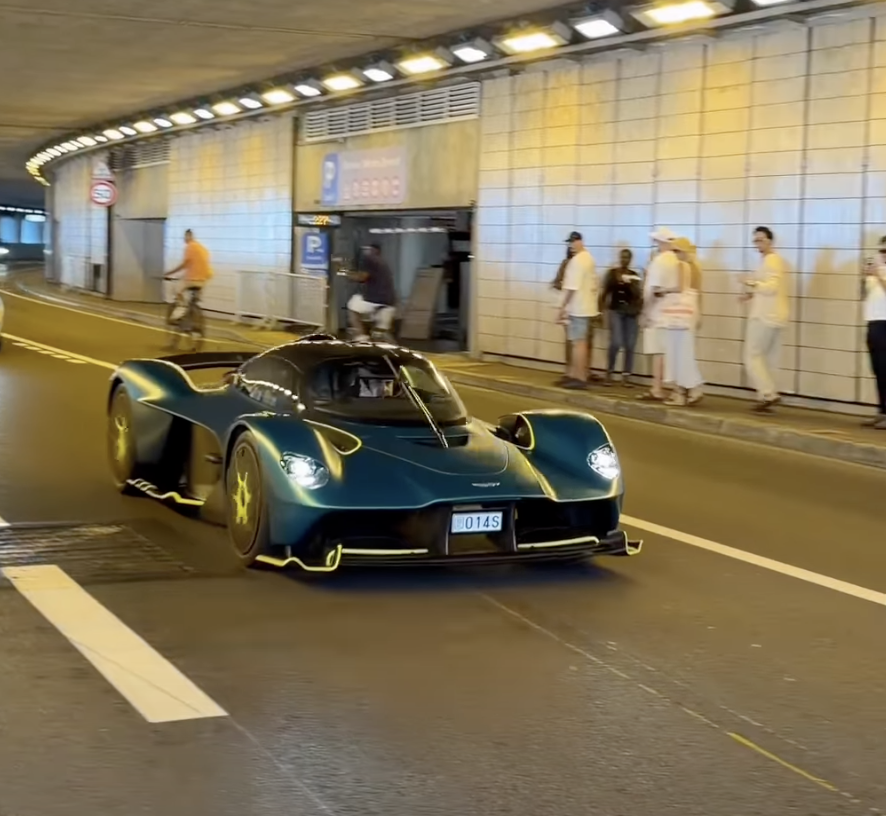
The clip going around this week shows Fernando Alonso threading his Aston Martin Valkyrie through Monaco, into the tunnel, and back out into daylight. The detail everyone fixated on was the headphones on his head. Fair enough. But the headphones are the least surprising thing in the video, and the fact that the car was moving at all is the most.
Start with the ears, because that’s actually an engineering story.
Why you wear a headset in a Valkyrie
Aston Martin’s own technical release on the Valkyrie powertrain spells out the reason without ever mentioning noise. The 6.5-litre Cosworth V12 is a fully stressed member of the chassis. So is the gearbox casing, which also carries the rear suspension mounting points. There is no rear subframe. There are no engine mounts in the sense you’d recognise from a normal car, because the engine is the structure connecting the front of the car to the back.
Related Articles
- KTM Recalls 6,257 Husqvarna and GasGas Dirt Bikes Over Rear Brake Calipers That Can Crack Mid-Ride
- Cédric Sbirrazzuoli, the Ferrari Racer Conquest Only Needed Four Times a Year, Dies at 39 After Cancer Battle
Think about what that means acoustically. In a conventional mid-engine supercar, combustion energy passes through rubber bushings, then a subframe, then more bushings, then the tub. Each interface eats vibration. In the Valkyrie, the path from the combustion chamber to the base of the driver’s spine is metal to carbon, full stop. Every firing pulse and every gear mesh in the valvetrain drive arrives essentially undamped, and the occupant’s head sits a few inches from the front of that engine.
Now add the rev range. Aston’s engine announcement confirms peak power of 1,000bhp at 10,500rpm with a 11,100rpm ceiling, and an engine that weighs 206kg. Light and structural is a wonderful combination for lap time. It is a terrible combination for anyone who wants to hear their own thoughts. A headset in that cabin isn’t a pose. It’s the same logic as ear defenders on a flight line.
The tunnel makes it worse, incidentally, and better. Concrete is acoustically hard and reflects almost everything back at you. A high-revving naturally aspirated V12 in an enclosed tube isn’t just louder, it’s louder in a way that stacks reflections on top of the direct sound. Anyone who’s driven a straight-piped car through a parking structure knows the effect. Multiply it by twelve cylinders and five figures of rpm.
This car has been a Monaco local for two years
Worth flagging for anyone treating this as a debut: it isn’t one. Aston Martin’s own press release dates the handover to 4 September 2024, out of the Monte Carlo Bay Hotel, with Alonso specifying the car through Q by Aston Martin. The team’s announcement lists the details that identify it in any footage: Satin Aston Martin Racing Green, AMR Satin Lime graphics, Speed Red plus light and dark blue painted into the venturi tunnels, exposed carbon on the roof, engine cover and lower aero, titanium wings badge on the nose.
There’s a small numbers puzzle in Aston’s own paperwork, too. The 2019 powertrain release put combined output at 1,160bhp at 10,500rpm with 900Nm at 6,000rpm. The 2024 release about Alonso’s car quotes 1,155PS. Those aren’t the same figure dressed differently. Convert 1,155PS and you land near 1,139bhp, roughly 20 horsepower shy of the original claim. Metric versus imperial hides a lot of sins in hypercar press material, and it’s worth doing the arithmetic before repeating a number.
The part nobody mentions: the brakes
Here’s something genuinely useful that hasn’t shown up in the coverage of this video, and it comes straight from a federal filing.
On 3 June 2026, Aston Martin The Americas submitted Part 573 recall 26V359 to NHTSA covering 2024 Valkyries fitted with the track suspension pack. The population is seven cars. The report also states that Aston knows of 51 model-year 2024 Valkyries in the United States total, which is a rare and precise look at how thin the US parc really is.
The defect is a seal inside one of the brake master cylinders that can deform under a specific pressure reversal. When it does, fluid in that diagonal circuit can’t return to the reservoir, so pressure stays trapped and the brakes drag. Heat builds. If the discs are already hot, Aston’s filing says the resin in the carbon fibre rear brake cooling duct can reach ignition point. That’s a fire risk, and NHTSA logged the advisory as do not drive, park outside.
The root cause is the interesting bit for anyone who follows how these cars get built. Per the filing, the Valkyrie’s brake system was originally designed without an electronic stability program or adjustable traction control in the plan. The master cylinder seal was never engineered to manage fluid during a simultaneous ESP intervention and a hard pedal application. ESP and TC arrived later, as they had to for road homologation, and the hydraulics underneath were left playing catch-up.
The chronology in the report is a slow burn in every sense. A prototype caught fire during a deliberately induced emergency stop in November 2022. Root cause was identified in February 2023. New parts entered Aston’s system in September 2025. The recall committee convened in May 2026.
Related Articles
- California’s Replacement Tire Rules Explained: Dates, Exemptions and What Enthusiasts Keep Getting Wrong
- The Bonneville Octavia at 15: The Record Škoda Doesn’t Mention Losing
One caveat that matters for the video: Aston states the trigger conditions require track use, specific yaw and body slip angles, and speeds that cannot be reached on a public road. Alonso rolling through the Monaco tunnel is nowhere near that envelope. But if you own one of the 51, or you’re bidding on one, the VIN and the track suspension pack status are the first two things to check.
The practical takeaway
For everyone who isn’t Fernando Alonso, the lesson from a nine-second clip is that a Valkyrie’s usability constraints are structural, not cosmetic. The noise comes from the same decision that gives it a 3.3g lateral capability and a six-point harness. You can’t fix one without giving up the other, which is presumably why nobody tried.
And yes, Alonso has form for finding this funny. When his freshly delivered car appeared on a flatbed in 2024 and social media declared it broken, he replied from his own account with a crack about distant sources and a wall of laughing emojis before posting the delivery photos himself. Two years on, the car still runs, still gets driven, and still requires hearing protection. That’s about as good an outcome as this category offers.
Images Via: monaco_luxurystyle on Instagram
About the Author