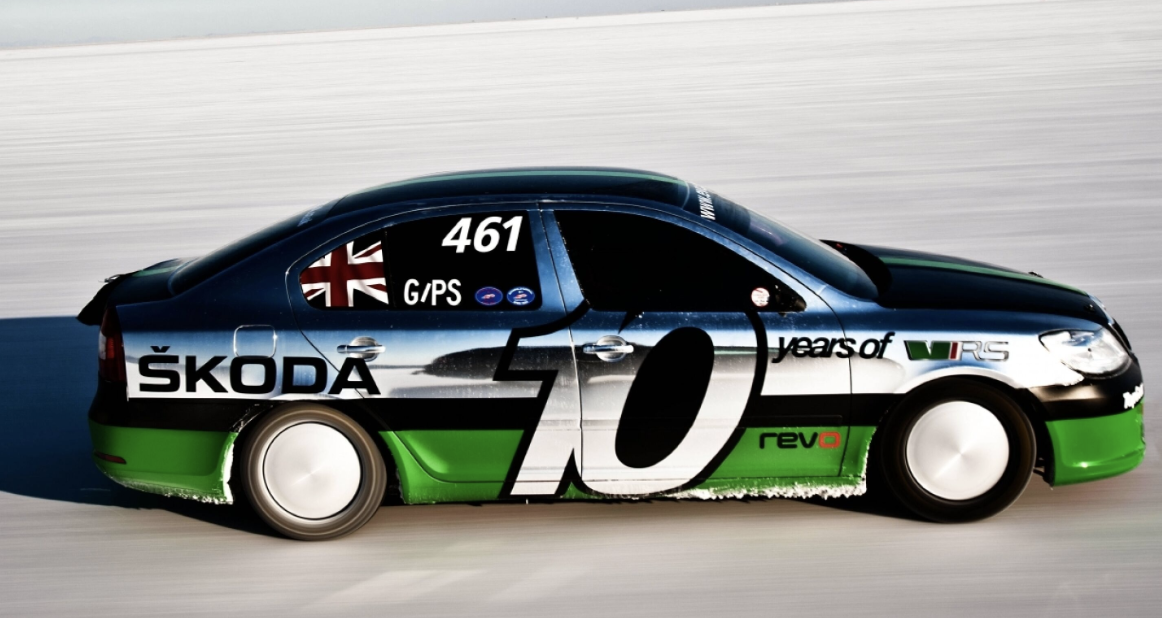
Fifteen years ago this week, a press-fleet Škoda Octavia that had been quietly stolen from the loan pool went 227.080 mph across a dry lakebed in Utah. Škoda UK is marking the anniversary, and the number still lands — a family hatchback with a 2.0-litre four running faster than a Ferrari 458 of the same era could manage flat out.
But the anniversary release leaves out the most interesting development of the last fifteen years, which is that the record it commemorates belongs to somebody else now.
Check the book
Land speed records at Bonneville aren’t vague. The Southern California Timing Association keeps a published class-by-class ledger, and the current edition of that rulebook record list shows the Production Supercharged category, engine class G, at 234.252 mph — set in September 2017 by an entry listed as Potter Brothers Passat, driver D. Potter.
Read that again. The Octavia’s class record was taken seven mph clear by another Volkswagen Group sedan with the same displacement bracket. The salt keeps its own scoreboard, and it doesn’t care about press releases.
Related Articles
- Suspect Charged After Greg Biffle’s NASCAR Rings Surface in Georgia
- California Just Set Efficiency Rules For Replacement Tires — And Your Track Rubber Is Exempt
To be fair to Škoda, the surviving claim is narrower and still true: the Bonneville Special remains the fastest Škoda ever built. That’s a different sentence from “the record still stands,” and the difference is worth knowing before you repeat it at a car meet.
The class rules are the whole story
G/PS looks like alphabet soup until you decode it. Škoda’s own technical account puts the car in Gas/Production Supercharged, chasing an existing benchmark of 216 mph.
The /PS half comes from SCTA’s body class structure — Production Supercharged, gasoline only, meaning the tank gets sealed with fuel bought on the salt and the bodyshell has to stay recognisably production. The G is the displacement bracket. SCTA’s engine chart puts class G at 93 through 122 cubic inches — 1.51 to 2.00 litres.
The EA888 2.0 TSI displaces 1,984cc. That’s sixteen cubic centimetres of headroom under the class ceiling. Bore it out even slightly and the car falls into class F, where it would be racing against 3.0-litre machinery and getting embarrassed. Which is why Škoda’s engineers left the block, pistons and crankshaft exactly as the factory made them and went looking for power everywhere else: a bigger Garrett turbo, a reworked injection system, and more than 600 hp out of an engine architecture that left Wolfsburg making 197.
There’s a floor as well as a ceiling to every bracket, incidentally. A car can’t drop down into a smaller class to look heroic, and a smaller-engined car can’t jump up. That’s why the Bonneville book is full of little engines posting numbers that embarrass big ones.
Gearing is the unglamorous hero
Everyone fixates on the horsepower figure. The part that actually made 227 mph possible was the gearbox, and it came from the least likely donor in the Škoda catalogue: the fuel-sipping Octavia GreenLine.
The logic is pure terminal-velocity arithmetic. Top speed happens where the engine’s power curve intersects aerodynamic drag — and drag scales with the cube of velocity, so every extra mph costs disproportionately more. A standard vRS gearbox would have hit the rev limiter long before the car ran out of thrust. GreenLine’s tall economy ratios let the engine keep pulling into the mid-200s instead of screaming pointlessly against a limiter. An eco-spec gearbox from a diesel commuter special is what put the car in the record book. Fifteen years on, that’s still the funniest engineering decision in the whole project.
The rest of the aero work was subtraction. Škoda describes smoothed body openings, polished disc wheel covers and lowered suspension — the sort of drag reduction that costs nothing in horsepower and pays back at cubed rates.
A note on those brakes
Škoda UK’s account says the discs and calipers were removed entirely and replaced by a parachute, saving weight and drag. Škoda Auto’s own retrospective says the parachute handled deceleration from high speed while a conventional braking system was retained for bringing the car to a full stop and manoeuvring.
Both are Škoda. They don’t agree. The second version is far more likely to be right, because you cannot pass SCTA tech inspection and then get the car back to the pits with no way of stopping it below chute speed. Parachutes are useless under about 50 mph — the drag force falls off with the square of velocity, exactly like everything else out there.
Worth knowing if you’re building one: the chute does the violent work between 220 and 80, and friction brakes do the last, undramatic bit. Anyone telling you a salt car runs without brakes has skipped a step.
Why 228.647 isn’t the record
Here’s the bit that trips up most people reading these stories. The Octavia’s fastest single pass was 228.647 mph on the Friday morning. The record is 227.080. The difference isn’t a typo.
Related Articles
- Fernando Alonso Designed His Own Aston Martin — And Insisted It Keep a Manual Gearbox
- Xiaomi Just Delivered Its 500,000th SU7 in 28.5 Months, and the Real Story Isn’t the Car
Bonneville records are the average of two runs, and the protocol is strict. As the record procedure sets out, your first pass over the existing record is the qualifying run. You then report to Impound within one hour of the timestamp on your slip. Officials take custody. Crews can work on the car inside Impound, but pull it out for any reason and the attempt is forfeit — you requalify from scratch. The return run happens first thing the next morning, and any spinout or loss of power kills it. Only then does the car go back to Impound for a compliance inspection on body class, displacement and technical requirements before the paperwork is signed.
So the Octavia’s 225.513 on Thursday 18 August qualified it. The 228.647 at 07:45 on Friday 19 August was the backup. Average the two and you get 227.080. That averaging rule exists specifically to strip out a lucky tailwind or a perfect surface, which is also why a single-pass number from any manufacturer’s press material should be treated as marketing until you see the two slips.
The takeaway
Škoda pulled this together in weeks, not years, from a car that was supposed to spend its life doing motorway miles with journalists in it. The car itself now lives in the Škoda Museum in Mladá Boleslav.
The record it set is gone. The point it made isn’t: at Bonneville, the classes are tight enough and the entry barrier low enough that a small team with a production block, a borrowed economy gearbox and a good understanding of drag can still write their name in a book that’s been kept since 1937. That’s more interesting than a number on a press release anyway.
Images Via: Škoda
About the Author