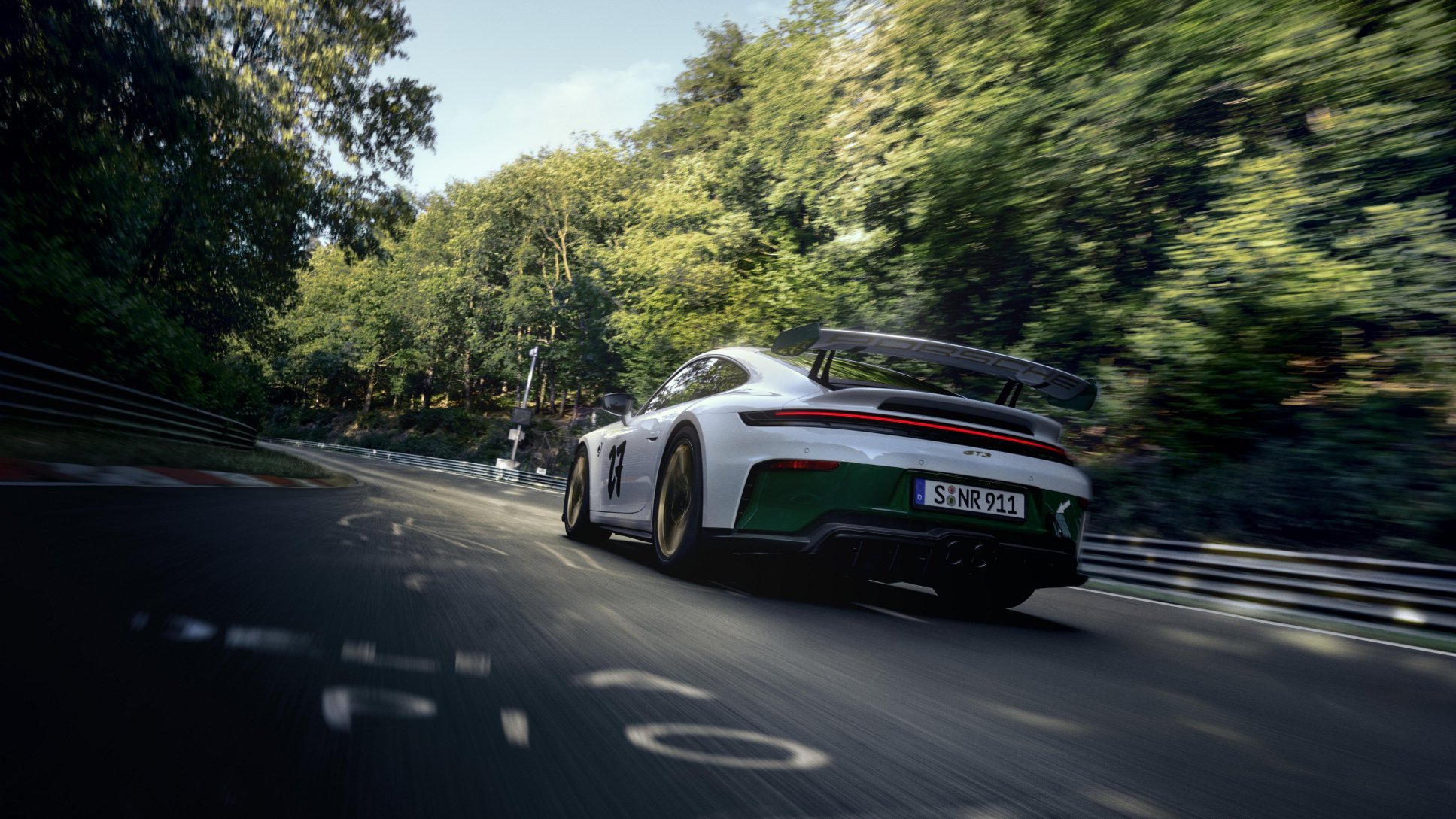
Porsche just pulled the covers off a 911 GT3 built to mark 100 years of the Nürburgring, and the most consequential number attached to the car isn’t the 502 horsepower, the 9,000-rpm redline, or the 6:50.853 Nordschleife lap Porsche is now quoting. It’s one word: German. Porsche is building exactly 100 of these, every one allocated to the German market. Order books open in September 2026, deliveries land in 2027, and the car makes its public debut at the Porsche Sixt Carrera Cup Deutschland at the Nürburgring on August 15 and 16.
That distribution decision defines this car more than any of the green trim does. So let’s start with what actually changed, work through what the spec sheet is quietly not telling you, and then get to the part nobody wants to hear: the paperwork.
Nothing Mechanical Changed, and That Was Always the Plan
Underneath the graphics, this is a standard 911 GT3. The 4.0-liter naturally aspirated flat-six still makes 502 hp and 331 lb-ft, still spins to 9,000 rpm, and still comes with a choice of seven-speed PDK or the six-speed GT Sport manual. No extra power, no lighter panels, no revised gearing.
That isn’t laziness, it’s arithmetic. Touching a powertrain triggers a fresh round of emissions and homologation work, and you cannot amortize that across a hundred cars. An edition run this small gets its personality from the paint shop, the trim shop, and the badge press, because those are the only departments where a hundred-unit order makes financial sense. Style Porsche and Exclusive Manufaktur did the work here, and the results are more interesting than a horsepower bump would have been.
The Green Nose Is a Wrap, Which Is the Smarter Answer
The green front section and rear trim aren’t painted. Porsche applied them as a film that doubles as protective wrap. Anyone who has spent real time at speed knows what happens to the leading edge of a GT3 nose after a season of track days: it gets sandblasted by everything the car ahead kicks up. Owners fit paint protection film anyway, usually for four figures. A factory-applied colored film that serves the same purpose means that the day it looks tired, you replace a panel of vinyl instead of repainting a bumper and chasing a color match on a low-volume finish.
The historical justification is better than the practical one. Porsche points out that factory teams used to mark cars this way specifically so crews and spotters could tell identical entries apart at distance. That is the same logic behind decades of team-specific stripe placement, and it still shows up in modern liveries, as Porsche’s Road America throwback schemes demonstrated.
Buyers choose between White and GT Silver Metallic. White is the neutral factory delivery color that leaves room for sponsor decals, GT Silver nods to the Cup cars, and the green accents reference the Nordschleife’s Green Hell nickname, a phrase Sir Jackie Stewart is credited with coining. Wheels are the 20/21-inch forged GT3 items in high-gloss California Gold, with satin black center locks and a GT3 logo.
The Manthey Kit Downforce Figure Needs an Asterisk
Porsche lists the optional color-matched Manthey Kit as producing 540 kilograms of downforce at 285 km/h, roughly 1,190 pounds at 177 mph. True, but incomplete. Porsche’s own technical material for that kit puts the road-legal configuration at 355 kilograms at the same speed. The 540 figure is the track-exclusive setup.
That 185-kilogram delta is not a rounding error. It is the difference between a car you drive to the circuit and a car you unload and reconfigure once you are there, and it changes ride height, tire loading, and how much front grip you need to dial in to keep the thing balanced. Buy the kit, never touch the adjustment, and you own the 355-kilogram car.
The lap time deserves a second look too. Porsche credits DTM champion Ayhancan Güven with a 6:50.853 in the Manthey-equipped GT3. When Porsche launched that kit, it published a 6:52.981 for the same driver in the same hardware, certified by a notary on site. Two seconds around the Nordschleife is a real gap, not driver variance, and Porsche has not said what changed between the two runs.
Lap claims here get scrutinized hard by the people chasing them, which is why records at this circuit rarely stand unchallenged for long. Two more things worth knowing about the kit itself: Porsche states it does not compromise the factory warranty, which is unusual enough in the aftermarket-aero world to count as a selling point on its own, and the tow lugs, finished in green here with the white recovery arrows racing regulations require, have to come off before the car goes on public roads.
Why an American Can’t Buy One, Import One, or Wait One Out
Here is the part that matters if you are reading this from a garage in Ohio. All 100 cars go to German customers, which means they are built to European specification and never certified to Federal Motor Vehicle Safety Standards. That closes the front door. The two side doors are locked as well.
The 25-year rule is the one everyone knows: a vehicle can come in freely once it is 25 years past its build date, with no volume cap, no certification requirement, and no mileage limit. A car delivered in 2027 becomes eligible in 2052. That is not a typo, and it is the same clock that recently released cars like the Tommykaira ZZ into legal US ownership.
The shortcut people reach for is NHTSA’s Show or Display exemption, and it does not apply here. That program requires the vehicle to be of historical or technological significance, caps eligibility at models built in quantities under 500, and is explicitly unavailable where a substantially similar US-certified version of the model exists. The 911 GT3 is sold new in American Porsche Centers. The exemption is written to exclude exactly this scenario. Even if it somehow applied, Show or Display cars are capped at 2,500 miles a year, a strange fit for a car whose entire pitch is track use.
So the honest American answer is to build it yourself. Order a GT3, which opened at $222,500 plus $1,995 destination for the current generation, and add the Manthey Kit when it reaches US dealers in spring 2026. You will have the hardware. You will not have the badges, and the badges are the whole product.
The Custom Start Number Is a Resale Decision, Not a Styling One
Each car gets a start number of the buyer’s choosing, anywhere from 0 to 999, applied to the hood, doors, and rear window in a hand-drawn typeface Porsche’s designers modeled on the graffiti that covers the Nordschleife’s tarmac. It is a lovely detail and a liquidity problem.
Bespoke numbering narrows your buyer pool to people who do not mind driving around in someone else’s anniversary or jersey number. The vinyl comes off, which limits the damage, but the permanent identifiers stay: B-pillar badges reading GT3 100 Jahre Nürburgring with a California Gold track outline, gold Nürburgring emblems on the wing sideplates, and gold Porsche script under the wing blade. If you are specifying one of these, a number with racing provenance ages considerably better on the secondary market than a birthday does. Collector demand rewards a story that is not only yours, which is why factory-documented Sonderwunsch work holds value the way independent customization usually does not.
About the Author