Vanderhall’s 50-car Santarosa Launch Edition is mostly carbon trim, and the fine print matters more
Provo’s three-wheel specialists rolled into Concours Village this week with a numbered special edition, which is the oldest trick in the small-manufacturer playbook and, to be fair, one that usually works.
Per Vanderhall’s announcement, the Santarosa Launch Edition is capped at 50 individually numbered vehicles, carries an MSRP of $54,950, and should begin reaching customers in the fourth quarter of 2026. Existing Santarosa reservation holders get first crack, dealers get second, and whatever’s left goes public by the end of this month. Both the Santarosa and the off-road Brawley are on display at Pebble Beach through Sunday.
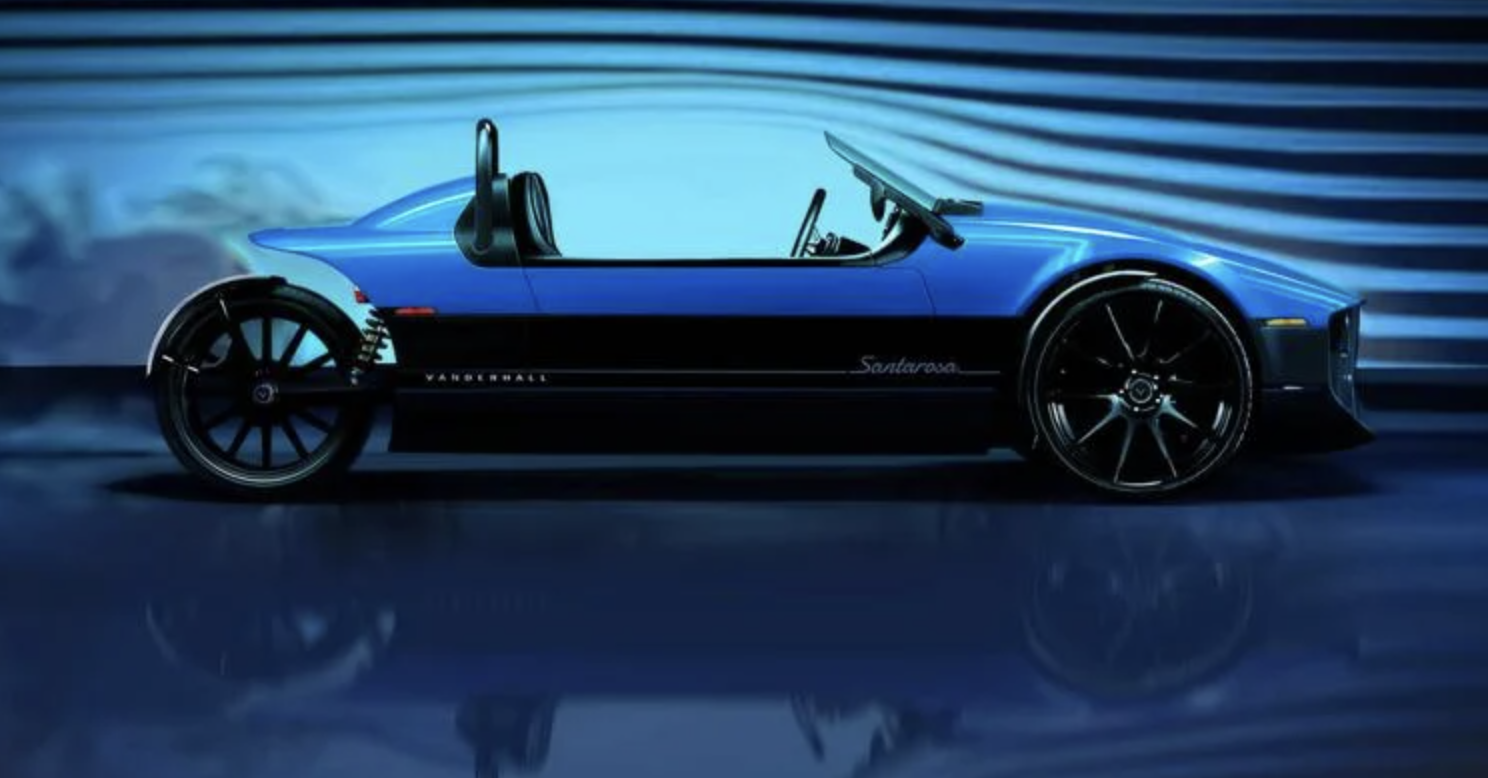
What separates a Launch Edition from a Santarosa? Numbered badging, a 40 kWh battery, and carbon fiber applied to the dashboard, glovebox, center console, door jamb trim, front spoiler and ducktail. Vanderhall says more exclusive features will be announced before production.
Start with the battery footnote
Here’s the thing worth knowing before you get excited about that 40 kWh figure: Vanderhall’s own Santarosa specifications page carries a footnote stating battery options are currently limited to 40 kWh. So the Launch Edition’s headline battery is the same pack every other Santarosa gets. It’s listed as a feature because the Launch Edition includes it, not because it’s exclusive to it.
Related Articles
- How Police Legally Drove An Uninsured £3.7m Ferrari Through London
- Hero’s First Electric Motorcycle Arrives 2027 On All-New Platforms
The published range figures are 150 miles standard and 300 miles on the GTS+ with an extended pack, with a separate note pricing that extended option at $6,950 — though the same site says 40 kWh is all that’s on offer right now. Do the arithmetic on the standard figure and you get roughly 267 watt-hours per mile, which is in the neighborhood of a midsize electric sedan. That’s not flattering for a machine Vanderhall lists at 1,539 to 1,749 pounds, and the reason is aerodynamics: an open cockpit with a windscreen and a 295-section rear tire has a drag profile no amount of lightness can rescue. Vanderhall’s own disclosure notes the range numbers come from internal testing under ideal closed-course conditions. Plan on considerably less at 70 mph with the top off, which is the only way anyone actually drives these.
The chassis is more interesting than the carbon
The published specs list twin electric motors driving the front wheels, 180 horsepower and 216 lb-ft of torque, an aluminum unibody, cast aluminum double wishbones up front and a cast aluminum trailing arm at the rear.
Front-wheel drive with 216 lb-ft is the detail that will define how this thing feels. Electric motors deliver peak torque from zero, and the Santarosa’s front tires are the narrow ones — 225/35R19 up front against 295/30R19 at the back. That’s backwards from how you’d normally size tires on a car that drives its front axle, and it exists for the same reason it does on every Vanderhall: the single fat rear tire is the look. Expect the traction control system Vanderhall specifically calls out to be earning its keep, and expect some torque steer on corner exit. That’s not a criticism so much as a description of the genre.
The brake spec is the one that’ll surprise people. The listing shows 200 mm inboard front rotors with high-temp stainless discs and ceramic pads, working with adaptive regenerative braking, plus an electric parking brake. Inboard rotors cut unsprung weight and let the designers keep the wheels clean, and on a front-drive layout with a rear weight bias you’d expect from a single trailing wheel, most of your stopping happens up front anyway. The service implication is that pad and rotor jobs are not a curbside affair — inboard brakes live next to the driveline, so budget more labor than you would for a normal caliper swap. Ground clearance is listed at 4.9 inches, so add steep driveways and unloading ramps to the list of things to think about.
The regulatory bit that saves Vanderhall real money
Vanderhall’s spec page states it plainly: these are three-wheeled motorcycles, not automobiles, they have no airbags, and they don’t meet automotive safety standards. Drivers may need a motorcycle endorsement, and the company advises a DOT-approved full-face helmet along with the three-point belts.
That classification is doing enormous work. Federal motor vehicle safety standards for crashworthiness — the frontal and side impact tests, the airbag requirements, the roof crush rules — apply to passenger cars. A three-wheeler is federally a motorcycle, which is why a small company in Utah can build a road-legal vehicle at all without spending nine figures on crash validation. State law is where it gets messy: many states have written specific autocycle definitions that waive helmet and endorsement requirements, and many haven’t. Check your own before you sign anything, because the answer varies wildly and it changes what you’re legally required to wear.
The same classification shows up in the warranty. Vanderhall lists a one-year limited vehicle warranty and 36 months on the battery pack. For context, mainstream EV buyers are used to eight years of battery coverage, and that’s not corporate generosity — it’s tied to emissions warranty requirements that apply to cars and light trucks. Motorcycles sit outside that framework. Three years on the most expensive component in the vehicle is the real cost of the exemption, and it’s the single most important number in this story for anyone writing a check.
Related Articles
- VinFast Rasad Maxi-Scooter Appears On India’s Design Register
- NASCAR’s Wheatley Vodka Clash Returns To Daytona For 2027, Ending A Six-Year Venue Experiment
Insurance follows the same logic. You’ll likely be writing a motorcycle policy rather than an auto policy, which changes available coverages, medical payment structures and — in some states — how liability is treated in an at-fault crash. Get a quote before you reserve, not after.
What you’re actually buying
Strip it down and the Launch Edition premium buys a serial number and six carbon fiber pieces, four of which are interior trim. That’s fine. Limited runs are a legitimate way for a low-volume manufacturer to smooth out early production and reward the people who waited. Just don’t confuse cosmetic exclusivity with a mechanically different vehicle, and be honest about resale: niche three-wheelers have historically depreciated like the recreational purchases they are, and a build number does less at auction than enthusiasts hope.
One last item nobody will mention in the show coverage. Vanderhall’s published reservation terms note that reservation payments aren’t held in escrow or a trust fund, don’t earn interest, and that reservations aren’t transferable without written approval — though they’re refundable until you enter a purchase agreement. Those are ordinary terms for a company this size, but they’re worth reading before you put money down on a Q4 delivery promise.
Fifty of them. It’ll be the numbered badge people remember.
Images Via: Vanderhall North America LLC
About the Author