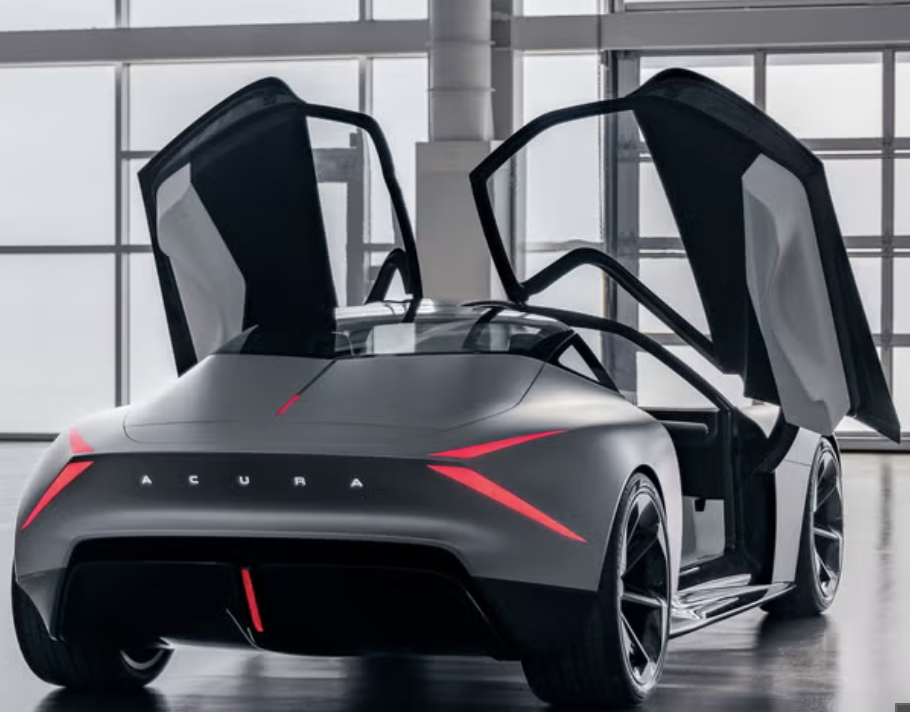
Acura brought a low, wide, matte-titanium two-door to The Quail and Pebble Beach this month, and the honest summary of what it means is this: the first production car to inherit anything from it is a family crossover. Per Acura’s own announcement, the NEXERA Vision’s new lighting signature will “debut on the next-generation Acura models, beginning with RDX Hybrid arriving in the coming years.”
That’s not a knock on the concept, which looks genuinely good. It’s just worth being clear-eyed about the transaction. Acura is 40 years old this year, it has a new design boss in Yasutake Tsuchida running the Acura Design California studio in Los Angeles, and it needed a hero object to hang a design language on. The hero object is a coupe. The deliverable is an SUV.
The interesting part is what Acura will actually have to solve to get any of this onto a car with a VIN.
The lighting trick is the whole point, and it’s the hardest part
Acura calls it “phantom lighting” — headlights and taillights hidden behind the bodywork that only reveal themselves when illuminated, leaving the surfaces unbroken when they’re off. It’s a beautiful idea and a very old designer’s fantasy. It also runs straight into federal lighting law in a way that’s worth understanding.
Federal Motor Vehicle Safety Standard 108, codified at 49 CFR 571.108, contains a short paragraph called S6.2.3.1 that has quietly killed a lot of concept-car headlight ideas. It says that when headlamps are activated in the steady burning state, they must not have any styling ornament or other feature, such as a translucent cover or grill, in front of the lens.
Related Articles
- A UK Petition Wants to Ban Driverless Taxis. Britain’s New Permitting Rules Show Why 400,000 Drivers Are Nervous
- A Dealership Handed Out A Salesman’s Number. Federal Threat Charges Followed
Read that carefully. “Translucent” is specifically named. So a design where the beam fires through a semi-opaque body panel isn’t automatically fine just because enough light gets through — the panel itself is the problem.
There are two legitimate ways around it, and both cost money. The first is to make the surface genuinely part of the optical assembly rather than a cover sitting in front of it — a lens that happens to look like body panel when unlit, which means matching gloss, color, and thermal expansion between a polycarbonate optic and adjacent painted metal. Panel gaps and color match on that boundary are brutal, and they’re the sort of thing that looks flawless on a show stand under controlled lighting and mediocre in a Costco parking lot in July.
The second is a moving cover. FMVSS 108 defines a headlamp concealment device as a device that conceals the headlamp when not in use, including a movable cover or a headlamp that displaces to hide itself, and the standard defines fully opened as the position where the lamp sits in its design open operating position. That’s the pop-up-headlight pathway, and it brings motors, linkages, freeze-up in winter, and a failure mode that leaves you driving home with one eye closed.
Either way, the same rule sets the floor: whatever surface the light passes through has to let the lamp hit its photometric numbers. Aesthetics don’t get a waiver.
Practical takeaway for future RDX buyers: integrated, structural lighting is expensive to fix. When a headlamp assembly is bonded into a painted body surface rather than bolted into an opening behind a bumper cover, a parking-lot tap that used to mean a $600 lamp can mean a lamp plus a body panel plus blend-panel refinishing. Ask about that at the parts counter before you assume it’ll be a cheap repair.
Centerlock wheels are a bigger deal than the press release makes them sound
Acura says the 22-inch wheels are centerlock, a first for the brand, with carbon-ceramic Brembos visible through them.
Centerlock isn’t just jewelry. A single large nut replaces five studs, which lets the hub carry the clamping load differently and shaves a little rotating and unsprung mass. But it also changes the ownership math in ways nobody tells you at delivery. Centerlock hubs require a manufacturer-specific socket and a torque wrench with a range most independent shops don’t own. The torque figure is enormous compared to a conventional lug nut, and it’s not a number you eyeball. Many tire shops will simply decline the job. That means a flat on a road trip becomes a dealer problem, not a strip-mall problem.
The carbon-ceramic rotors carry their own asterisk. They effectively don’t warp and they last a very long time under normal use, which is the sales pitch. What isn’t in the brochure: they’re dramatically more expensive to replace when they eventually do wear out or get damaged, and they can feel wooden until they get heat in them. On a crossover doing school runs in February, that trade-off is a lot less obviously worth it than on a track car.
Forged carbon looks great and doesn’t take repairs
The release lists forged carbon fiber on the aero fascia, rear diffuser, rocker panels, and even inner door structures, plus inserts in the wheels.
Forged carbon is made by compression-molding chopped carbon tow rather than laying up woven cloth, which is why it has that marbled, random-swirl look instead of a checkerboard weave. It’s cheaper to produce in complex shapes and structurally excellent for its weight. It is also, for practical purposes, not repairable in a body shop. You don’t fill and refinish it — the finish is the material. Damage means replacing the part.
That matters at claim time. Cars with structural or semi-structural composite panels reach an insurer’s total-loss threshold faster than equivalent steel-bodied cars, because there’s no middle ground between “fine” and “new part.” If forged carbon migrates from show car to option package, buyers should look hard at their deductible and at whether their carrier writes agreed-value coverage.
The seats won’t survive contact with production
The one genuinely radical engineering idea in the interior is that the front seats are fixed and integrated into the floor, with the pedals and steering wheel moving to meet the driver.
This is racing thinking, and the logic is sound: a fixed seat can be bonded into the structure, which cuts mass and drops the driver’s hip point closer to the floor, lowering the center of gravity and improving the sense of connection to the car. It also removes seat rails, motors, and the reinforcement they demand.
Related Articles
- Lamborghini’s Revuelto SV Starts At $741,172, And Leaked Order Sheets Show How Fast That Climbs
- Ayrton Senna’s Personal Honda NSX Heads to Auction, and Its Backstory Runs Deeper Than the Hosepipe Photo
The catch is that airbag calibration and belt geometry are tuned around occupant position. When the seat can’t move, the entire range of body sizes has to be accommodated by a pedal box and column with enormous travel, and the restraint system has to protect a 5th-percentile occupant and a 95th-percentile occupant at the same distance from the same airbag. It’s solvable — it’s been done — but it’s an expensive solution for a vehicle segment where people expect eight-way power adjustment and memory settings.
What this actually tells us about Acura
The release lists Acura’s lineup as four vehicles: the Integra sport sedan, plus the ADX, RDX, and MDX. Three of the four are SUVs. Acura also notes that roughly 85% of the vehicles it sold in America in 2025 were built in America.
So the strategy is legible enough. Acura needs a visual identity distinctive enough that you can name the brand from a taillight in traffic, and it has decided the fastest route there is a lighting signature derived from the “A” caliper logo. Announcing that on a coupe is smart theater, because nobody’s pulse quickens for a crossover DRL graphic.
The test comes when the fourth-generation RDX Hybrid shows up. Design languages developed on wide, low, two-seat proportions have a habit of translating badly onto tall boxes with high beltlines and roof rails. Whether Acura can carry the disciplined surfacing across without it turning into creases-for-the-sake-of-creases is the actual question. The Nexera answers nothing about that. It just makes a promise.
Images Via: Acura
About the Author