Nobody at Volkswagen has announced an American pickup truck. There’s no press release, no plant allocation, no name, no date. What exists is a lot of chatter about a truck arriving before the decade is out — and, more usefully, a set of hard constraints that determine whether such a thing is even buildable. Those constraints are public, they’re written down, and they tell you more about VW’s odds than any anonymous source will.
Start with the one that has killed every previous version of this idea.
The 1964 problem that never went away
Pickups don’t enter the United States under the same rules as cars. They’re classified under heading 8704 of the tariff schedule — motor vehicles for the transport of goods — and Customs applies a duty of 25% ad valorem to them. Passenger cars under 8703 pay 2.5%. That tenfold gap is the residue of a trade fight over frozen chicken exports six decades ago, and it is the single largest reason no European automaker has ever seriously contested the American truck market.
For a company whose only pickup, the Amarok, is built overseas, that math is fatal. Land a $40,000 truck at a U.S. port and you’ve added $10,000 in duty before it touches a dealer lot. There is no trim strategy that survives that.
Related Articles
- Lamborghini’s Revuelto SV Starts At $741,172, And Leaked Order Sheets Show How Fast That Climbs
- Ayrton Senna’s Personal Honda NSX Heads to Auction, and Its Backstory Runs Deeper Than the Hosepipe Photo
Then it got worse — or, depending on where you build, better. Proclamation 10908 imposed an additional 25% Section 232 tariff on imported automobiles effective April 3, 2025, with parts following in May. A month later the administration added an offset for manufacturers assembling in the U.S., worth 3.75% of the aggregate MSRP of domestically assembled vehicles through April 2026 and 2.5% for the following year, usable against parts tariffs.
Read those two documents together and the conclusion writes itself: any VW pickup for this market gets assembled on U.S. soil or it doesn’t exist. That’s not a preference. It’s arithmetic.
Which plant, and what that dictates
Volkswagen has exactly one U.S. assembly facility. Chattanooga has built more than 1.85 million vehicles since 2011, absorbed $4.3 billion in investment, employs over 4,000 people and currently turns out the Atlas and Atlas Cross Sport. Its workforce ratified a contract with the UAW — the first foreign-owned assembly plant in the South to do so.
Here’s what matters for truck speculation: Chattanooga is a unibody plant tooled around MQB. Body-on-frame production is a fundamentally different animal — frame lines, different fixtures, different paint handling, a separate cab-and-box marriage station. Converting a running unibody plant to build a ladder-frame midsizer is a capital project on the order of a new factory, and it would have to happen while the plant keeps building the vehicles that pay for it.
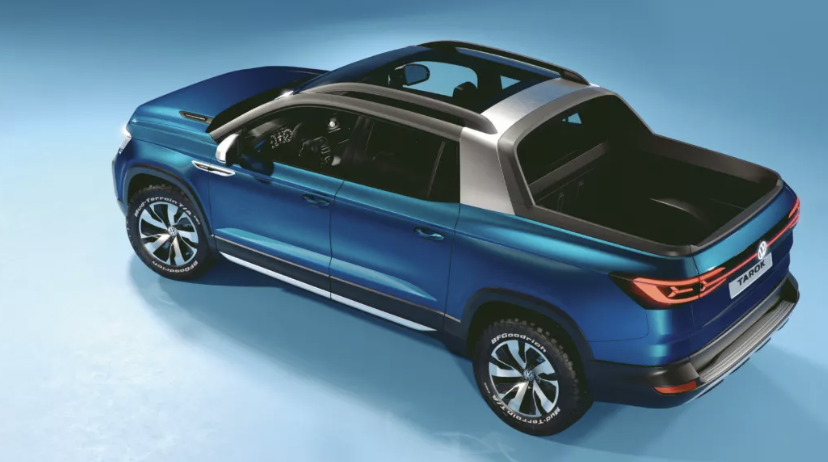
A unibody pickup, on the other hand, is a body-in-white variation on hardware already flowing down the line. Volkswagen has already proven the concept works dimensionally: the Tanoak concept shown in New York in 2018 was 214.1 inches long, packed a 276-horsepower V6 with all-wheel drive, and was — VW said so at the time — the first pickup built on MQB. The company was equally clear there were no production plans, and that it was fishing for reaction.
Eight years later, the reaction data is in.
The segment that actually grew
By Ford’s own tally, the Maverick posted a record 155,051 U.S. sales in 2025. The body-on-frame Ranger, a size class up, managed 70,960. Same dealer network, same brand, same year — and the unibody compact more than doubled the frame truck. F-Series moved 828,832, which is the number that keeps everyone else out of full-size.
That’s the market intelligence a product planner in Wolfsburg is staring at. The profitable, defensible, entry-priced end of the American truck market is now served by a vehicle architecturally identical to a crossover. Volkswagen builds crossovers in Tennessee. You do not need an insider to connect those dots.
The complication wearing a Scout badge
Volkswagen Group is already building an American truck factory — just not for Volkswagen. Per Scout’s plant updates, the Blythewood, South Carolina site spans more than 1,100 acres, represents a $2 billion investment, targets more than 4,000 permanent jobs and up to 200,000 vehicles annually at full capacity. The Terra is a full-size, body-on-frame pickup offered as a battery-electric with an estimated 350-mile range or with the Harvester range-extender targeting up to 500 miles. Production is slated for 2027.
Related Articles
- Some Rivian R2s Have a Fast-Charging Connector That Can Cook Itself, and Rivian Is Calling Owners One by One
- Street Outlaws Star Chris ‘Block’ Gordon Dies in Crash at Ohio’s ‘The Hill’ Drag Strip
So the group already has its ladder-frame truck program, its off-road heritage play, and its factory. What it doesn’t have is anything competing for Maverick money. A compact unibody VW pickup out of Chattanooga wouldn’t cannibalize Scout — it would occupy the one truck segment Scout deliberately isn’t in.
What buyers should actually do with this
Nothing, for now. But a few things are worth filing away.
If you want a Volkswagen Group truck in this decade, Scout is the only one with a factory going up and a stated production year. Reservations there are refundable, which makes them cheap optionality — and worth understanding as exactly that, not as a purchase.
If a unibody VW pickup does materialize, understand what you’d be buying. Unibody trucks don’t have a bolt-on bed you can unbolt and replace after a hard rear hit; the cargo box is structure, and collision damage propagates into the body shell. That tends to mean pricier repairs and earlier total-loss decisions on rear-end damage than a body-on-frame truck of similar value. It’s the same trade the Maverick, Santa Cruz and Ridgeline all make, and it’s worth a conversation with your insurer before you sign, not after.
And be skeptical of any timeline stated in years rather than model years. A vehicle “by 2030” that hasn’t been shown, named, or allocated to a plant is a slide in a strategy deck. The tariff structure now makes a U.S.-built VW truck more logical than at any point since the Rabbit-based pickup left the market. Logical isn’t the same as funded.
Images Via: Volkswagon
About the Author