Chris “Block” Gordon spent almost two decades building a name as one of the toughest small-tire racers to come out of the Carolinas, and on Saturday night that career came to an end at a drag strip nicknamed for the one thing a quarter-mile track is never supposed to have: a hill.
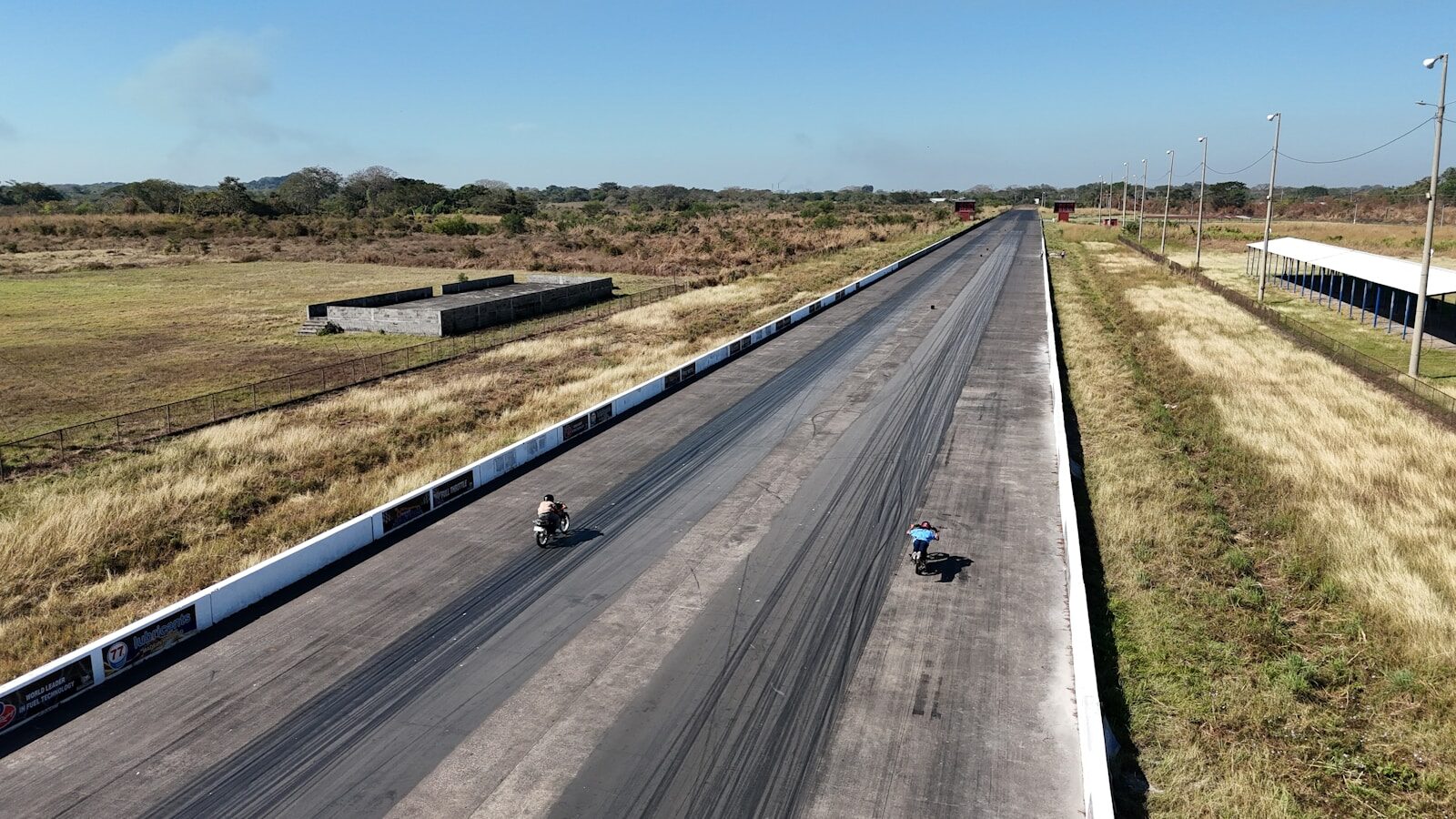
Gordon died following a crash during Saturday night’s racing at KD Motorsports Park in South Webster, Ohio, a small town along the Ohio River in Scioto County. Racers know the eighth-mile strip by a different name, “The Hill,” a nod to the roughly 150-foot rise built into the middle of the racing surface that makes KD Dragway one of the strangest, and least forgiving, tracks running no-prep and grudge events anywhere in the country.
That elevation change matters more than it sounds like it should. Drag strips are normally built flat and dead straight so a car’s weight transfer, tire contact patch and steering inputs stay predictable from the starting line to the finish. Add a hill, and a driver has to manage a chassis that’s compressing and unloading its suspension while trying to hook up on a surface with no traction compound laid down, since no-prep events skip the VHT that sanctioned tracks use to glue tires to the pavement. It’s part of what turned KD Dragway into a cult favorite on the outlaw racing circuit, and it’s also exactly the kind of variable that can turn a routine pass into a bad one in a hurry.
Details about what caused the crash have not been released. KD Motorsports Park told fans in a social media post Saturday night that a bad accident had cut the night’s races short, asking for prayers for the driver and his family while rescue crews and EMS performed life-saving measures at the scene. Gordon died at the track. The following morning, the venue confirmed his death directly and called him “an absolute legend of our sport,” asking the community to also keep the medical staff, firefighters and EMTs who responded in their thoughts.
Gordon raced out of Moncks Corner, South Carolina, where he built Block Motorsports and spent years leading Team South Carolina on Discovery’s Street Outlaws: Fastest in America. His weapon of choice was a 1979 Ford Fairmont nicknamed “Mayhem,” built for the small-tire class that has become the show’s signature: cars running skinny radial tires instead of wrinkle-wall slicks, which makes them dramatically harder to keep pointed straight under full power. It’s the same class that turned Street Outlaws into appointment television, and the same one that puts more of a car’s fate in the tire’s contact patch than most viewers watching from the couch probably appreciate.
It has been a rough stretch for the Street Outlaws roster. The show is still working through the fallout from Jim Howe’s indictment over a bail-bonds gunfight story that didn’t hold up once video surfaced, and now it loses one of its own team leaders in a track-side tragedy that had nothing to do with the cameras.
KD Motorsports Park, like most of the venues hosting the no-prep and grudge racing that fuels the current wave of drag-racing television, isn’t an NHRA or IHRA-sanctioned facility. That distinction matters more than casual fans realize. At a sanctioned national event, safety equipment requirements, track-prep standards and on-site medical response are dictated by the sanctioning body and enforced uniformly across every stop on the tour. At a privately owned bracket or outlaw track, those calls are made by the promoter, and they vary from track to track. That grassroots side of the sport has turned into real money in recent years, which is part of why a track financing dispute involving an IHRA-connected contractor recently landed in court, but it also means liability, insurance costs and safety protocols after a fatality fall on the track owner rather than a national governing body.
That gap in oversight doesn’t mean sanctioned racing is risk-free; nitro cars still let go with some regularity. But it does show what modern safety engineering can do when it’s mandated rather than optional. When Ron Capps walked away from an explosion and fireball at an NHRA national event last year, he climbed out because his car was built to SFI safety-cell specifications that are non-negotiable at that level of the sport. Grudge and no-prep tracks don’t operate under that same rulebook, and Saturday night is a reminder of what that gap can cost.
Gordon’s death is the second time this month Backfire News has had to write about a racing community mourning one of its own; earlier in August it was Ferrari factory driver Cedric Sbirrazzuoli, who died of cancer at 39. Different causes, same reality: racing communities are small, and losses like this one ripple through every level of the sport at once. KD Motorsports Park has not announced whether it will resume its normal event schedule, and no cause of the crash had been made public as of this writing. Backfire News will update this story as more information becomes available.
About the Author