Image via IMDB
Paramount hasn’t confirmed a single frame of a “Days of Thunder” sequel exists, but as of July 22, the project has its first real body attached to the engine. Jonathan Levine, the director behind “50/50” and “Long Shot,” is in talks to take the wheel behind the camera, according to a report from Deadline. It’s the first tangible movement on a sequel that’s been idling since Tom Cruise entered early talks with the studio back in November 2024.
For a franchise that’s spent nearly two years as industry rumor rather than greenlit production, an actual director attachment is a big deal. Deals like this collapse constantly in Hollywood, and “in talks” is a long way from “signed, sealed, and in pre-production.” But it’s the clearest signal yet that Paramount wants Cole Trickle back on track, with Cruise producing alongside Jerry Bruckheimer and a script from writer Will Staples already finished.
Here’s the part that should make gearheads do a double take: Levine isn’t a racing guy, or much of an action director at all. His resume runs through cancer dramedy in “50/50,” a zombie rom-com in “Warm Bodies,” political comedy in “Long Shot,” and his next film for Paramount, “Mr. Irrelevant,” a Christmas Day release about John Tuggle, the last player picked in the 1983 NFL Draft. That’s a filmmaker who specializes in character and tone, not one who’s spent a career figuring out how to mount a camera on a quarter-panel at 190 mph. Whether that’s a feature or a bug depends entirely on what story Paramount wants to tell this time: a character piece that happens to be set at a superspeedway, or a spec-driven spectacle in the mold of the original.
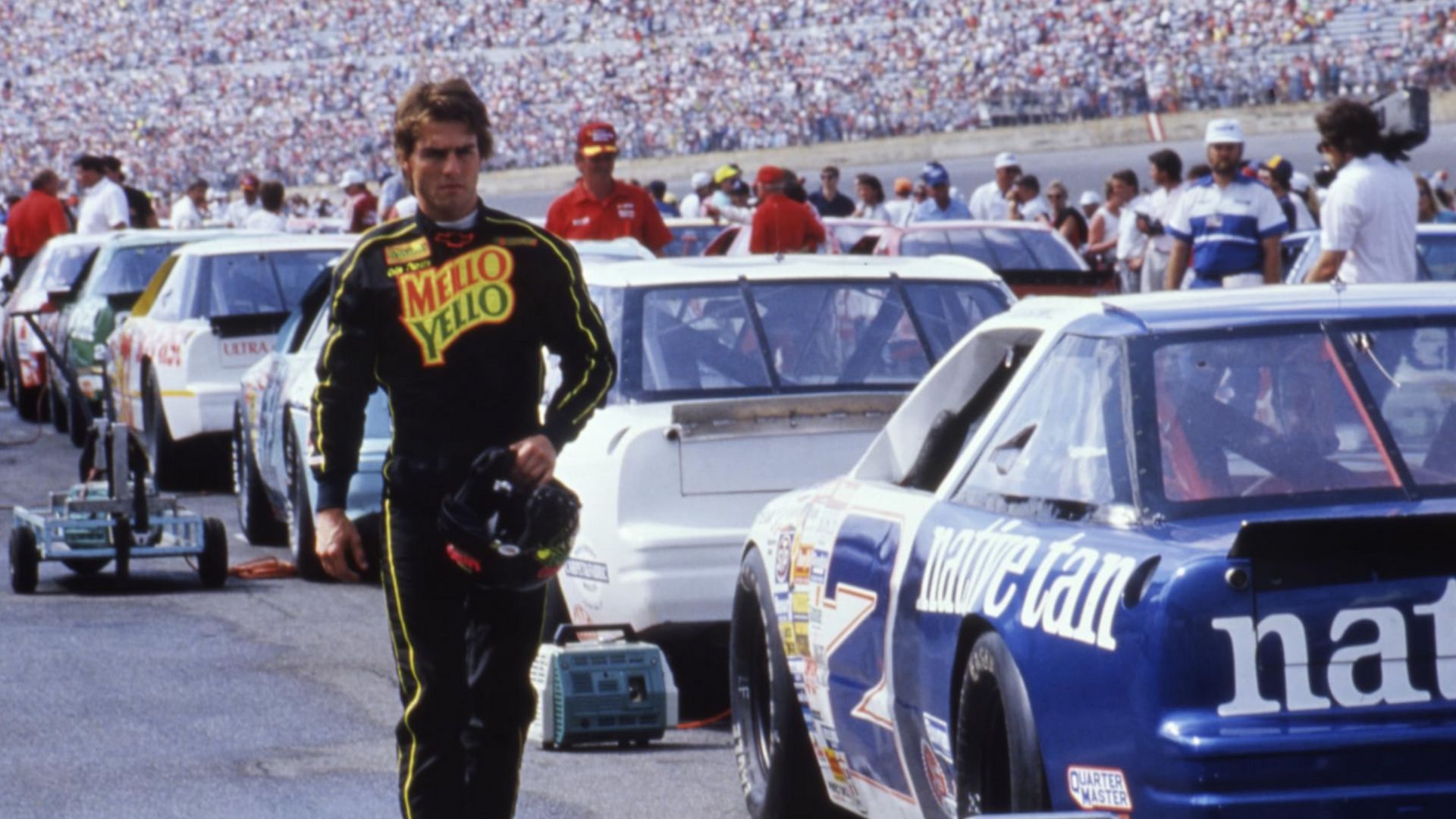
Because make no mistake, the original “Days of Thunder” was never really about NASCAR as a sport. Tony Scott directed it from a Robert Towne script built around a story Cruise helped conceive, with Don Simpson and Bruckheimer producing. Robert Duvall, Randy Quaid, Cary Elwes, and Michael Rooker rounded out the cast, and the film became one of the more consequential productions of Cruise’s career for reasons that had nothing to do with the box office, it’s where he met co-star Nicole Kidman, who he later married for eleven years. On the ledger, the 1990 film brought in $82.6 million domestic and $157.9 million worldwide, numbers that look modest next to today’s tentpoles until you adjust for inflation, at which point that gross lands somewhere north of $380 million in 2026 dollars.
The timing here isn’t a coincidence. Bruckheimer also produced last year’s “F1,” pairing Brad Pitt with director Joseph Kosinski and Lewis Hamilton as a producer, and that film cleared $634 million worldwide, a number that reset Hollywood’s math on whether racing movies can actually open big, after a stretch where “Ford v Ferrari,” “Ferrari,” and “Rush” all turned in respectable but hardly franchise-sustaining numbers. It’s part of a broader land grab, too: studios are simultaneously developing a Monaco-set heist prequel built around Formula 1’s crown-jewel race, and Brad Pitt and Channing Tatum have separately been linked to an Isle of Man TT project, treating real-world racing calendars like unclaimed intellectual property. Bruckheimer told Entertainment Tonight in February that a “Top Gun” script was close and called it “a horse race” against a “Pirates of the Caribbean” revival, right around the same stretch he confirmed the F1 sequel is also moving forward. Cruise, separately, has said he’s “working on” ideas for both a third “Top Gun” and the “Days of Thunder” follow-up at once. Studios don’t chase two legacy sequels from the same star in the same breath unless the math on at least one of them just changed dramatically, and “F1” is the film that changed it.
There’s a telling wrinkle buried in a separate Brad Pitt interview that explains why Cruise cares so much about being the one actually driving. Roughly a decade before “Ford v Ferrari” got made with Christian Bale and Matt Damon, Pitt and Cruise were attached to an earlier version with Kosinski directing, Pitt as Ken Miles and Cruise as Carroll Shelby. Pitt told The National News the project fell apart specifically because Cruise realized Shelby, as the car’s designer rather than its driver, would not be driving much in the movie. Cruise is hardly the only star in Hollywood’s driving-obsessed set, but that anecdote is a useful data point for anyone wondering how a “Days of Thunder” sequel gets shot: Cruise has built the back half of his career on doing his own driving, flying, and climbing, and a NASCAR sequel without him genuinely behind the wheel would undercut everything that’s made his recent output bankable.
That also raises a practical production question the original never had to answer. NASCAR’s Next Gen car, introduced in 2022, is a completely different machine than what Cole Trickle wrestled with in 1990, a symmetrical, independent-suspension chassis built around single-source suppliers, far removed from the fabricated stock-bodied cars of the early Cup Series. A production wanting the same practical, camera-in-the-cockpit realism Bruckheimer described achieving on “F1,” where Mercedes helped design a car specifically to house film equipment, would need NASCAR’s direct cooperation to modify a Next Gen chassis for filming or build purpose-made replicas capable of running at speed on an active track. Neither option is cheap, and both require a level of sanctioning-body access NASCAR has rarely granted at this scale.
None of this guarantees Levine ends up in the director’s chair when cameras eventually roll, or that Paramount locks a start date before something else derails it, which is exactly what happened between late 2024 and now. But for a project that’s spent longer in “in talks” purgatory than the original spent in theaters, a real filmmaker attachment is the first sign this one might actually make it to a starting grid.
About the Author