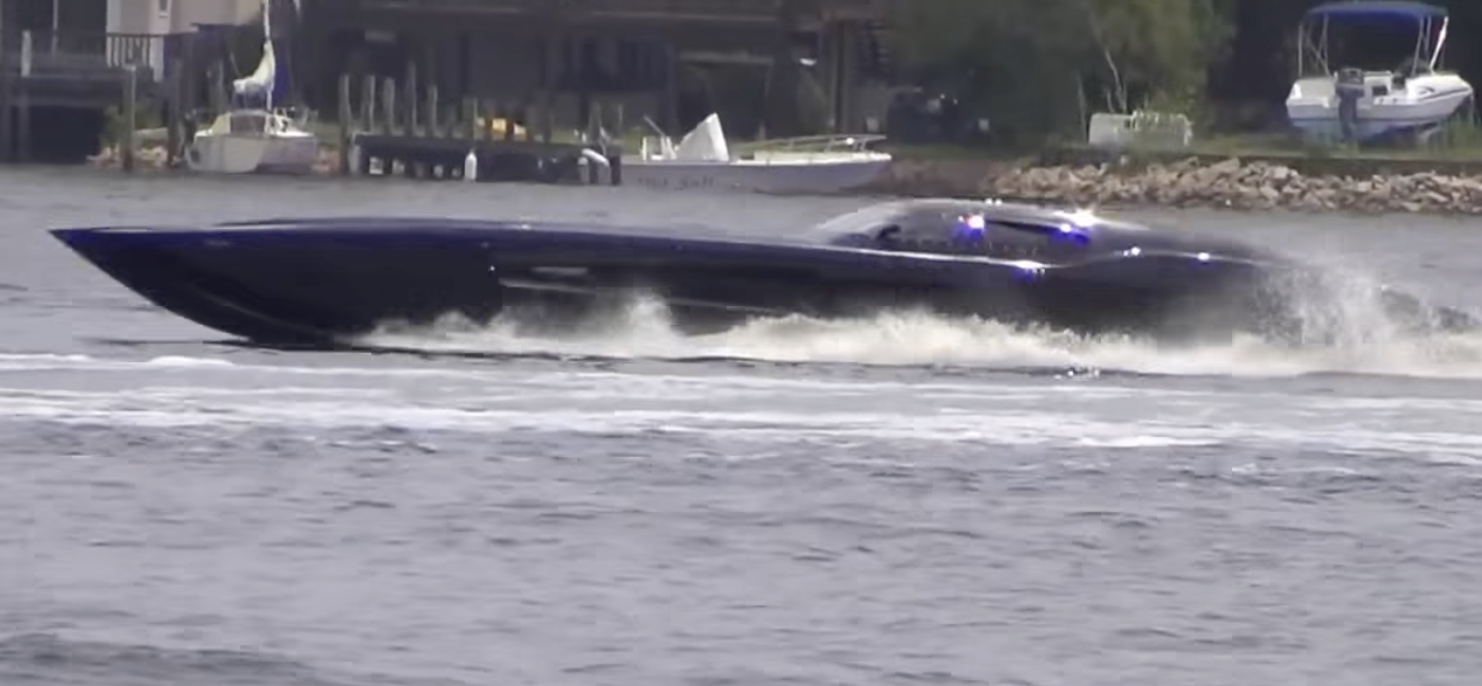
Every summer the same clip resurfaces: a long black catamaran wearing Corvette taillights, a shaky vertical phone video, and a caption claiming it left the Coast Guard in its wake. It’s a great piece of internet, and it has been recycled for the better part of a decade.
It’s also a story with almost nothing underneath it. There’s no case number attached to the footage. No U.S. Attorney’s office press release, which is exactly the kind of thing prosecutors publicize when someone runs from a federal boarding. No charging document. No Coast Guard statement. What exists is a video, a caption, and a decade of reposting — and the caption is doing all the heavy lifting. Before anybody frames this as a folk-hero moment, it’s worth understanding what the machine actually is and what the law actually says, because both are more interesting than the clip.
The arithmetic behind 2,700
The boat is a one-off from Marine Technology Inc., the custom catamaran builder based in Wentzville, Missouri. MTI’s whole business is high-performance offshore hulls — race boats, pleasure cats and center consoles built one at a time to an owner’s spec, which is why a Corvette-themed hull with automotive taillights exists at all. Nobody tooled up a production line for this.
The 2,700 number is simple multiplication: two Mercury Racing 1350s. That engine is worth knowing because it’s genuinely exotic hardware, not a warmed-over big block. Mercury’s own published specs list a 9.0-liter, 552-cubic-inch quad-cam four-valve V8 running a 7.8:1 compression ratio — deliberately low, because the power comes from boost, not squeeze. Redline sits between 6,000 and 6,500 rpm. Each engine weighs 1,720 pounds, which means the propulsion package alone is roughly the curb weight of a Miata before you add fuel, drives, or hull.
Related Articles
- Lando Norris Just Got His Own Prime Video Documentary — Produced by the Studio Behind Drive to Survive
- Fernando Alonso’s Headset Isn’t a Fashion Statement — It’s Basically Ear Protection From His Own Engine
Here’s the detail most people miss: the 1350 rating isn’t always on. Mercury sells it as a dual-calibration engine, with output selected by swapping electronic key fobs at the dash. The 1350 map requires 91 octane. Drop to the 1100 fob and the octane requirement falls to 89. That’s not a gimmick — it’s an acknowledgment that marine fuel quality is wildly inconsistent, and detonation in a turbocharged 9.0-liter is not a cheap lesson.
Behind each engine is Mercury’s M8 surface-piercing sterndrive, rated to handle 1,600 lb-ft and 1,600 horsepower. Note how little headroom that leaves. The 1350 isn’t a mild state of tune with a big drive behind it; the whole driveline is running near its ceiling by design.
Why you can’t actually outrun the Coast Guard
This is where the internet’s framing falls apart. Maritime law enforcement doesn’t work like a traffic stop, and the person in that video wouldn’t be escaping anything. They’d be upgrading the charge.
Federal law makes it a crime for the operator of a vessel to knowingly disobey an order from a federal officer to heave to. Title 18, Section 2237 defines “heave to” broadly — slow down, stop, or adjust course and speed to allow a boarding. Ignore it knowingly and the exposure is a fine, up to five years in prison, or both. Not a citation. A felony.
Stack on top of that the negligent operation statute. Title 46, Section 2302 exposes a recreational operator to a civil penalty of up to $5,000 for negligent operation that endangers life, limb or property, and makes grossly negligent operation a class A misdemeanor. That section was amended in 2025 to add a felony tier when gross negligence results in serious bodily injury — a meaningful change that hasn’t gotten much attention among performance boaters. Running wide open near swimmers and anchored boats is the textbook fact pattern.
And the boat doesn’t disappear. It’s registered or documented, it’s distinctive to the point of absurdity, and it needs a ramp, a slip, and a fuel dock. Speed buys you distance, not anonymity.
What that kind of running actually costs
The maintenance reality is the part enthusiasts underrate. Mercury Racing backs the 1350 with a one-year limited warranty for recreational use, and separately offers a QC4 Refresh Program where the original build technicians return the engine to factory condition. When a manufacturer builds a formal teardown-and-rebuild service into the ownership model, that tells you these are consumables with a service life, not appliances. Sustained wide-open-throttle running against a hard-charging pursuit is precisely the duty cycle that shortens the interval.
There’s also a regulatory wrinkle riders on the automotive side will recognize instantly. Mercury sells an X-Haust Noise Reducer specifically so high-performance sterndrives can meet regional noise limits. Marine sound regulation is a real and enforced thing in a lot of jurisdictions, and it’s the boating equivalent of a decibel-tested exhaust. A boat this loud in a crowded cove is generating enforcement interest before anyone even reaches for a throttle.
Related Articles
- Callaway Just Supercharged the Exact Chevy Engine the Feds Are Investigating for Blowing Up
- Porsche’s New Track-Only 911 Costs More Than the Street Car It’s Built From — And You Still Can’t Drive It Home
Insurance is the last unglamorous piece. Marine policies on high-value performance hulls are typically written on an agreed-value basis with navigational limits and layup periods, and they routinely exclude losses arising from intentional or illegal acts. A documented incident of fleeing a federal boarding is the kind of thing that turns a claim into a coverage dispute — and makes the next renewal an interesting conversation.
The context nobody puts in the caption
The Coast Guard’s 2024 boating statistics counted 3,887 verified incidents, 556 deaths, 2,170 injuries and roughly $88 million in property damage. Fatalities were the lowest in more than 50 years of record-keeping, which is genuinely good news and a testament to how much boating safety culture has improved. Operator inattention and improper lookout still lead the causes list. Those aren’t abstractions when a 2,700-horsepower hull is threading past anchored boats.
None of which makes the ZR48 less impressive as an object. A custom carbon catamaran wearing sports car cues, built one-off by a small Missouri shop, driven by two of the most sophisticated marine V8s ever offered to civilians — that’s a legitimately remarkable piece of American engineering. It just doesn’t need a made-up chase story bolted to it, and the story it’s usually given gets the law exactly backwards.
Images Via: TKR Motorsports on Facebook
About the Author