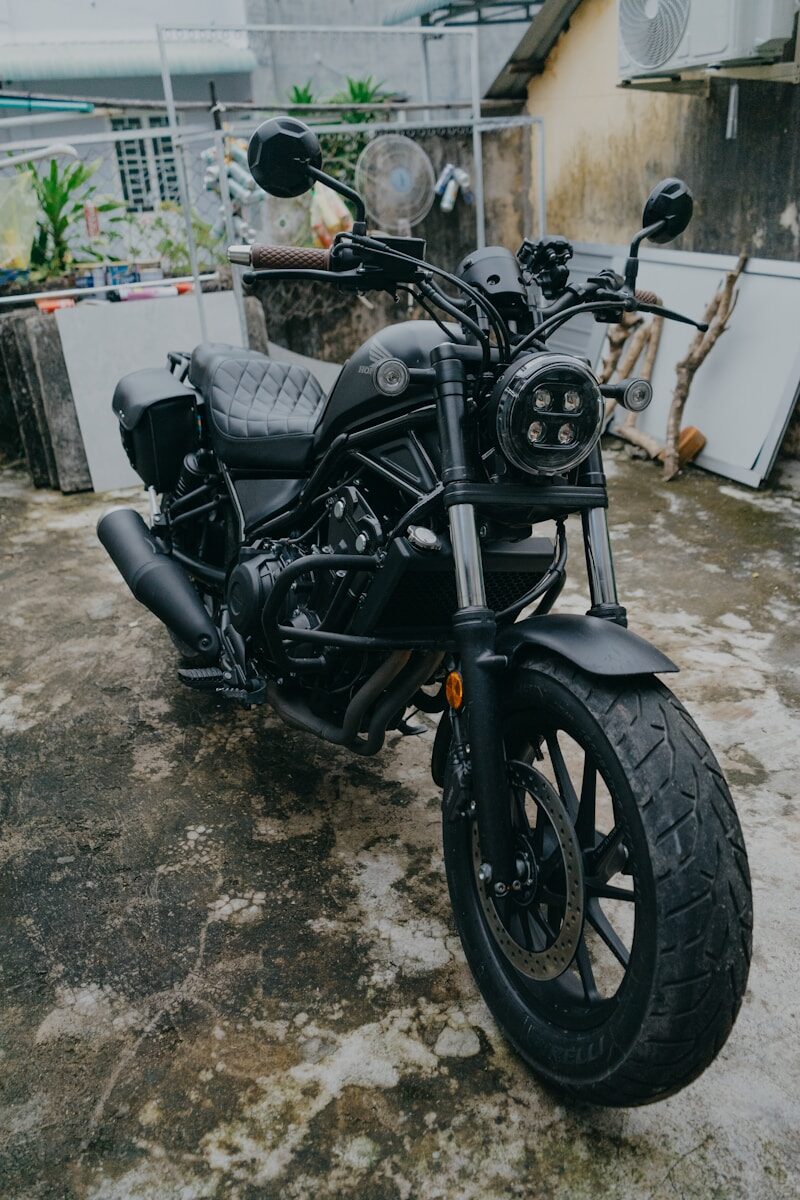
Honda just told federal regulators that a recall it opened five months ago was too small. On July 30, American Honda Motor Co. filed a new campaign with NHTSA, numbered 26V500000, that pulls in 43,913 Rebel 300, Rebel 500, and SCL500 motorcycles built between 2017 and 2026. That’s more than double the 19,406 bikes Honda recalled back in March under campaign 26V146000, which only covered 2023 through 2025 model years. The defect hasn’t changed. What changed is how far back Honda now believes it goes.
The part in question is unglamorous: a single lock screw that clamps the handlebar’s top mount to the steering stem, the shaft the front forks pivot around. NHTSA’s filing says the screw may not have been tightened to spec on the assembly line, and without enough clamping force it can work itself loose over time, drop out, and lodge in the gap between the frame’s steering head and the stem. Once that happens, the bike’s steering can bind or resist turning input, which on a cruiser being walked out of a parking spot or leaned into a low-speed U-turn is exactly the moment riders have the least margin for a surprise.
That mechanical detail matters more than it sounds. The Rebel 300 and Rebel 500 aren’t niche machines Honda sells to riders who torque their own hardware between trips to the garage. They’re the bikes Honda built to be first motorcycles: light, low-seated, cheap to insure, and pushed hard through dealer demo fleets and new-rider course partnerships. A steering hiccup that would be a minor annoyance to someone with a decade of seat time is a much bigger problem for a rider who bought a Rebel 300 four months ago specifically because it was the easiest thing in the showroom to handle.
Honda’s remedy tells you what actually went wrong on the line. Dealers aren’t installing a redesigned screw or adding a mechanical lock washer. They’re removing the existing hardware, cleaning it, and reinstalling it with a thread-locking compound under a revised procedure. That’s a process fix, not a parts fix, and it points to a torque or adhesive-application step that Honda’s own quality control didn’t catch until warranty claims and complaints started flagging loose hardware. The March recall covered exactly the model years Honda’s engineers first pinned as the affected build window. Missing that window by six additional model years, all the way back to 2017, suggests the original investigation underestimated how long the assembly problem had existed.
This expansion pulls in a lot of secondhand bikes. Anyone shopping a used Rebel 300, Rebel 500, or SCL500 built between 2017 and September 2025 should run the VIN before handing over cash, since Honda’s lookup for this expanded campaign only went live on NHTSA.gov on August 4. Owners who bought used and never registered with Honda are the ones most likely to fall through the cracks of a mailed notice, since American Honda plans to start sending letters on September 21. There’s no reason to wait for one. The fix is free, it’s minimal shop time for a dealer to pull one fastener and reapply thread lock, and Honda’s customer service line for this campaign is 1-866-784-1870, referenced internally as recall KUO.
This is the second time in under half a year that Honda has had to widen the same defect’s boundaries, and a recall that more than doubles its own affected population isn’t routine paperwork. It’s the kind of scope creep that regulators have grown less patient with across the industry lately, as NHTSA has been leaning harder on manufacturers to get root-cause numbers right the first time. Honda has other files open this year beyond this one, including a paint-peeling warranty lawsuit the automaker is fighting for a second time. Steering and brake defects also tend to draw more courtroom scrutiny than most, as a recent Ninth Circuit ruling on a Suzuki front-brake class action made clear.
For now, the math is simple. If you own or are looking at a 2017 through 2026 Rebel 300, a 2017 through 2025 Rebel 500, or a 2025 SCL500, check the VIN, book the free fix, and don’t assume an older model year means you dodged this one. Honda already assumed that once, and it was wrong.
About the Author