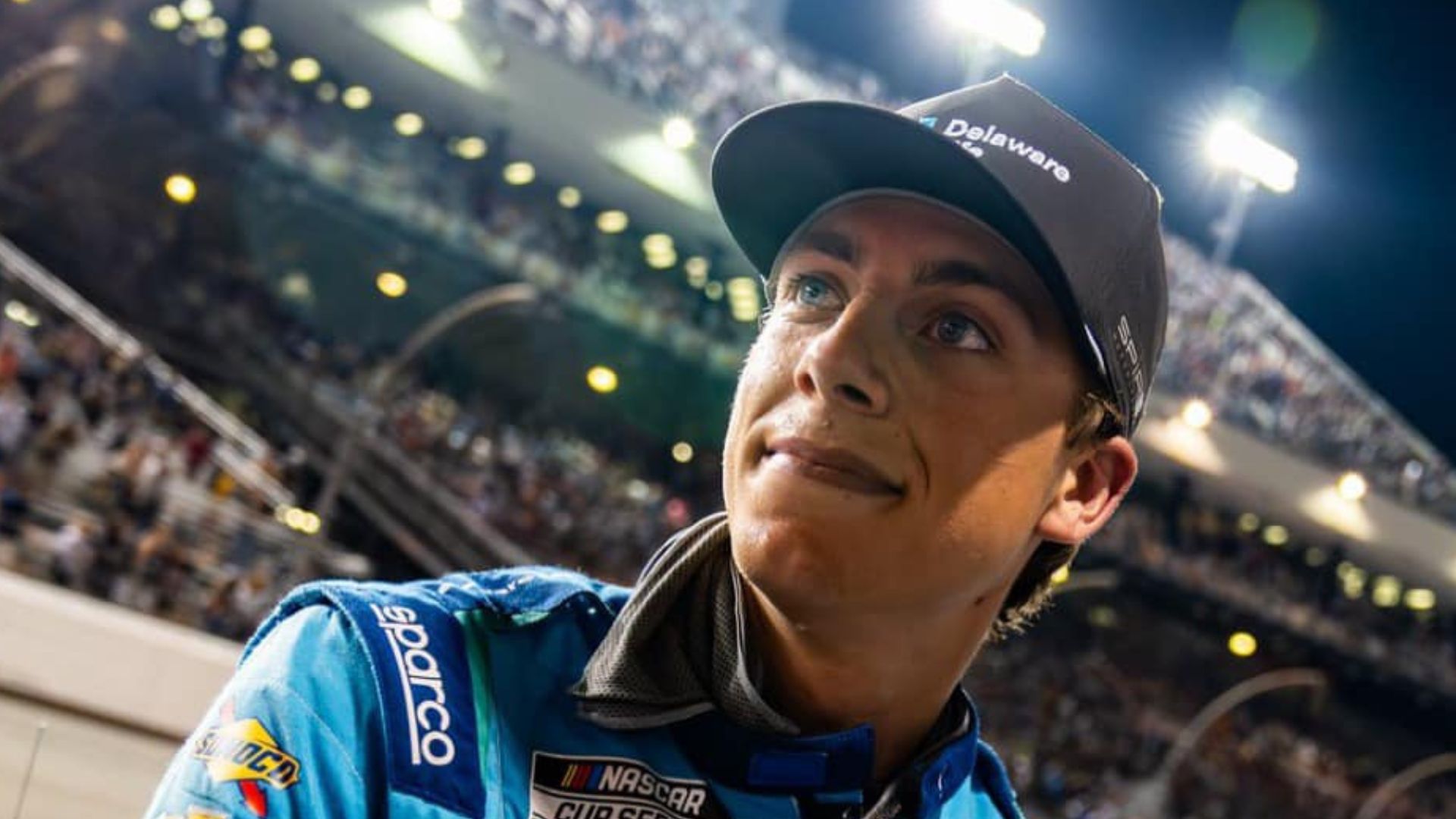
Carson Hocevar's Saturday night at Daytona ended early after a Turn 3 crash that sent the Coke Zero Sugar 400 to overtime. (Photo via Carson Hocevar/Facebook)
Carson Hocevar had track position, clean air, and a real shot at running down Ryan Preece for second when the picture changed in about half a second. Six laps from the finish of Saturday night’s Coke Zero Sugar 400, he dropped from the high line to the bottom entering Turn 3, and in that lane change his Chevrolet’s nose caught a gust of air it wasn’t built to handle. The car snapped loose, shot back up the racetrack, and slammed the outside wall, dragging Erik Jones and Ty Gibbs into the wreckage and sending Daytona International Speedway to overtime.
The crash itself isn’t the story. Daytona chews up race cars for a living, and a stock car losing the back end at 190 mph is not exactly breaking news. What’s worth sitting with is what Hocevar said afterward, because it wasn’t the answer you’d expect from a driver whose night just ended early on a rules package the entire garage was learning in real time, under the lights, with no practice session to soften the curve. He didn’t blame the package. He blamed himself. Look closely at what actually happened to his car, and he had a point.
What Actually Got Him
Superspeedway aero is a deal with the devil: a car’s nose and splitter need low, undisturbed air to stay pinned to the track, which is the entire logic behind drafting in the first place. Hocevar had spent much of the night, in his words, “super tight behind people” — stuck in someone else’s disturbed air with nowhere to go. When he finally dropped from the outside line to the bottom entering Turn 3 to complete a pass, his nose caught a gust of air from an angle the underbody wasn’t sealed against. For a half-second it lifted, the rear tires lost their bite, and — in Hocevar’s own words — “it just kept going.” NASCAR’s new superspeedway package changed plenty about how these cars draft, pass, and race in heavy traffic, but it didn’t rewrite the sport’s oldest rule at a plate track: changing lanes while side-by-side is a bet, and the house usually holds the edge.
No Penalty, and Rightly So
Worth noting for anyone tracking how NASCAR officiates late-race contact heading into the postseason: there was no penalty review announced for the move that collected Jones and Gibbs, and post-race inspection focused solely on confirming Preece as the winner. That’s the right call. A car simply losing the aerodynamic argument mid-lane-change, with no bumping or hooking involved, is about as clean a hard-racing incident as this sport produces — a useful contrast to the kind of contact NASCAR has actually gone back and reviewed this season, where intent and contact patterns made the difference between a shrug and a penalty box.
A Bumpy Landing on a Genuine Breakthrough Year
Saturday’s wreck caps a rough final stretch of the regular season that saw Hocevar slide into a 12th-place seed for the 16-driver Chase field. That’s still real progress for a driver and organization that didn’t have a seat at NASCAR’s top table a few years ago. Hocevar’s signature moment this season came at Talladega in April, the same brand of superspeedway chaos that bit him on Saturday, and Spire Motorsports has built a genuine multi-car program around that kind of speed even while navigating legal disputes involving personnel away from the racetrack. Simply qualifying a car into the Chase field remains a real step forward for Spire, Saturday’s finish notwithstanding.
What to Watch Next
The Chase opens Sunday at Darlington, a track that punishes the exact same impatience that ended Hocevar’s night at Daytona, just through an entirely different mechanism — no draft, no dirty air, just abrasive pavement, one fast groove, and a wall that doesn’t forgive a driver trying to be somewhere the car isn’t. How Hocevar’s team responds in a completely different discipline will say more about their championship chances than Saturday’s wreck ever will. More relevant to Saturday’s story: the Round of 12 elimination race lands at Talladega on Oct. 25, which will double as the real referendum on both the new superspeedway package and on whether Hocevar’s plate-track speed is a genuine strength or a small sample size he can’t count on twice. Shane van Gisbergen, who watched a 31-point cushion evaporate in one night and missed the field by 17 points, won’t be around to find out — a blunt reminder of how little room the new Chase format leaves for a bad final race, even for a driver who spent much of the summer at the front.
About the Author