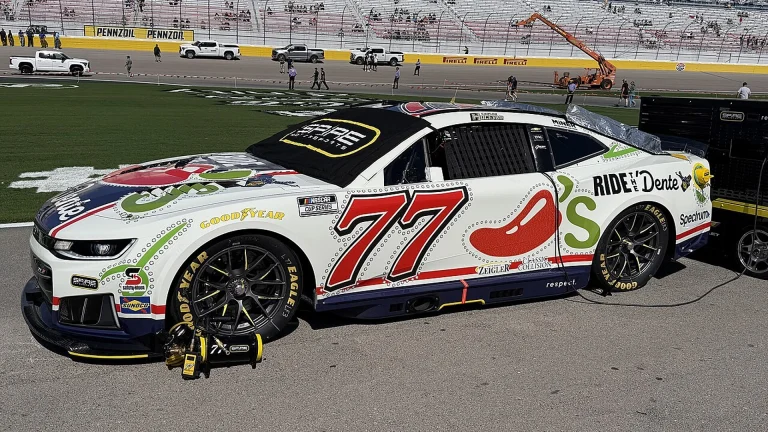
On July 29, inside a federal courthouse in Charlotte, Joe Gibbs Racing’s own attorneys asked a judge to strike one of the juiciest lines from their lawsuit against former competition director Chris Gabehart — because they admitted, in writing, that they can’t back it up. The allegation claimed Gabehart was secretly steering Spire Motorsports’ race-day strategy from behind the scenes, in violation of the noncompete he signed before leaving JGR, and that Spire had told its own employees to keep quiet about it. It was one of the most damaging lines in a lawsuit that has already produced a private investigator, a forensic exam of a crew member’s personal laptop, and a fight over a used car chief that reads like a trade-deadline text chain. Now that particular claim is gone, and the way it disappeared says almost as much as the claim itself ever did.
The claim lived in paragraph 129 of JGR’s Second Amended Complaint, filed back in June. It accused Spire of leaning on Gabehart’s alleged insider knowledge for a competitive edge, and it was serious enough that removing it required a formal Rule 12(f) motion, the legal tool for striking material a party can no longer support. When Spire’s lawyers asked JGR during discovery to produce the evidence behind that specific paragraph, JGR came back empty-handed. Rather than fight over it, JGR asked the court to strike the allegation entirely, Spire didn’t oppose the motion, and the judge signed off the same day. That’s a fast, quiet way to make an embarrassing admission: no hearing, no headlines, just a five-page filing pulling a single paragraph most casual followers of this case never even knew existed.
None of this ends the underlying fight. The noncompete claim against Gabehart survives in other forms, the trade-secret allegations tied to files he admits photographing are still very much alive, and Spire’s countersuit over an entirely separate personnel dispute keeps rolling toward trial. But losing paragraph 129 matters, because it was the one allegation that turned a garden-variety noncompete dispute into something closer to a corporate conspiracy story — and now JGR has to litigate the rest of the case without it.
A Job That Didn’t Match What Was Promised
Gabehart isn’t some outside hire caught up in a corporate dispute. He spent thirteen years building his career inside Joe Gibbs Racing, arriving in 2012 as an engineer and working his way up to crew chief for Denny Hamlin, a pairing that produced 22 Cup Series wins and two Daytona 500 trophies. When JGR promoted him to Competition Director ahead of the 2025 season, it came with a new employment agreement, signed in November 2024, that included an unusually specific escape hatch buried in Section 6 of the contract. If, sometime between September 2025 and June 2026, Gabehart could show in good faith that his actual job diverged from what he’d been promised, give the team sixty days to fix it, and then give sixty days’ notice, his eighteen-month noncompete would shrink to a single week and JGR would owe him $100,000 for a clean break.
That clause only matters if the promised job never materialized, and according to Gabehart’s own court filings, it didn’t. He says he was sold on a COO-style role with real autonomy over competitive decisions, then found himself constantly overruled by Coach Gibbs and senior executives on calls that should have been his to make. He also says he was pushed to take over as crew chief for the No. 54 car, driven by Ty Gibbs, the team owner’s grandson, despite repeatedly objecting, and that Heather Gibbs, Ty’s mother, sent him a personal check for $500,000 outside his employment agreement in an apparent attempt to get him to take the job anyway.
The Texts JGR Wishes It Could Take Back
What makes this case unusually messy for JGR is how much of its own internal communication ended up validating Gabehart’s side of the story. After he formally invoked his Section 6 rights during a November 2025 meeting with Coach Gibbs, JGR’s own chief financial officer reportedly told Gabehart directly that his actual role never matched what he’d been told, and separately warned a colleague that the company had 60 to 120 days to give Gabehart what he wanted or risk losing him entirely. JGR’s in-house counsel is also said to have written, around the same time, that the company was accepting Gabehart’s request to be released from his contract and paying him the $100,000 on top of it. None of that reads like a company that believed it was dealing with an executive angling to steal secrets. It reads like a company that knew it had a legitimate contract problem and was scrambling to manage the fallout internally.
Instead of settling on those terms, JGR placed Gabehart on what it internally called garden leave, told him to tell people he was on vacation, and then simply stopped paying him. That’s a meaningful legal exposure on its own: North Carolina’s Wage and Hour Act allows employees to recover unpaid wages plus liquidated damages and attorney’s fees when an employer withholds compensation in bad faith, and a paper trail showing the company’s own finance and legal staff privately agreeing Gabehart had a valid claim is not a good look in front of a jury.
A Private Investigator, a Forensic Exam, and a Privilege Fight
Three weeks after cutting off his pay, JGR hired a private investigator who photographed Gabehart having lunch in public with Spire co-owner Jeff Dickerson, apparently standard operating procedure for a team trying to build a noncompete case. JGR also gained access to a company laptop Gabehart had already returned, along with personal accounts that had synced to it, including a Gmail account holding privileged communications with his own attorneys about the ongoing separation talks.
Gabehart agreed to a forensic examination of his personal devices anyway, paying for it himself and letting JGR pick the examiner, a firm called Reliance Forensics. When the exam wrapped in late January 2026, it reportedly found no evidence that any JGR files had ever been transmitted or shared, only local copies that never left his devices. He consented to have everything flagged in the exam permanently deleted, a process finished just three days before JGR sent him a letter terminating his employment for cause. Separately, Gabehart’s attorneys have accused JGR’s forensic examiner of improperly handing over dozens of his privileged attorney-client emails to JGR’s own lawyers before they were legally entitled to see them, an allegation that, if substantiated, could create its own separate liability and helps explain why this case has generated so many motions before ever reaching a jury.
Fired “For Cause,” Except on Paper
The February 9, 2026 termination letter is where JGR’s version of events runs into its own paperwork. Even though the letter invoked a for-cause termination, it reportedly also described Gabehart’s exit in the language of a resignation, and JGR’s internal termination payroll notice lists the reason for his departure as a voluntary resignation rather than cause. Three days after the letter went out, Coach Gibbs told a SiriusXM audience that “we just decided to go our separate ways,” which is not exactly the language of a company that had just fired someone for misconduct. That kind of inconsistency is precisely the sort of thing a jury tends to notice, and it’s a large part of why a federal judge has already scheduled a nine-day trial in this case for February 2027, timed, awkwardly, to overlap with Daytona Speedweeks.
The Other Fight Inside the Fight: A Car Chief Traded Like a Draft Pick
Running parallel to the noncompete dispute is a completely separate disagreement over Spire car chief Robert “Cheddar” Smith, and it might be the more interesting story for anyone who follows how NASCAR teams actually operate behind the scenes. Spire says that when JGR came after Smith in early 2025 to help fix the struggling No. 54 team, Smith’s own noncompete blocked the move, so Dickerson proposed an informal trade: Spire would release Smith immediately in exchange for JGR later releasing a comparable competition-level employee back to Spire, or paying $100,000 if no trade materialized. Spire says it held up its end, releasing Smith, who joined JGR that April and has since helped turn the No. 54 program around. When Spire asked JGR to reciprocate, first with crew chief Tyler Allen and later with car chief Ryan Towles, JGR refused both times and also declined to pay the $100,000 alternative it had originally floated. Spire’s countersuit now seeks damages for breach of an oral contract, or alternatively an implied contract, plus unjust enrichment.
It’s a rare public look at something crew chiefs and team executives usually only discuss privately: an informal barter system for talent that operates alongside, and sometimes in spite of, the noncompete clauses everyone signs. In a Next Gen era where every team runs the same chassis, the same suppliers, and largely the same parts list, the people who can interpret setup data and simulation runs are the real competitive asset, which is exactly why two organizations are now suing each other over one of them.
What Today’s Filing Actually Means
Withdrawing paragraph 129 doesn’t resolve anything about who’s right in the broader case. JGR’s noncompete claim against Gabehart survived an earlier preliminary injunction fight in part, and the trade-secret allegations tied to the folders and photographs found on his old laptop are still active. But losing this specific claim strips out the single most sensational allegation in the complaint, the idea that Spire was actively concealing a compliance violation, right as both sides head toward a jury that will eventually have to decide whose account of the last two years holds up. For a case that’s likely already cost both organizations well into seven figures in legal fees, with a trial date still six months out, that’s one less exhibit either side has to explain from the witness stand.
For anyone in the garage signing an employment agreement this offseason, the case is already a useful lesson regardless of how the jury eventually rules. Narrowly drafted restrictive covenants, like the role-specific noncompete JGR wrote for Gabehart, tend to survive court scrutiny far better than broad, industry-wide bans, which North Carolina courts routinely refuse to rewrite and simply strike down instead. And internal communications, the texts and emails a company never expects to see in a court filing, have a way of mattering more than the carefully worded termination letter written after the fact. That same Charlotte federal courthouse handed Front Row Motorsports a major antitrust win over NASCAR last year, a reminder that this particular district has become a genuine venue for high-stakes racing litigation, not just a footnote to it.
About the Author