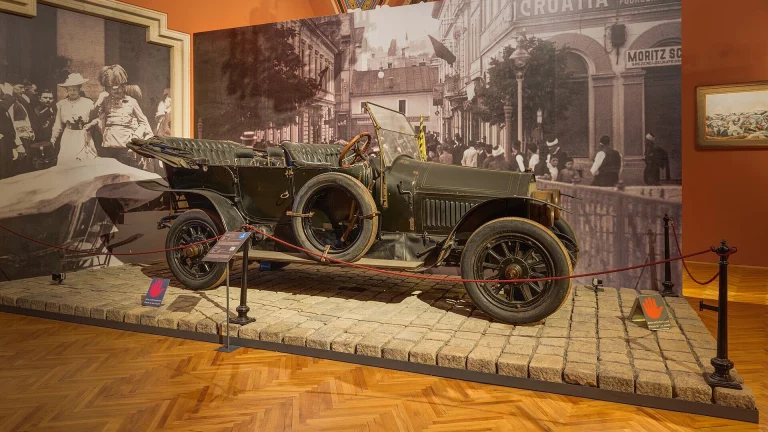
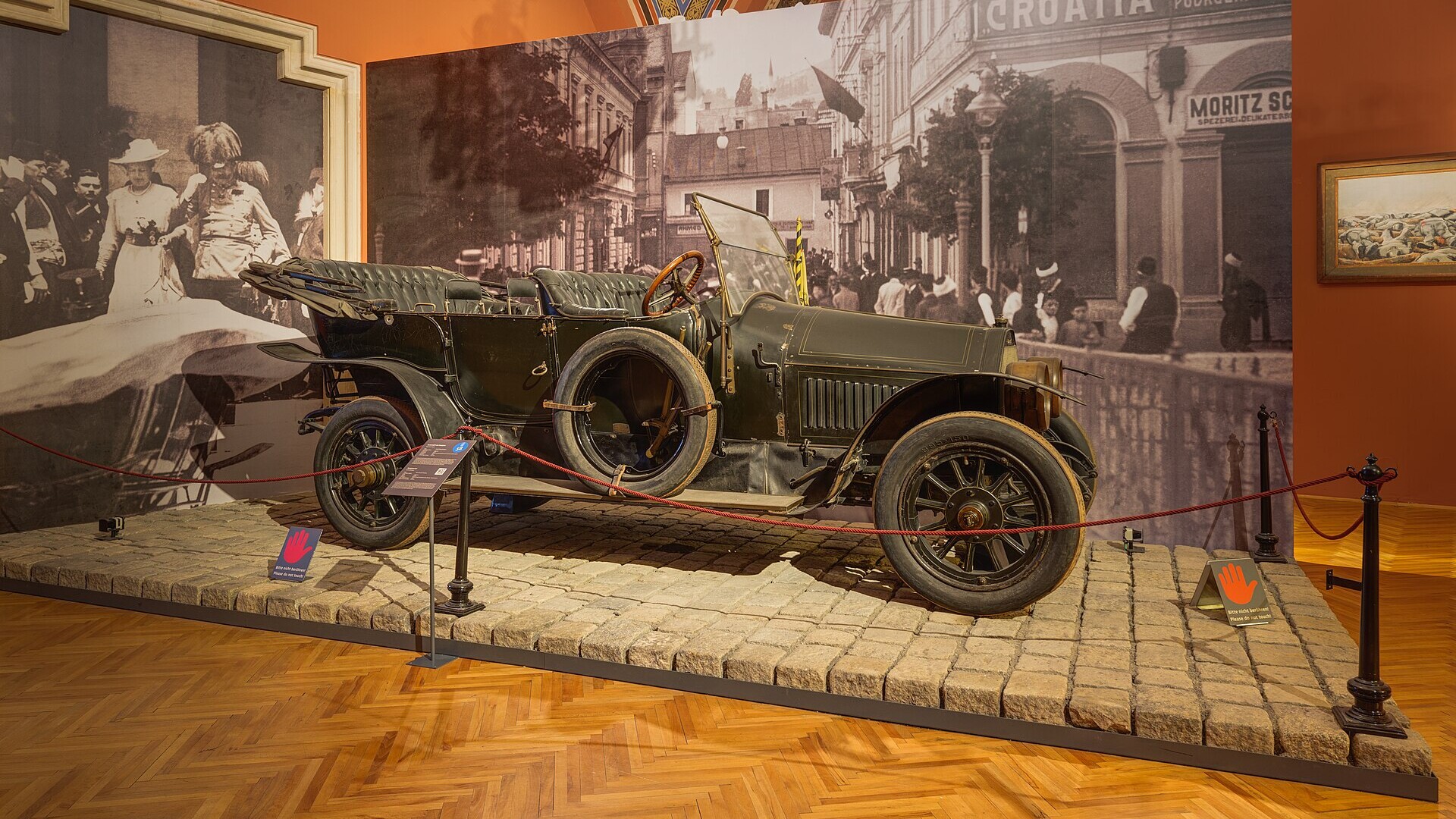
The Gräf & Stift Double Phaeton at the Heeresgeschichtliches Museum in Vienna. Photo: Hubertl via Wikimedia Commons (CC BY-SA 4.0)
The car Archduke Franz Ferdinand was riding in when he was shot in 1914 supposedly carried a curse that killed a dozen or more of its later owners, and its license plate, A III 118, supposedly predicted the Armistice on 11/11/18. It’s the best cursed-car story going. According to historian Mike Dash, who dug into its origins, it’s also almost entirely made up.
The real history doesn’t need any help. On June 28, 1914, Franz Ferdinand and his wife Sophie were shot and killed by Gavrilo Princip in Sarajevo. They were riding in a Gräf & Stift Double Phaeton lent to them by Count Franz von Harrach. Within weeks, Europe was at war. Few assassinations in history are better documented, and the car survives today at the Heeresgeschichtliches Museum, the Museum of Military History in Vienna, where it has been on display for many decades.
That museum history is the first problem for the curse. A car that went into a museum’s collection doesn’t pass through a long line of doomed private owners. Dash traced the curse narrative back to popular books of the 1950s, especially Frank Edwards’s Stranger Than Science, published in 1959. That was the same period when the James Dean “Little Bastard” stories were taking off, and publishers had figured out that haunted cars sold well. The license-plate prophecy looks like the same kind of after-the-fact cleverness, a coincidence dressed up as destiny.
The odd part is that the fake story has become part of the car’s identity anyway. Plenty of people who know nothing else about the assassination have heard about the cursed car. We saw something similar with Elvis’s Pantera earlier this month, where the bullet holes are real and the story around them only adds to the car’s pull.
The car earned its place in history in about six seconds in Sarajevo. The curse came 45 years later, out of a paperback.
If this month’s series has had a theme, it’s that famous cars collect stories faster than they collect miles. Some of those stories are backed by a witness and a steering wheel full of bullet holes. Some come from a wig in a wreckage photo. And some, like this one, trace back to a paperback and a knack for numerology. The Gräf & Stift was there when the twentieth century changed direction, which makes a paperback curse a downgrade. Which car from this month’s series would you most want to stand next to?
Sources
- Mike Dash History: Curses — Archduke Franz Ferdinand and His Astounding Death Car
- BestRide: Cursed Cars II — Franz Ferdinand’s 1910 Gräf & Stift Double Phaeton
About the Author