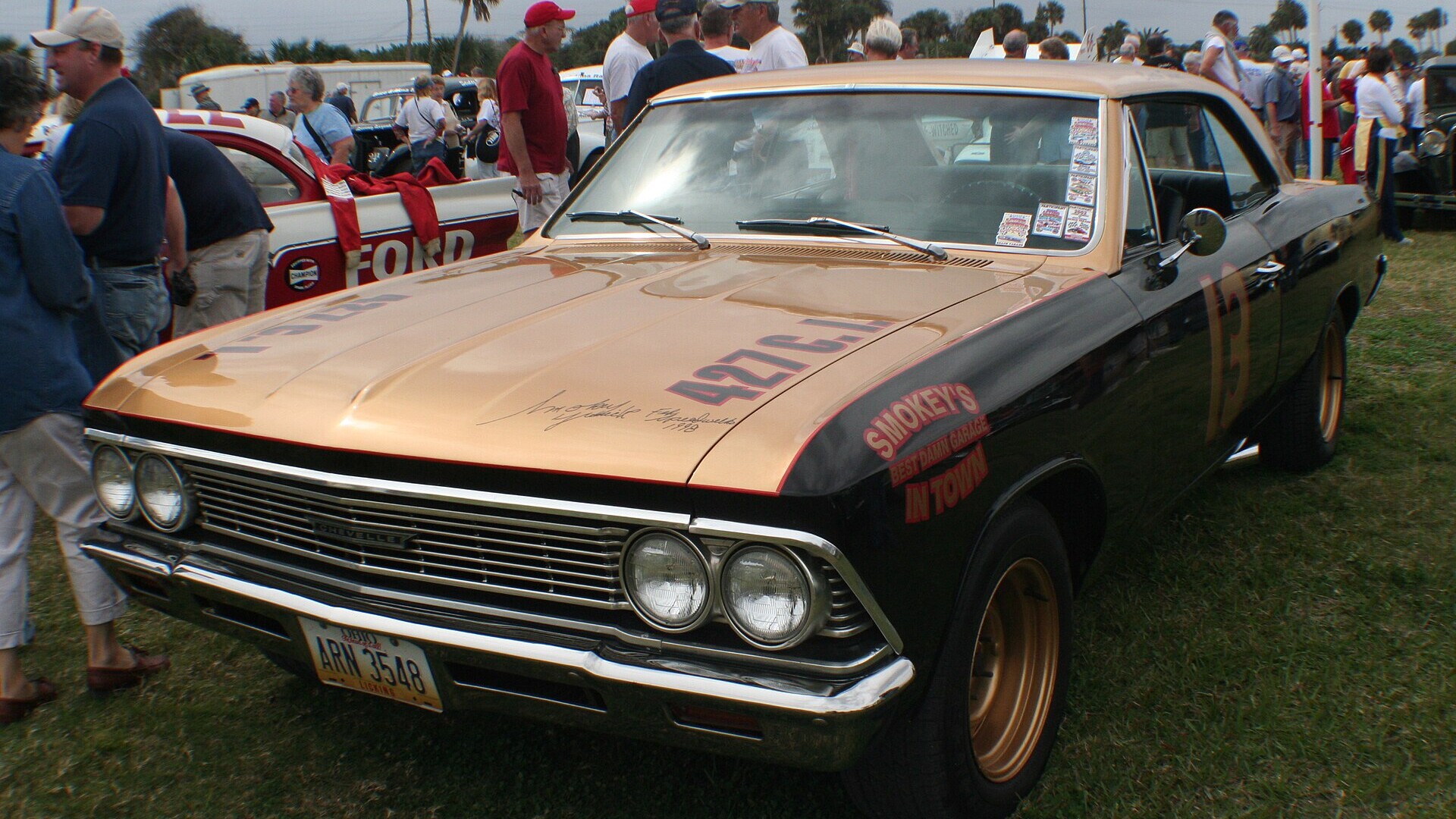
The 1966 Chevrolet Chevelle Curtis Turner drove for Smokey Yunick, displayed at Daytona during Speedweeks 2008. Photo: Freewheeling Daredevil via Flickr/Wikimedia Commons, CC BY 2.0
The University of Nebraska patent behind the SAFER barrier lists among its citations a race-track crash wall invented by Henry “Smokey” Yunick, the Daytona Beach mechanic most people remember for a suspiciously fast Chevelle.
Yunick filed the application in September 1994. U.S. Patent 5,645,368, “Race track with novel crash barrier and method,” was granted on July 8, 1997, to Yunick as an individual, with no company named as assignee. Nebraska’s Patent 6,926,461, filed April 8, 2002, is one of the two patents the university’s Midwest Roadside Safety Facility lists for the SAFER barrier, which was first installed at Indianapolis Motor Speedway that same year.
Yunick’s patent shows up in the Nebraska filing’s citations table and nowhere else. The text never discusses his design, and neither document says the Nebraska engineers worked from it. Google’s patent record counts 40 later patents that cite the Yunick barrier.
What the barrier patent claims
Yunick’s wall was made of old tires. Each module is a rectangular steel base carrying rows of tires stacked in layers and staggered like brickwork, with plywood sheets between the layers and cables or rods running from the base up through the stack to hold it together. The modules sit end to end on a bed of sand or gravel just below the edge of the racing surface, in two staggered rings.
A car hits the inner ring and the tires take the first load. Then the whole module slides, and friction between its steel base and the ground absorbs more. A hard enough hit drives the inner module back into the outer ring. Some modules have no connection to their neighbors, so each one can move on its own, and short replacement modules can be dropped in with a forklift.
The patent’s worked example is a 3,500-pound stock car hitting a module head-on at 150 mph. Yunick wrote that the barrier had to move at least a foot within five milliseconds of contact, and the claims call for each module to absorb enough energy that a driver would normally survive a worst-case hit.
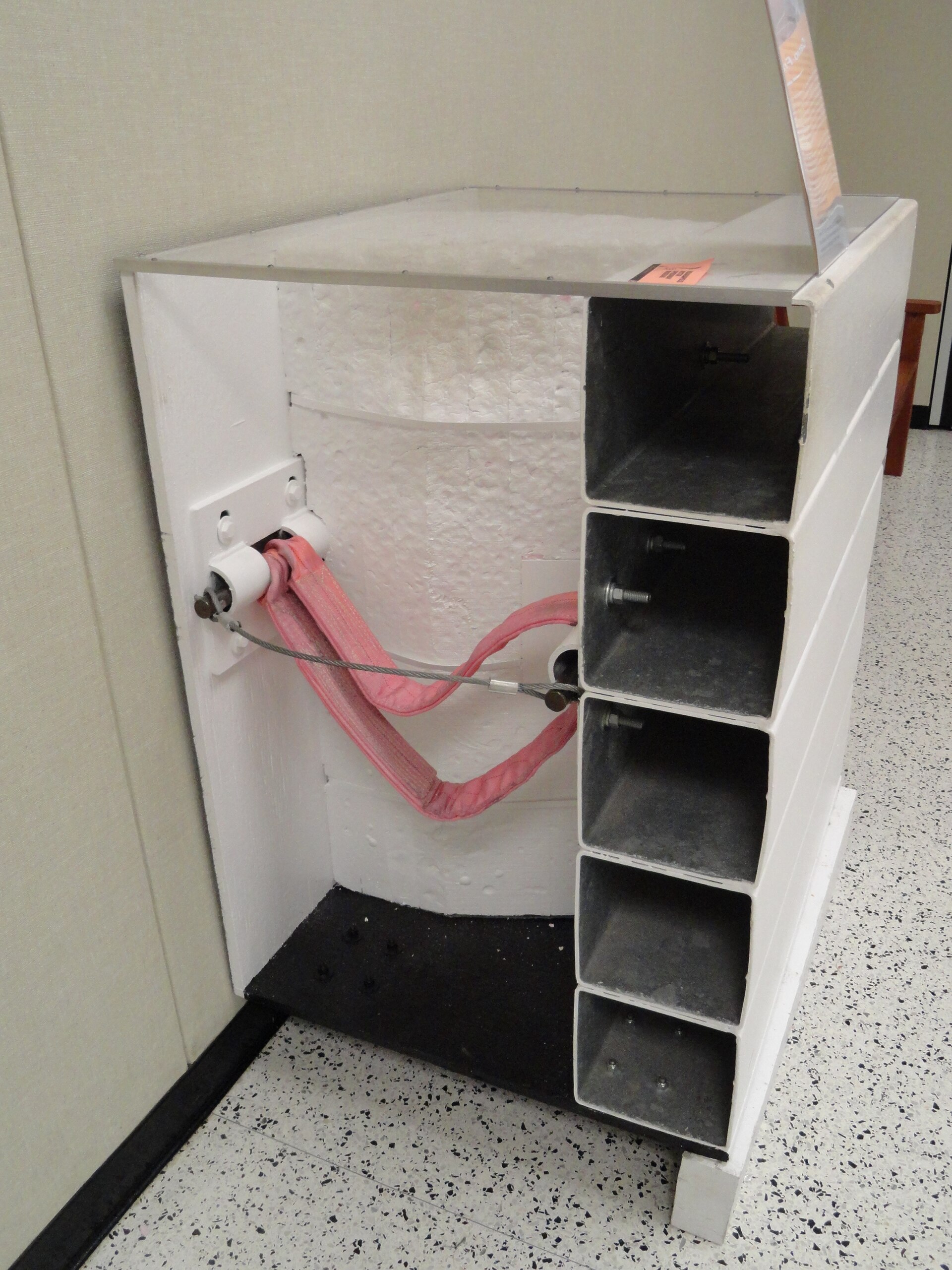
The SAFER barrier that went into Indianapolis looks nothing like it. According to the Midwest Roadside Safety Facility, it is built from rectangular steel tubes welded into 20-foot modules standing 38-1/2 inches high, set in front of the existing concrete wall with blocks of closed-cell polystyrene foam between the two and three 3/8-inch cables every 10 feet holding the tubes in line. What the two designs share is a wall that gives way on contact instead of stopping the car dead.
The same Yunick filing also claims a way to run a championship: build several nearly identical tracks, race cars built to a common specification, score the finishing positions and use the scores to pick a series winner. Google Patents lists the patent as expired for unpaid fees.
The other filings
The barrier was one of at least nine U.S. patents issued to Yunick between 1978 and 1997. The first, 4,068,635, filed in June 1976, is a valve-cover breather with a ball between two seats. Inertia and cornering loads push the ball toward whichever end oil is flooding, so the engine can breathe at high rpm without throwing its upper-end oil out the vent.
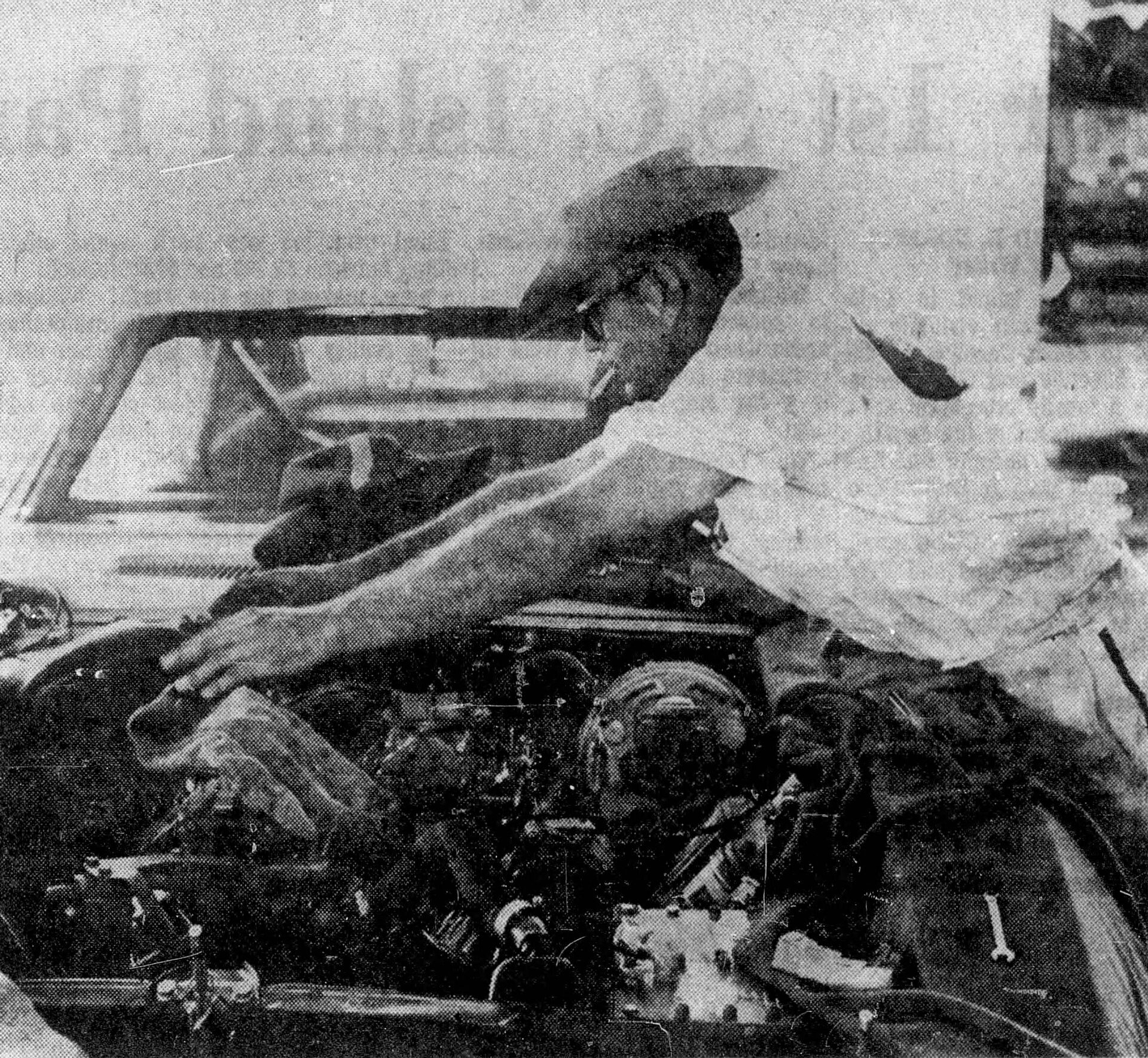
The one people still argue about is 4,503,833, granted March 12, 1985, the “hot vapor cycle” engine. Coolant heat partly vaporizes the mixture leaving the carburetor, an exhaust-driven pair of turbines stirs it, and exhaust heat raises it to about 400°F on 93-octane unleaded before it reaches the cylinders. The patent says a 1980 Buick Skylark fitted with the system averaged 48.25 mpg over ten runs of a 133-mile city and highway loop and ran 0-60 mph in 9.4 seconds.
It gives no figure for an unmodified Skylark on that loop, so the 48.25 mpg has no baseline in the document itself. The original assignee was Motortech Inc., which assigned the patent back to Yunick in 1989. A companion filing, 4,637,365, covers the finned coolant heat exchanger, and Google lists it as expired for unpaid maintenance fees.
His later patents were plainer. 5,246,086, granted in 1993, fills a new oil filter from a pressurized tank through a check-valve fitting, so oil reaches the engine’s passages and backflushes the pump before the first start. 5,515,712, granted in 1996, uses an electric motor to spin an engine through its operating range, up to about 15,000 rpm for racing engines, and measure friction power without firing it.
The 1968 Chevelle, first hand
Yunick’s reputation as a rule-bender rests mostly on stories told years later. One of the few first-hand accounts on record comes from Joe Gazaway, a NASCAR inspector at Daytona in February 1968, who told The Atlanta Journal-Constitution in 2013 that Yunick showed up with a downsized Chevelle built for Gordon Johncock. Gazaway said the car was flat underneath and the engine sat so low in the frame rails that Yunick couldn’t take the valve covers off.
According to Gazaway, the fuel tank was there for weight and was too small to race on. He had it drained and unhooked so no fuel could be added, gave Yunick a long list of required changes, and then watched Yunick and a helper start the car, drive it out of the speedway and park it across the road before heading to Bill France Sr.’s office. France’s reply, as Gazaway recalled it: “Do what the man told you.”
His account doesn’t explain how the car ran with its tank drained, and the newspaper didn’t independently verify it. It also doesn’t include the line usually attached to the story, in which Yunick tells officials to add one more item to the list.
Outside the stories, the Motorsports Hall of Fame of America credits Yunick as chief mechanic on Jim Rathmann’s winning car at the 1960 Indianapolis 500, the builder behind Herb Thomas’s 1951 and 1953 NASCAR championships, and the owner of the cars that won the 1961 and 1962 Daytona 500s. Indianapolis still fights over how far a team can push the rules, as Roger Penske’s response to the cheating allegations against his own Indy 500 team showed.
Yunick died on May 9, 2001. Nebraska filed the SAFER patent that cites his barrier eleven months later.
Should Smokey Yunick go down as NASCAR’s great rule-bender, or as an engineer whose patents got there before the rulebook did?
Sources: U.S. Patents 4,068,635; 4,503,833; 4,637,365; 5,246,086; 5,515,712; 5,645,368 and 6,926,461 (USPTO records via Google Patents); Midwest Roadside Safety Facility, University of Nebraska–Lincoln; Motorsports Hall of Fame of America inductee profile; Joe Gazaway interview, The Atlanta Journal-Constitution, July 27, 2013.
About the Author