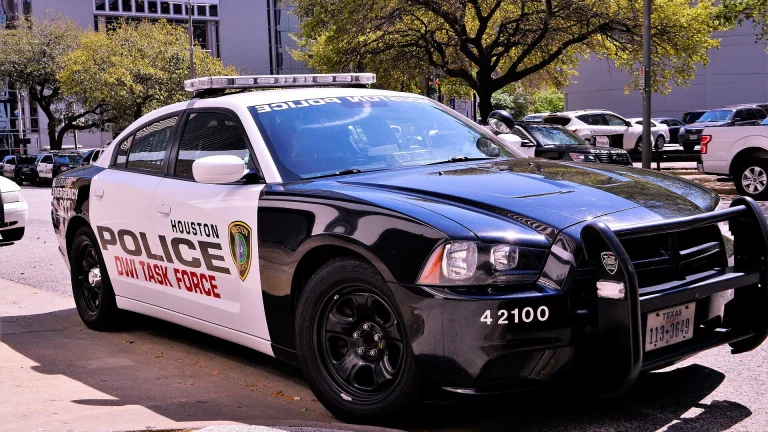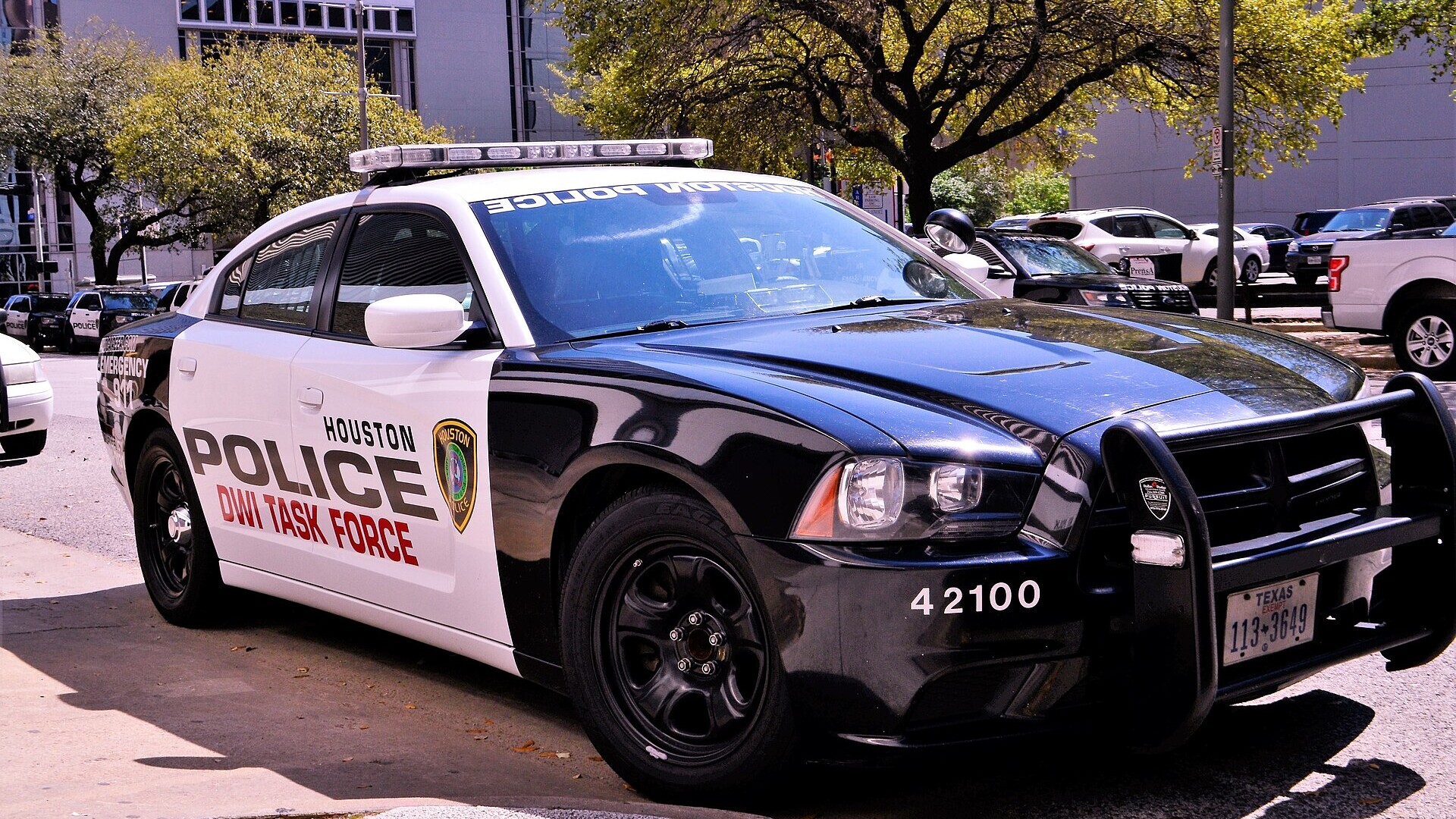
Houston Police Department Dodge Charger. Photo: ArtisticOperations via Wikimedia Commons (CC0)
A tan GMC pickup that Houston police chased from the Houston Zoo on Thursday afternoon ended its run against a tree in Woodland Heights, the latest Houston pursuit to finish with a fleeing vehicle off the pavement and into something that doesn’t move. The Houston Police Department told ABC13 the chase began around 1:20 p.m. with a call about two men breaking into cars, or trying to steal one, in the 6200 block of Hermann Park Drive. About 20 minutes later, one of them was in custody on Parkview Street. The other got away.
From Hermann Park Drive to a tree on Parkview Street
KHOU 11 reported, citing a transcript of police scanner audio, that officers worked with Webster police to track an older tan GMC pickup near the zoo, and that some of the officers were in unmarked cars and called for more units. On the radio, they tracked the truck onto U.S. 59 and the northbound I-45 split and reported the driver running a red light, cutting across freeway traffic and driving on the shoulder.
KHOU’s helicopter picked up the chase north of downtown. Its Air 11 video shows the pickup crossing a shopping center parking lot at Studemont Street and I-10, passing under the freeway and cutting through a park, where KHOU reported it narrowly missed a person. An HPD unit tried a PIT maneuver and didn’t stop it. The truck kept going through business parking lots and along sidewalks until it hit a tree on Parkview Street near Woodland Park, close to where I-10 meets the North Freeway. KPRC 2 put the end of the pursuit at 203 Parkview Street. Smoke poured from under the hood, a man climbed out the passenger door, and officers took him into custody.
KHOU said no injuries were reported. As of Friday afternoon, HPD had not publicly released the man’s name, his age beyond describing him as young, a top speed for the chase, or any charges, and Backfire News found no charging document filed in the case. The second man was still being sought.
A misdemeanor call that can become a felony case
The call that started this was small by Texas standards. Section 30.04 of the Penal Code makes breaking into or entering a vehicle without the owner’s consent, with intent to commit theft or a felony, a Class A misdemeanor for someone with no prior convictions for it. The maximum for a Class A misdemeanor is a year in jail and a $4,000 fine.
Fleeing in a vehicle is punished on a different scale. Section 38.04 makes it a crime to intentionally flee from someone you know is a peace officer lawfully trying to arrest or detain you, and the statute as printed still carries two competing punishment schemes passed in the same 2011 session. One makes a first offense in a vehicle a state jail felony. The other, from Senate Bill 1416, makes using a vehicle in flight a third-degree felony. Texas appeals courts, including the Fort Worth court in Adetomiwa v. State in 2014, have read the two together and held that evading in a vehicle is a third-degree felony whether or not the driver has a prior. A third-degree felony carries two to 10 years in prison and a fine of up to $10,000.
That means a suspected car break-in whose ceiling is a year in county jail can produce a felony charge with a two-year floor once the driver keeps going after the lights come on, and the evading charge doesn’t depend on prosecutors ever proving the break-in. Nothing has been filed here yet, and the man in custody is presumed innocent of both.
What HPD’s pursuit order allows on a car burglary call
HPD’s chase rules are in General Order 600-04, issued Sept. 14, 2023. It lets an officer start a pursuit only after deciding in good faith that the need to catch the suspect immediately outweighs the risk to officers and the public, and it requires every officer and supervisor involved to keep weighing that balance and end the chase when the risk wins. The factors it lists include population density and time of day, the number of cars, bicycles and pedestrians around, and whether officers could arrest the suspect later, for example by filing a warrant.
The order flatly bars a chase only when the suspect’s sole possible offense, other than evading itself, is a Class C offense, a traffic or municipal warrant, or a nonviolent misdemeanor warrant. A car break-in in progress is a Class A misdemeanor and isn’t on that list, so the policy allowed HPD to start this pursuit. Continuing it once the truck was crossing a park and riding sidewalks in the middle of a weekday afternoon was a judgment the order hands to the officers, the field supervisor running the pursuit and, when HPD’s own helicopter is overhead, its crew.
Two other provisions bear on Thursday. An officer in an unmarked car may take part in a chase only in uniform and with working lights and siren, and must give the lead to the first marked HPD unit that arrives. And whenever anyone tries a PIT maneuver, the field supervisor must have every vehicle involved photographed to document the damage or lack of it. The section setting out when HPD officers may use the PIT is blacked out in the copy the city posts online.
Houston car-burglary chases and the cases that reached the Texas Supreme Court
Houston has run this play before. In April, West University Place police said two people accused of burglarizing a vehicle led officers from several agencies, HPD among them, on a 43-minute chase that ended when an HPD unit used a PIT maneuver in the 6400 block of Del Rio, ABC13 reported. In October, Harris County deputies said a driver fleeing them in a stolen vehicle fell out mid-chase and was run over by it.
The state’s highest civil court has looked at misdemeanor chases from the bystander’s side. In City of Houston v. Rodriguez, decided Dec. 31, 2024, HPD officers working a prostitution sting chased a man accused of offering an undercover officer $40, and Officer Ricardo Corral’s patrol car crashed into another vehicle during a wide turn. The Texas Supreme Court threw out the injured men’s suit against the city, holding that Corral was protected by official immunity. Justice Brett Busby, joined by two colleagues, wrote separately that the ruling shouldn’t be read as approving the decision to start that chase, and that for most nonviolent misdemeanors, “a high-speed pursuit should not become the default response.”
Who pays when a Texas police chase hits a bystander
The Texas Tort Claims Act waives a city’s immunity for injuries and property damage caused by an employee’s negligent operation of a motor vehicle. It then carves out an emergency exception for employees responding to an emergency, as long as they follow the laws that apply to emergency action or, where none applies, don’t act with conscious indifference or reckless disregard for others’ safety. A successful claim against a city is capped at $250,000 per person and $500,000 per occurrence for injury or death, and $100,000 per occurrence for property damage.
Those defenses have held up. The Texas Supreme Court applied the emergency exception in a San Antonio pursuit crash in City of San Antonio v. Maspero in 2022, and sided with Austin in City of Austin v. Powell the same day it decided the Houston case. Backfire News has also covered how a Houston driver got nothing from the city even after HPD disciplined the officer who rear-ended her. The officer behind the wheel isn’t excused from everything: Transportation Code Section 546.005 keeps an emergency driver’s duty to drive with appropriate regard for the safety of all persons and leaves the driver answerable for reckless disregard. For a bystander, though, the realistic sources of money are usually the fleeing driver, whatever insurance that driver carries, and the bystander’s own collision and uninsured-motorist coverage.
What happens next in the Hermann Park chase
Once charges are filed, the Harris County court record will show what prosecutors accepted from HPD: burglary of a vehicle, evading arrest with a vehicle, or both. Police are still looking for the second man. Under the general order, the failed PIT attempt means a supervisor had to have the vehicles photographed, and the pursuit itself has to be documented in writing.
Should Houston police be allowed to chase a suspected car break-in through a city park in the middle of a weekday afternoon, or should a property-crime call like this one end with a warrant instead?
About the Author