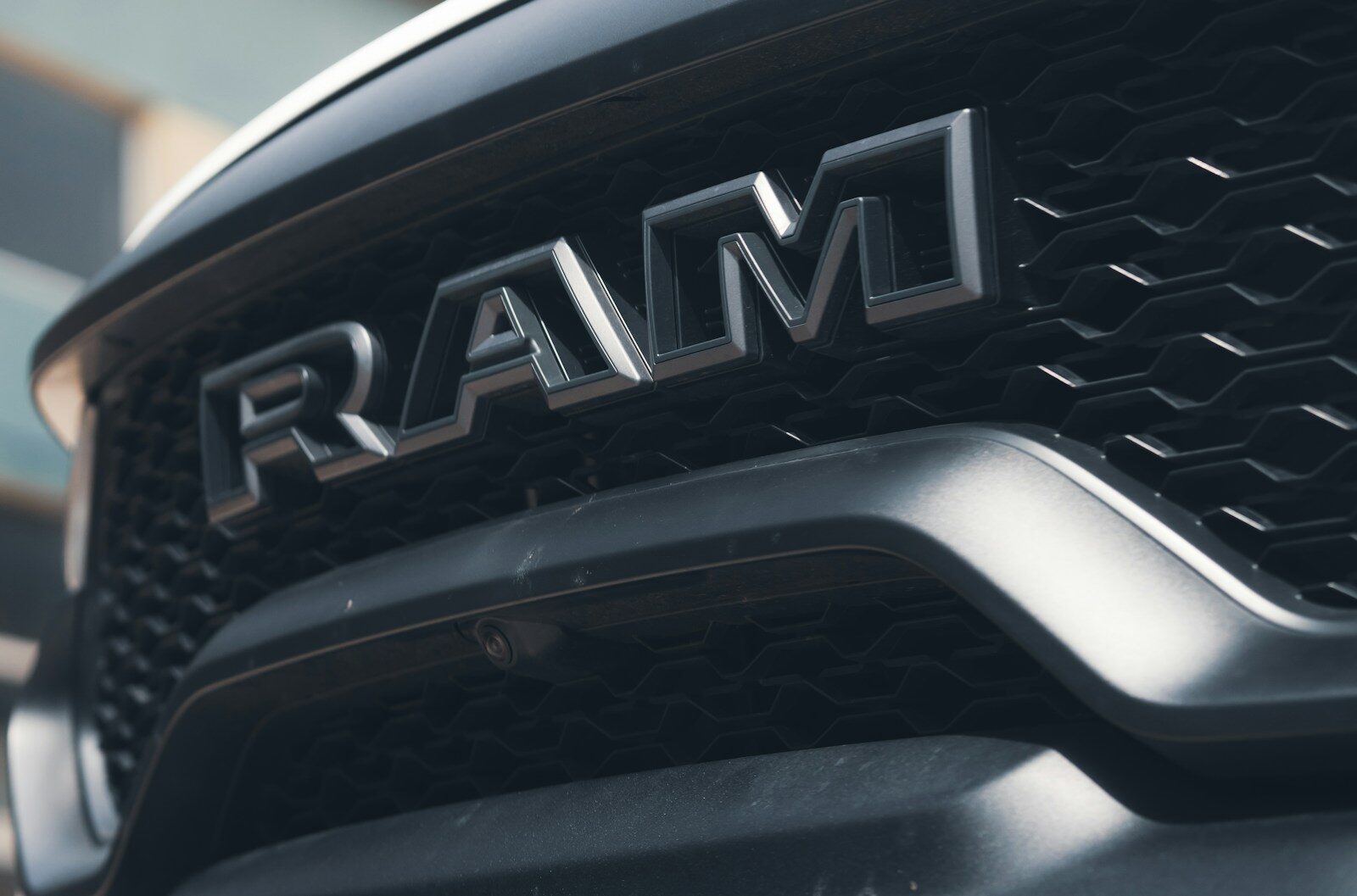
The horsepower number is the headline, and it’s the least interesting part of what Ram announced this week.
Direct Connection rolled out a full performance catalog for the 2027 Ram 1500 Rumble Bee family on August 4: supercharger kits, Magnaflow cat-backs, a Ridetech coilover lowering kit, and graphics. The kits target over 600 hp on the 5.7-liter truck, over 700 on the 392, and over 900 on the SRT. Each blower package is $10,995 before install. Parts for the 5.7 arrive in Q4 2026; the 392 and SRT versions follow in the first half of 2027.
The line that should actually stop you is this one: install it with an ASE-certified Mopar technician and Direct Connection honors the original five-year/60,000-mile limited powertrain warranty. Almost nobody does that.
Why a bigger blower on an already-blown truck
All three kits use the same hardware — a 3.0-liter twin-screw supercharger, an oversized air-to-water intercooler and a high-capacity coolant pump. On the 5.7 and the 392, that’s a straight addition of boost to a naturally aspirated engine. On the SRT, it replaces the factory 2.4-liter unit.
Related Articles
- Antonelli Out Of Engine Parts: What FIA Documents Reveal About Mercedes’ Penalty Squeeze
- Justin Marks Says Max Verstappen’s NASCAR Path Runs Straight Into a Ford Badge
That’s a 25 percent jump in displacement per revolution, and the reason it matters isn’t just “more air.” A twin-screw is a positive-displacement blower with internal compression, meaning charge is squeezed inside the rotor pack before it ever reaches the manifold. Move the same volume of air through a physically larger rotor set and you can do it at lower rotor speed, which cuts parasitic drag on the crank and — more importantly — keeps discharge temperature down for a given pressure ratio. Cooler charge means the calibration can run more timing before it hits knock. That’s where the extra 130-plus horsepower on the SRT actually comes from. The oversized intercooler and upsized coolant pump aren’t garnish; they’re what makes the boost survivable on a truck that might see a trailer in August.
The question the press release doesn’t answer
The SRT arrives with 777 horsepower and 680 lb-ft through a TorqueFlite 8HP95 eight-speed. Run the conversion and 680 lb-ft is about 922 Nm. ZF’s own material describes the 8HP family as spanning a torque range up to 1,000 Nm, and the number in each variant’s name tracks that capacity — the 95 in 8HP95 pointing at roughly 950 Nm.
So the truck leaves the factory sitting at something like 97 percent of its transmission’s nominal input rating. Push output past 900 hp and torque follows it upward. Nothing in the announcement mentions an upgraded torque converter, valve body, driveshaft, or rear axle, and no torque figures are quoted for any of the three kits.
That is not a gotcha — Ram is warrantying the thing, which implies its calibration keeps torque inside limits, likely with load-based limiting in the lower gears. But it’s the first question I’d put to a dealer: what exactly does the five-year/60,000-mile coverage extend to, and does the kit’s calibration cap torque to protect the box? Get the answer in writing before the $10,995 leaves your account.
The warranty angle is bigger than it looks
Under the Magnuson-Moss Warranty Act and the FTC’s interpretations at 16 CFR Part 700, a manufacturer can’t void your warranty simply because you fitted an aftermarket part — it has to show the part caused the failure. That’s the legal floor, and it’s a floor most owners never test because arguing it with a service manager while your truck sits on a lift is nobody’s idea of a good afternoon.
Direct Connection is offering something above that floor: affirmative coverage rather than a fight you might win. The catch is the installer requirement. Bolt this on in your own garage and you’ve kept your Magnuson-Moss rights but forfeited the factory-backed coverage that justifies the price premium over a generic blower kit. Budget for professional installation — it isn’t optional if the warranty is why you’re buying.
The emissions homework nobody mentions
The announcement says nothing about a CARB Executive Order. In California, any add-on part that affects emissions control needs an exemption from Vehicle Code Section 27156, which CARB grants as an Executive Order after engineering evaluation. No EO, no legal street installation — and that extends to the states that follow California’s rules.
Superchargers do get EOs; plenty of kits carry them. But an EO is application-specific by year, make, model and engine family, and none of these kits exist yet. If you live in a CARB state, the EO number is the single detail that determines whether you’re buying a performance part or an expensive off-road paperweight.
The rest of the catalog, and one omission
The Ridetech kit swaps all four corners for HQ-series coilovers with impact-forged aluminum monotube shocks and 24-way adjustable damping, drops the truck one inch front and three rear, and adds tubular front control arms to keep the geometry honest. That last bit matters — a three-inch rear drop without addressing front camber curve is how lowered trucks eat inside tire shoulders. It’s $4,590 with a three-year/36,000-mile warranty.
Note the compatibility line: the suspension kit fits the coil-sprung Rumble Bee and Rumble Bee 392. The SRT isn’t on the list. Buy the fastest one and the lowering kit isn’t yours to order.
Related Articles
- Florida Is Making an Example Out of Supercars, and This 137 MPH Lamborghini Just Became Exhibit A
- Ford’s 1.0L EcoBoost Timing Belt Can Kill an Engine at 70,000 Miles. NHTSA Just Escalated Its Investigation.
The Magnaflow cat-backs run three inches with an X-pipe and five-inch black tips, from $1,599 on the 5.7 to $2,399 on the SRT, with a limited lifetime warranty on defects but only one year on the black tip finish. Black exhaust coatings and 1,000-degree tip temperatures have a well-known relationship, and Magnaflow priced that honesty into the coverage.
What you’re actually building
The 6.2-supercharged Ram 1500 already carries the lowest numbers in the lineup where trucks are concerned: 8,580 pounds towing and 1,140 pounds of payload, versus 11,530 for the Hurricane SO. Adding 130 horsepower doesn’t move GVWR, and dropping the rear three inches changes your trailer’s tongue geometry. This is a street truck, and Ram has been refreshingly clear about that — the SRT rides on 325/40R22 rubber on 22-by-12-inch wheels, the widest combination the company has fitted since the Viper.
None of this is new territory for the badge. Ram’s own history file notes the Rumble Bee arrived in 2004 as a nod to the Super Bee muscle car of the late ’60s, then returned as a 2013 Woodward concept. The difference is that the 2004 truck made the same 345 hp as any other 5.7 Ram and sold on stripes. This one sells on a dyno sheet, with a parts counter attached.
Add it up and a fully kitted 392 runs about $17,884 in parts before a single labor hour. Tell your insurer before you build it, not after — most policies require declared modifications, and a $17,000 uninsured parts loss is a worse outcome than any dyno pull is a good one.
About the Author