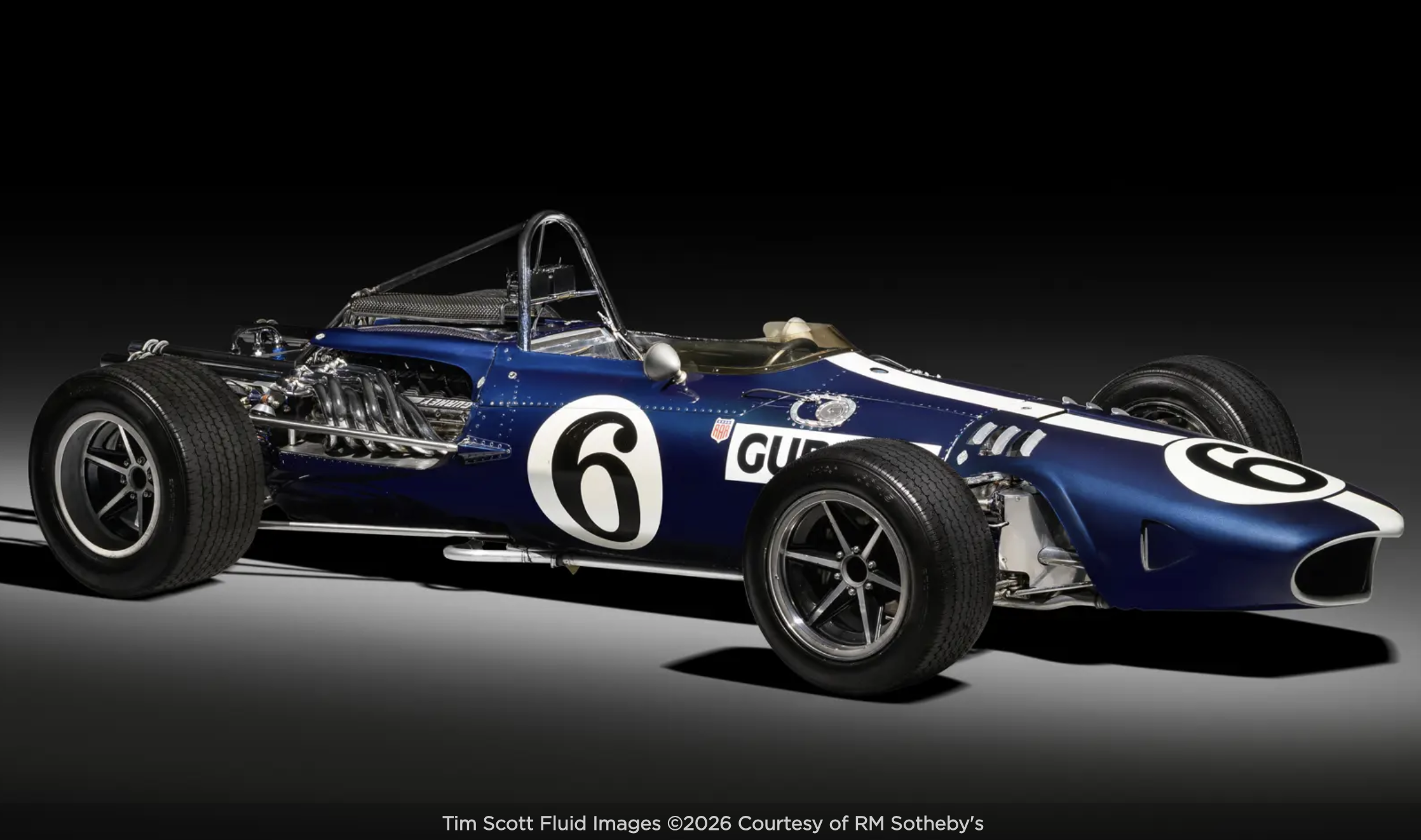
Somewhere in Culver City sits a race car that never won a Grand Prix, yet it’s about to sell for more than most people will earn in several lifetimes. RM Sotheby’s is offering chassis 103 of the AAR Eagle Mk I Gurney-Weslake this September, with a presale estimate of $7 million to $9 million. That’s a staggering number for a car that finished exactly two of the six Grands Prix it started. But this sale isn’t really about wins and losses. It’s about the only time an American constructor built a Formula 1 car good enough to beat the world at its own game, and this is one of just three examples that ever carried the engine that made it possible.
The story starts in 1964, with Carroll Shelby and Dan Gurney talking shop while Goodyear looked for a way to finally crack Firestone’s stranglehold on Indianapolis, a winning streak stretching back to 1920. That conversation turned into All-American Racers, a Goodyear-backed shop in Santa Ana that started out running Lotus and Shrike chassis before Gurney decided he’d rather build his own car. Being Gurney, he didn’t stop at IndyCar. He also wanted a Formula 1 team, so a second shop went up across the Atlantic in Rye, England, close to Weslake and Co., the engine builder tasked with producing a bespoke three-liter V12 for the job.
Len Terry, fresh off designing the Lotus 38 that won the Indianapolis 500 with Jim Clark, penned the Eagle’s monocoque, using 18-gauge aluminum for the Formula 1 cars versus 16-gauge on the IndyCar version to save weight. Weslake’s V12 was a 48-valve, dual-overhead-cam design producing 390 horsepower at 10,500 rpm from just 2,997 cc, roughly 130 horsepower per liter with 1967 metallurgy and fuel. That was genuinely trick engineering for the era, even if it showed up late to the party and occasionally let go without warning.
Chassis 103 was the second Eagle built around that V12, debuting at the non-championship Race of Champions at Brands Hatch in March 1967 with Richie Ginther behind the wheel and taking the marque’s first V12-powered race finish. Ginther’s Monaco Grand Prix weekend that May turned out to be his last as a driver. He failed to qualify, then retired from racing entirely. Gurney took over 103 for the Monaco race itself and lasted four laps before a fuel injection pump belt let go. The car’s best result came at Mosport that August, where Gurney fought through a rain-soaked Canadian Grand Prix to finish third behind the Brabham-Repcos of Jack Brabham and Denny Hulme. A month later at Monza, with Ludovico Scarfiotti driving, its engine gave out after five laps while running comfortably inside the points.
The car that actually won a Grand Prix was chassis 104, the lightweight “Mag-Ti” Eagle that Gurney drove to victory at Spa-Francorchamps in June 1967, still the only Formula 1 win by an American constructor since Jimmy Murphy took a Duesenberg to victory at the 1921 French Grand Prix. It’s a wild stat considering how the rest of the season went. Across 15 championship starts in 1967, AAR finished exactly two races and scored 13 of a possible 99 points, all of them Gurney’s. That gap between engineering ambition and race-day results is exactly why cars like chassis 103 fascinate collectors as much as plenty of actual championship winners. It’s a beautifully engineered near-miss, not a trophy case.
After AAR shuttered its Formula 1 operation in 1968, chassis 103 went to Danny Ongais, the NHRA drag racing champion known as “the Flyin’ Hawaiian,” who reportedly intended to convert it for SCCA Formula A racing and never got around to it. From there the car bounced through a string of California and Florida owners for three decades, including a swap for a Lola T300 in 1974, before crossing back to England in 1998 and returning to serious historic racing at the Goodwood Revival and the Monaco Historic Grand Prix. The current owner has held it since 2002, and a recent inspection by marque specialists Hall & Hall reportedly found it needs proper race preparation before it turns a wheel again. On a numbers-matching 1960s Grand Prix car, that kind of work routinely runs into six figures once you account for period-correct fasteners, magnesium castings, and an engine rebuild by someone who genuinely understands a Weslake V12.
Worth noting for anyone unfamiliar with vintage racing cars: this Eagle is being sold on a bill of sale only, with no title. That’s completely normal for a car never built to be road-registered in the first place, and it doesn’t affect its eligibility for historic racing. The car is reportedly eligible for events like the Monaco Grand Prix Historique and the Rolex Monterey Motorsports Reunion, which for a car like this is arguably more valuable than a DMV title anyway. Historic racing eligibility is a major driver of value in this segment, since it’s the difference between a static museum piece and something an owner can actually campaign at the events collectors care about most.
A $7 to $9 million estimate sounds enormous until you consider what comparably significant race history has fetched recently. Ayrton Senna’s first F1 car found a buyer earlier this year in the same rough neighborhood of money, for a car with far less race-winning history attached to its marque. Provenance-driven sales like these, where the story matters as much as the lap times, have become one of the steadiest growth areas in the collector market. See also Paul Newman’s Daytona-winning Mustang, Ricardo Montalban’s ultra-rare Jaguar, or even Jay Leno’s million-dollar Toronado sleeper, where the appeal is the tale behind the machine as much as the machine itself.
Whether chassis 103 sells at the top of its estimate or not, it’s a reminder that Formula 1 once had room for a scrappy American underdog project bankrolled by a tire company trying to beat its rival at Indianapolis. That kind of crossover between open-wheel disciplines doesn’t happen anymore, and neither does an engine builder in rural England hand-building V12s for a customer racing team based in California. The Eagle Mk I was never going to be remembered as the car that won everything. It’s remembered because, for one afternoon in Belgium and one soaked afternoon in Canada, it proved an American-built Grand Prix car could hang with the best in the world. That’s worth considerably more than a trophy.
About the Author