Most people walking past this car at a concours event would probably mistake it for a vintage Maserati or Alfa Romeo. That’s exactly what makes this Jaguar so fascinating, and why collectors are suddenly paying close attention again.
A Strange Mid-1950s Experiment
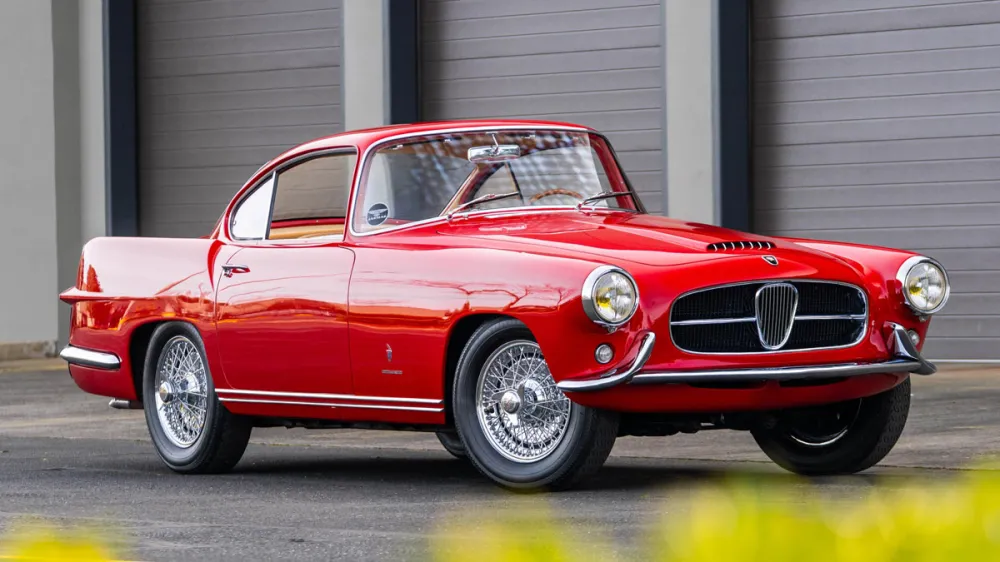
A one-of-four 1956 Jaguar XK140 SE Ghia once owned by actor Ricardo Montalbán is heading back to auction, and the story behind the car is almost stranger than the machine itself. This wasn’t a normal Jaguar built for mass production — it was part of a bizarre mid-1950s experiment where Jaguar handed bare rolling chassis to Italian coachbuilders and let them create something completely different. Back in 1955, Jaguar was riding high with the success of the XK line and its dominance at the 24 Hours of Le Mans. Instead of sticking to predictable production models, the company experimented with offering stripped-down XK140 rolling chassis to European coachbuilders. Only 10 were supplied, and four of those chassis ended up at Carrozzeria Ghia in Turin, where designer Giovanni Savonuzzi reportedly developed a completely unique body for the platform, shaped from aluminum with styling that looked more like a Jet Age concept than a traditional British sports car.
The XK140 already represented an improvement over the earlier XK120, but Ghia’s interpretation turned the car into something far more exotic, with dramatic tail fins, a tall glass-heavy cabin, a stretched hood, and proportions that looked years ahead of most production cars of the era. Even today, it barely looks connected to Jaguar. Even experienced enthusiasts would struggle to trace the styling back to Jaguar without looking closely — there’s Jaguar lettering on the trunk lid, a growler badge on the nose, and Jaguar knock-off wheel spinners, and careful observers can spot traces of the original XK140 grille shape hidden inside Ghia’s redesigned front fascia, but beyond that, the Italian styling completely overwhelms the British roots underneath.
Not Just About Looks
Underneath the dramatic bodywork sat the upgraded XK140 mechanical package Jaguar introduced in 1955: a 3.4-liter inline-six producing 210 horsepower, enough for a top speed around 125 mph and a zero-to-60 time of roughly 8.4 seconds, serious numbers for the period. Ghia’s aluminum body likely made the car even quicker than the standard steel-bodied version. Jaguar had also improved braking and steering on the XK140 compared to the older XK120, with a newer rack-and-pinion setup replacing the earlier recirculating ball steering system, modernizing the car’s road manners at a time when sports cars were rapidly evolving. This wasn’t some static styling exercise meant to sit under lights at an auto show — it was still a legitimate performance car underneath the custom coachbuilt skin.
Hollywood Ownership Made the Car Even More Unusual
This particular 1956 example was reportedly delivered to R.W. Martin of La Jolla, California, through Los Angeles distributor Hornburg. It later found its way to Broadway director and Tony Award winner Gower Champion, who reportedly kept the car for nearly 10 years. Then, in 1967, Ricardo Montalbán acquired the XK140 SE Ghia. Long before many younger enthusiasts knew him from Fantasy Island reruns, Montalbán had already built a strong Hollywood profile and later became closely associated with Chrysler through years of television advertising promoting the Chrysler Cordoba. There are reportedly numerous photographs showing Montalbán with the Jaguar around Los Angeles, and he apparently enjoyed the fact that almost nobody could identify the car correctly.
The Collector Market Keeps Pushing Cars Like This Higher
By the early 1990s, the Jaguar had entered the famous Blackhawk Collection in Danville, California, under collector Don Williams. During that period, the car underwent a major restoration and appeared at the Pebble Beach Concours d’Elegance in both 1992 and 1996. The restoration appears to have held up remarkably well — today, the Jaguar reportedly still presents almost exactly as it did after leaving the Blackhawk restoration shop, with an immaculate engine bay and an interior featuring reupholstered tan leather paired with brown wool carpeting edged in tan leather piping. The car still retains its yellow Marchal headlamps, though the hood intake is believed to have been added sometime during the 1960s.
The Jaguar resurfaced publicly in 2022 during RM Sotheby’s Monterey auction, where it sold for $335,000. Now Mecum is offering the car again as part of a highly visible 41-car collection from the secretive M Group based in Burlington, Washington, at the Indy 2026 sale in Indianapolis on May 16. Mecum isn’t attaching an official estimate since the sale is being conducted without reserve, but expectations reportedly place the car somewhere in the $400,000 to $500,000 range, a significant jump in a relatively short period of time.
Why Enthusiasts Actually Care About Cars Like This
Modern performance cars are faster than ever, more reliable, safer, and packed with technology, but cars like this Jaguar remind enthusiasts of a period when automakers still took creative risks that bordered on irrational. No modern manufacturer is sending bare chassis to Italian coachbuilders today and letting them reinvent an entire car from scratch — corporate oversight, regulations, production economics, and branding departments killed that era decades ago. That’s part of what makes this Jaguar feel important beyond its celebrity ownership: it represents a time when Jaguar was willing to experiment while sitting at the top of the motorsports world, and it reflects an era when coachbuilders could transform an automaker’s identity into something wildly personal and nearly impossible to duplicate. Now one of the rarest examples from that entire period is heading back under the auction lights again. For collectors, the appeal is obvious. For enthusiasts, this Jaguar tells a bigger story about what the automotive industry used to be before everything became safer, more corporate, and far more predictable.
About the Author