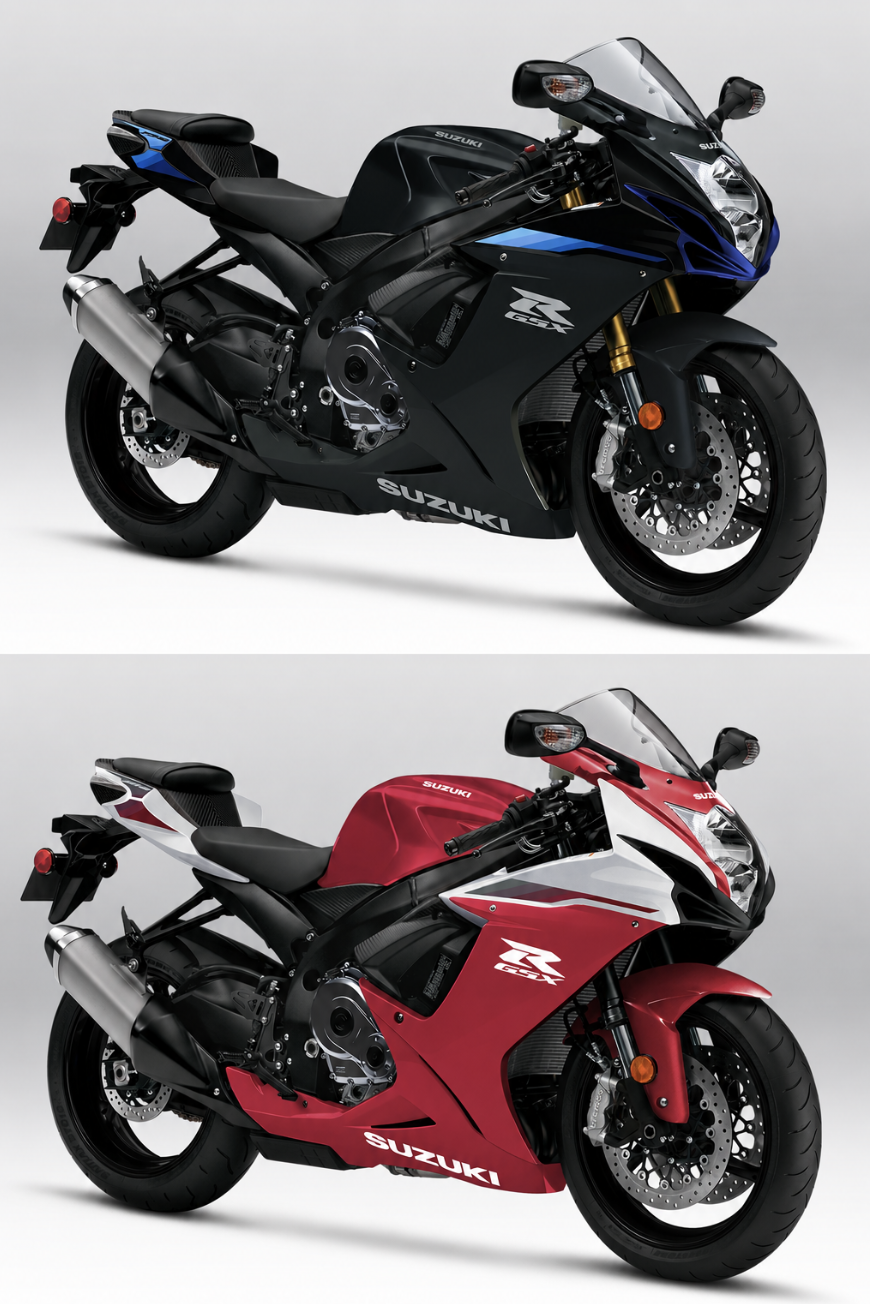
Suzuki has posted its 2027 GSX-R600 and GSX-R750 to the consumer site, and if you want to know what changed, the honest answer is: the paint. Both bikes come in Candy Daring Red or Metallic Matte Black No.2, plus a Pearl Vigor Blue and Pearl Tech White 40th Anniversary trim badged GSX-R600Z and GSX-R750Z.
Everything underneath is the same hardware Suzuki has been shipping for well over a decade, and that’s not a slam. It’s the whole reason these two still exist.
What you actually pay
The GSX-R600 opens at $12,499 plus a $650 destination charge. The GSX-R750 is $13,549 plus $750 destination. Anniversary versions add exactly $200 each: $12,699 for the 600Z and $13,749 for the 750Z, with freight unchanged.
Do the arithmetic and the 600 lands at $13,149 before tax and title, the 750 at $14,299. Note that Suzuki charges $100 more to freight the 750 than the 600 despite the bikes sharing a crate footprint, bodywork, and near-identical dimensions. Freight is a corporate accounting exercise, not a shipping invoice.
For your $200, the anniversary bikes get blue three-spoke wheels with commemorative rim decals, Bridgestone Battlax rubber, a tank-top anniversary logo, and a 3-D Suzuki emblem on the upper triple clamp. That’s a fair deal if you like the livery — dealer-applied graphics kits cost more than that.
Related Articles
- Land Rover’s Putting A Dakar Race Truck, A Rare ’90s Defender, And A Mystery Reveal On The Same Lawn At The Quail
- 2027 Kawasaki ZX-6R Returns Unchanged — And That’s the Story
One wrinkle Suzuki’s marketing department is hoping you don’t notice: the company’s own 750 page credits the 1985 GSX-R750 with launching the modern sportbike. A 40th anniversary of a 1985 model happened in 2025. Selling a 40th Anniversary Edition as a 2027 is a bit like blowing out the candles two birthdays late, though in fairness the same livery now spans the 600, 750, and 1000, so at least the family photo matches.
The ABS question is the whole ballgame
Look at Suzuki’s own specifications and you’ll find front brakes listed as Brembo four-piston twin discs and rears as single-piston Nissin. What you won’t find, anywhere on either sheet, is ABS.
That single omission explains almost everything about these motorcycles’ commercial situation. EU type-approval rules under Regulation 168/2013 require anti-lock brakes on all new motorcycles above 125cc. A non-ABS supersport simply cannot be homologated for European sale. The United States has no equivalent federal mandate, which is why a design that’s legally extinct across the Atlantic remains a catalog item in Brea, California.
There’s a cost to that freedom, and it isn’t abstract. IIHS and its data affiliate HLDI have been petitioning federal regulators on this for over a decade, reporting that fatal crash rates for models with optional ABS run 22 percent lower than identical bikes without it, and collision claim frequency 21 to 24 percent lower. Critically, HLDI controlled for riders’ auto claim histories, which knocks down the usual objection that cautious riders simply self-select into ABS bikes.
Translate that into your renewal notice: many carriers offer an anti-lock discount, and you won’t qualify. Supersport-class bikes already draw the ugliest rates in motorcycling. Get quotes on both a GSX-R600 and, say, a GSX-8R before you sign anything — the premium delta can run larger than the price gap between the bikes.
The flip side is real, though rarely mentioned. No ABS means no hydraulic modulator to bleed, no wheel-speed sensors to damage during a tire change, no tone rings to bend, and no dedicated fault codes to chase. Brake service on these is a caliper rebuild and a bleed. If you’re a track rider who wrenches at home, that’s a genuine ledger entry in the plus column.
Reading the spec sheet like a mechanic
The 600 runs a 599cc four with a 67.0 x 42.5 mm bore and stroke and a 12.9:1 compression ratio. The 750 uses 70.0 x 48.7 mm and 12.5:1. Both are aggressively oversquare, and both static compression figures put you firmly on premium fuel — this is not a bike to feed 87 octane on a hot Georgia afternoon and hope for the best.
Chains are model-specific despite the bikes looking identical: RK525SMOZ8 in 114 links for the 600, RK525ROZ5Y in 116 for the 750. Order by part number, not by eyeball. Plugs are NGK CR9EIA-9 iridium or Denso IU27D, four of them, and iridium pricing has not gotten friendlier.
Lighting is where the age shows most plainly. The headlight is a multi-reflector unit running a 65-watt H9 high beam and 55-watt H7 low beam. In 2026 that reads as antique — until your neighbor with the LED-projector bike gets quoted several hundred dollars for a sealed assembly after a parking-lot tip-over, and you replace a bulb from an auto parts store for the price of lunch. The taillight is LED.
The instrument cluster is analog tach plus LCD, with a built-in lap timer and programmable shift light. Suspension is a Showa Big Piston Fork with a remote-reservoir shock adjustable for rebound, compression, and ride height. The 750 additionally lists an electronically controlled steering damper; the 600’s chassis section doesn’t mention one.
There’s no traction control, no IMU, no cornering ABS, no quickshifter, no ride modes beyond the two-position S-DMS map selector. The throttle bodies use Suzuki’s dual-valve arrangement, where the rider commands the primary butterflies and the ECM manages secondaries to smooth delivery.
Related Articles
- Hand-Built Widebody Ferrari F355 Rolls Into Las Vegas With No Reserve
- Bugatti Destrier: The Bolide-Based One-Off Nobody Has Confirmed Is Road Legal
Curb weights: 412 pounds for the 600, 419 for the 750. Seven pounds buys you 151cc. That ratio has been the 750’s entire sales pitch since Reagan’s second term, and it’s still the most compelling number on either page.
A small oddity worth flagging for anyone building a garage door or a van rack: Suzuki lists the 750’s overall width at 710 mm but the 600’s at 1135 mm. The bikes share bodywork. One of those numbers is measuring mirrors and one isn’t.
Practical notes before you buy
California buyers get a 4.2-gallon tank instead of 4.5 — a concession to evaporative emissions hardware. That’s roughly 12 to 15 fewer miles between fuel stops, which matters on a canyon day more than it sounds.
Warranty is twelve months, unlimited mileage, with Suzuki Extended Protection available at extra cost. Twelve months is short in a market where several rivals offer more, and on a bike with a 12.9:1 compression ratio destined for track days, the extension is worth pricing out rather than dismissing.
Finally, the used-market angle. Because the platform hasn’t meaningfully changed in years, parts interchange across a deep pool of donor bikes and the aftermarket is fully mature. Fairings, rearsets, exhausts, and suspension internals are plentiful and cheap. That’s an unglamorous advantage no new-for-2027 middleweight can offer, and for a rider who plans to crash-test their own body of work at a track day, it may be worth more than an IMU.
Suzuki’s own copy calls the 600 the 2019 MotoAmerica Supersport champion. That’s a fine credential. It’s also seven seasons ago, which tells you exactly where this motorcycle sits: a proven, honest, mechanically simple tool that the rest of the world has legislated out of existence.
Images Via: Suzuki
About the Author