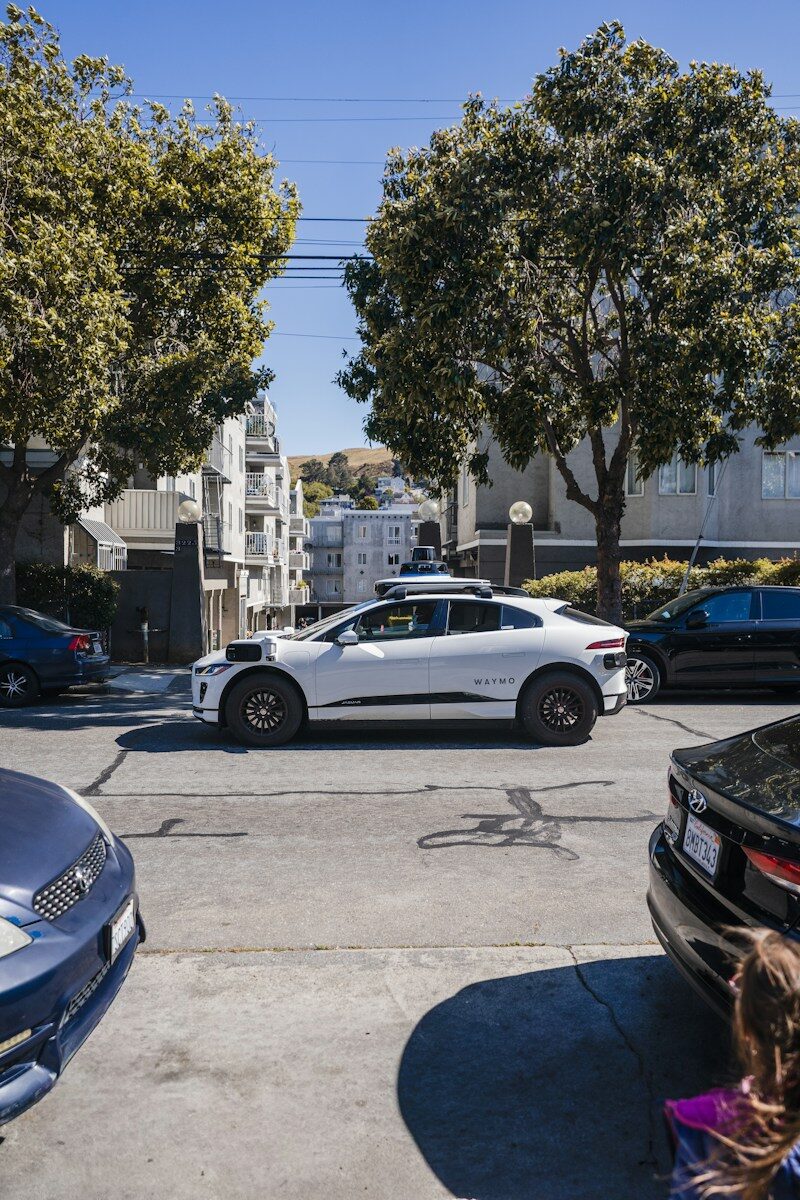
A driverless Waymo carrying two passengers drove onto the trolley crossing at San Diego’s County Center/Little Italy station on Monday night, Nov. 16, and stopped there. A security guard who saw it told CBS 8 the car drove into the intersection and stopped. The crossing gates came down, both passengers got out, and the car then backed up through the gates, breaking its rear window. Police responded, and a short time later a Waymo employee arrived and drove the car away. No one was reported hurt. cbs8yahoo
The Waymo handled the last part of this correctly. Backing through a lowered gate to get off the tracks is what federal safety guidance tells a trapped driver to do. The violation happened earlier, when the car pulled onto the crossing without room to clear it. For a human driver, that mistake leads to a traffic ticket. For a robotaxi in California, it leads to a form with no fine sent to the company. The city whose trolley line was blocked has almost no say over any of it.
The gate was designed to be broken
Crossing gates are designed to give way when a car hits them. A federal truck-safety advisory published with NHTSA and Operation Lifesaver tells drivers: “If the gate comes down after you have started across, drive through the gate even if it means breaking the gate—the gate is designed to break.” Operation Lifesaver’s guidance for all drivers adds that if a vehicle gets stuck, everyone should get out and far away immediately, even if no train is in sight.
Related Articles
- A Park Police Officer Shot a Woman After a PIT Maneuver Ended a Chase in Suitland, Md. She Died, and the FBI Is Investigating
- Somebody Stole a 1987 Brandywine Fire Engine. Now There’s a Felony Theft Charge
Both of those things happened in Little Italy, in the order the guidance gives. The passengers got out, and then the empty car broke the gate to get clear. The broken rear window is the cost of the escape.
The guidance also covers what the Waymo did before the gates came down. The same federal advisory says to never stop on the tracks and never enter a crossing without enough space to clear them completely. California has written that rule into law. Vehicle Code 22526, part of the Anti-Gridlock Act of 1987, bars a driver from entering a railroad or rail transit crossing, even with a green signal, unless there is “sufficient space on the other side of the railroad or rail transit crossing” for the vehicle and the train or trolley. A separate subsection names trolleys specifically.
Nobody has said publicly why the Waymo stopped where it did. MTS hasn’t released its findings, and Waymo has declined to explain. On the facts reported so far, the car entered a light-rail crossing and stopped on it. Put a human behind the wheel and that’s the whole ticket, right there.
A $100 ticket for a human driver, a form for Waymo
A human driver who did the same thing would face a real ticket. Vehicle Code 42001.16 sets the fines for California’s grade-crossing infractions, including violations of 22451 and the railroad provisions of 22526. A first infraction carries a fine of $100, a second within a year up to $200, and a third up to $250. California’s court assessments raise the amount drivers actually pay above those base fines, and depending on the county, a judge can also order traffic school with rail-safety content. A conviction also goes on the driver’s record, which affects insurance rates.
Vehicle Code 22451(b) covers the gate itself: “No driver or pedestrian shall proceed through, around, or under any railroad or rail transit crossing gate while the gate is closed.” Read literally, the statute makes no exception for a driver backing out of a crossing they’re trapped on, while safety guidance tells them to do exactly that. In practice, an officer would be far more interested in how the car ended up trapped.
A driverless Waymo has no driver to ticket. Since July 1, 2026, California police have had a different tool under the Vehicle Code changes passed as AB 1777. The San Francisco Police Department’s bulletin on autonomous vehicles describes it: officers may issue a DMV OL 325 Notice of Autonomous Vehicle Noncompliance to any AV they have witnessed commit a violation of the California Vehicle Code or local traffic code. If the officer believes the car’s driving put people or property at risk, they can mark the notice for priority review. Under the DMV’s regulations, as summarized by the law firm Sidley Austin, a manufacturer that receives such a notice must notify the DMV within 72 hours. The SFPD bulletin does not list a fine. The notice becomes part of the state’s file on the company, and the state uses that file when it decides whether the company keeps its permits. sanfranciscopolicesidley
It hasn’t been reported whether San Diego police issued an OL 325 on Monday night. The system also depends on timing. An officer has to witness the violation to write the notice, and by the time police got to Little Italy, the car had already backed off the tracks.
San Diego can complain, but the state decides
San Diego officials are angry, but under state law they can’t do much. KPBS reported that the California Public Utilities Commission and the DMV have full regulatory authority over autonomous vehicles, so cities cannot approve, deny, or tailor operations. The CPUC granted Waymo permission in August to expand operations in San Diego and other parts of California. Earlier this year, the MTS Board voted to oppose Waymo’s expansion in San Diego without local regulation or oversight. Under that framework, the board’s vote changed nothing. kpbs
MTS spokesperson Mark Olson told KPBS the agency “is in contact with Waymo and the California Public Utilities Commission as part of its investigation and will report the safety incident to the California Department of Motor Vehicles.” MTS can investigate the incident on its own tracks, but the decision about what happens to Waymo belongs to two state agencies in Sacramento and San Francisco. kpbs
City Councilmember Raul Campillo told Fox 5 that “Waymo shouldn’t be testing its technology on our people”. The station reported that city officials will look to recoup losses and that Campillo is frustrated San Diego can’t do more to push back against the company. Councilmember Sean Elo-Rivera, who sits on the MTS board, objected to the CPUC granting authority without considering local details such as where the trolley tracks and train stops are. KPBS reported that he has had “preliminary conversations” with Assemblymembers LaShae Sharp-Collins and Chris Ward about giving cities more control. No bill has been filed. fox5sandiegokpbs
Waymo did not answer KPBS’s questions about Little Italy. Instead, it said in a statement that “Our ride-hailing service continues to operate safely on surface streets, serving over half a million trips each week.” The company also did not respond to CBS 8’s request for comment. kpbsyahoo
A state regulator already pulled Waymo off California freeways
The phrase “surface streets” in Waymo’s statement refers to an action the state has already taken. On Nov. 11, the DMV restricted Waymo from operating or testing driverless vehicles on every freeway in California. The DMV said Waymo’s driverless freeway operations posed an imminent hazard to public safety because its vehicles kept entering active construction zones despite an earlier restriction and corrective actions after similar incidents on May 18, 2026. Waymo then paused commercial freeway rides in every market where it offered them.
Related Articles
- Spanaway Deputies Kept Losing a 20-Year-Old Driver, Then His Crash Split a Car in Half. He Now Faces Preliminary Vehicular Homicide Charges
- A SeaTac I-5 Race at 100+ MPH Left a Lexus Driver Held on $250,000 Bail, and Troopers Still Want a White Infiniti
That order was about freeway construction zones, not trolley crossings. Still, it proves the DMV moves once incidents pile up. It restricted a specific kind of driving after a pattern of incidents. The Little Italy report now goes to the same regulator. Whether one stop on a light-rail crossing becomes part of a pattern depends on how many similar reports reach the DMV from MTS, from police notices, and from the company’s own required filings.
What happens next
MTS’s investigation is open, and the agency has said it will send its findings to the DMV. Councilmembers have said San Diego will try to recover its costs. Any change in local authority would need state legislation, and so far that consists of preliminary conversations.
For San Diego drivers, the rules at the County Center/Little Italy crossing are the same as they were on Sunday. Don’t enter unless you can clear the tracks. If you get trapped, get out or drive through the gate, as federal safety guidance advises. A driver who stops on those tracks faces a fine starting at $100 and a mark on their record, while a robotaxi that does the same faces a notice to its maker if an officer sees it happen.
Trolley riders: had you seen a Waymo hesitate at the Little Italy crossing before Monday?
About the Author