Video still: Garrett Brink, via FOX 10 Phoenix
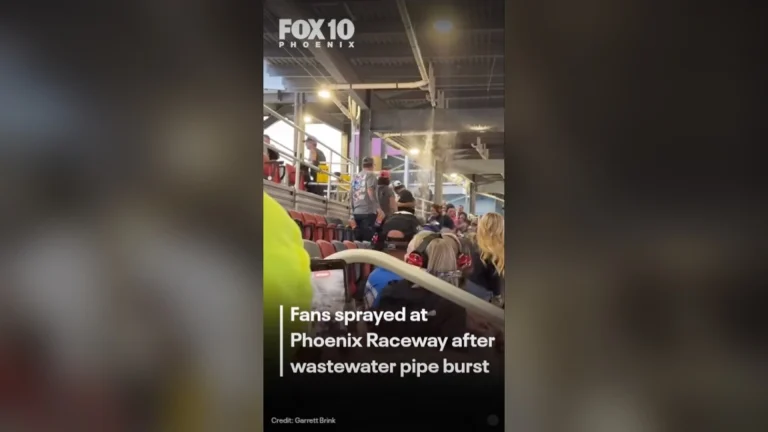
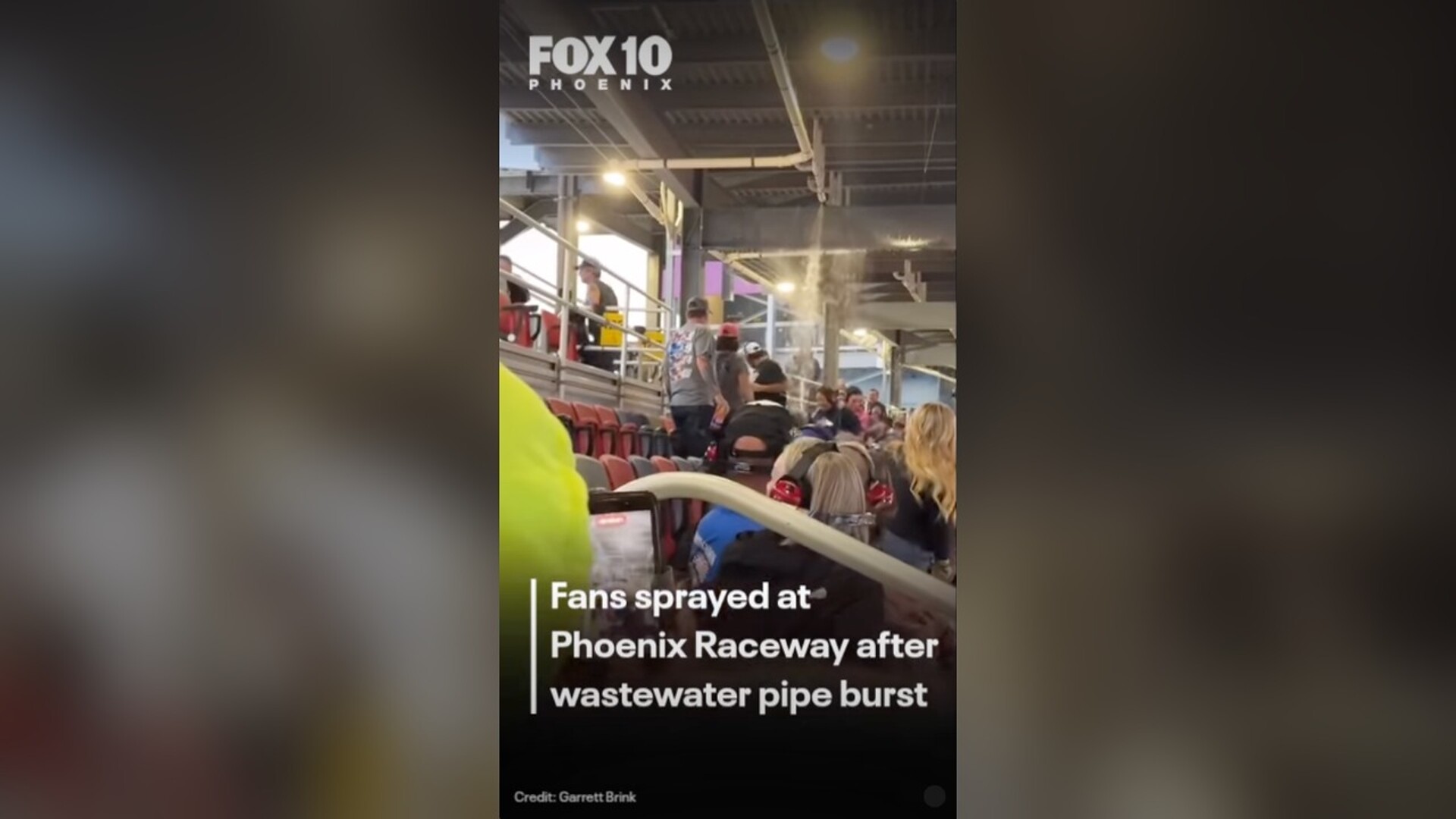
Garrett Brink was in the grandstand at Phoenix Raceway in Avondale, Arizona, on Saturday, Oct. 17, when a wastewater pipe running from one of the track’s suites broke over the seats below him. His video, which FOX 10 Phoenix posted with his credit, shows a plume of liquid falling from a line under the grandstand roof while fans in the rows underneath get up and move. FOX 10 put the time at about 5:50 p.m., on the day the O’Reilly Auto Parts Series ran its Timberland PRO 200.
“It was not water; it was sewer, which is not good,” Brink told 12News. He said toilet paper was hanging from the break and called it “definitely a health hazard.”
View this video from FOX 10 Phoenix (@fox10phoenix) on Instagram
Video: Garrett Brink, posted by FOX 10 Phoenix on Instagram
What the track said
According to 12News, the raceway said the pipe had been repaired, that it was sanitizing the affected areas with the Maricopa County health department, and that the track would be ready for fans at Sunday’s NASCAR Cup Series race. NASCAR officials told azfamily that crews responded right away, that workers followed the Maricopa County Department of Public Health’s protocols, and that no races were affected. 12News reported that workers put a container under the leak to catch what was still coming down.
Neither outlet reported injuries or said how many fans were hit; azfamily described it as a select number. Neither statement said anything about refunds, credits or cleaning costs for the people in those rows. Brink’s own verdict, to 12News: “It’s an unacceptable problem for paying spectators.”
What a NASCAR ticket says about refunds and risk
Phoenix Raceway sells its race tickets through NASCAR’s website, and the ticket terms NASCAR posts there, dated Nov. 4, 2021, put the money question in capital letters: “ALL TICKET SALES ARE FINAL – NO REFUNDS – NO EXCHANGES.” The track’s own FAQ page says cash refunds will not be issued, and its weather program only exchanges regular grandstand tickets for postponed events.
The same terms say the ticket holder “expressly assumes all risk incident to the Event” and releases the track and its affiliates from claims arising from the event, “including claims of negligence.” That language was written for what happens at a race: a tire or debris over the fence, a crash in the stands, noise, heat. A drain line from a luxury suite is building plumbing, the same thing a fan would expect to work at a basketball arena or a movie theater. Our read is that a sewage leak sits a long way from the kind of risk a race fan accepts by buying a seat, and the ticket’s wording does not settle whether it counts.
Arizona’s constitution sends waivers to a jury
Arizona makes that fine print weaker than it would be in most states. Article 18, Section 5 of the Arizona Constitution says the defenses of contributory negligence and assumption of risk “shall, in all cases whatsoever, be a question of fact” for a jury. In many states, a business can get a negligence suit thrown out early by showing a judge the waiver. In Arizona, that shortcut is closed.
The Arizona Supreme Court applied that rule to a racetrack in Phelps v. Firebird Raceway, decided May 18, 2005 (No. CV-04-0114-PR). The plaintiff in that case had signed a release and an assumption-of-risk agreement before taking part in an event at Firebird, and the trial court ruled for the track without a trial. The Supreme Court reversed, holding that “the validity of an express contractual assumption of risk is a question of fact for a jury, not a judge.” That case involved a signed document and a hazard close to the sport itself. A spectator who never signed anything and was hit by a plumbing failure would seem to have at least as good an argument.
Arizona also gives people two years after an injury to file a personal injury suit under A.R.S. 12-542. A jury question is not a payday, though. No one has reported filing a claim, getting splashed is not by itself an injury, and a court would want real damages: medical treatment, an illness, ruined clothes or gear. Anyone in that section with a real loss should talk to an Arizona lawyer about their own situation.
A $178 million renovation and 51 suites above the seats
Phoenix Raceway’s suites were a centerpiece of the track’s 2018 rebuild. When NASCAR laid out the $178 million modernization in March 2018, the plan included 32 renovated suites and 19 new ones. Stack suites over a grandstand and you stack their plumbing over the seats. Brink’s video shows what happens when one line fails. We found no public report of an earlier wastewater leak at the track, so on the record this looks like one failure on one weekend.
If you were in those rows
Phoenix Raceway’s FAQ lists Guest Services at 623-772-2007 while gates are open, and a non-emergency text line: PHXFAN plus the issue and location to 627227. First aid is on level 3 behind Sections 117 and 148 and in the Infield Experience. A fan who was sprayed should keep the ticket or receipt, the photos or video, and receipts for any doctor visit or replaced clothing, and put any request to the track in writing. The no-refund policy covers ticket sales; it does not stop the track from offering a credit or covering a cleaning bill if it decides to.
The next things to watch are whether Phoenix Raceway or NASCAR offers anything to the fans who were under that pipe, and whether the Maricopa County health department releases any report on the cleanup.
What does the track owe the fans who were under that pipe: a refund, a cleaning bill, or nothing, because the ticket says ‘assumes all risk’?
Lead image: Video still: Garrett Brink, via FOX 10 Phoenix
About the Author