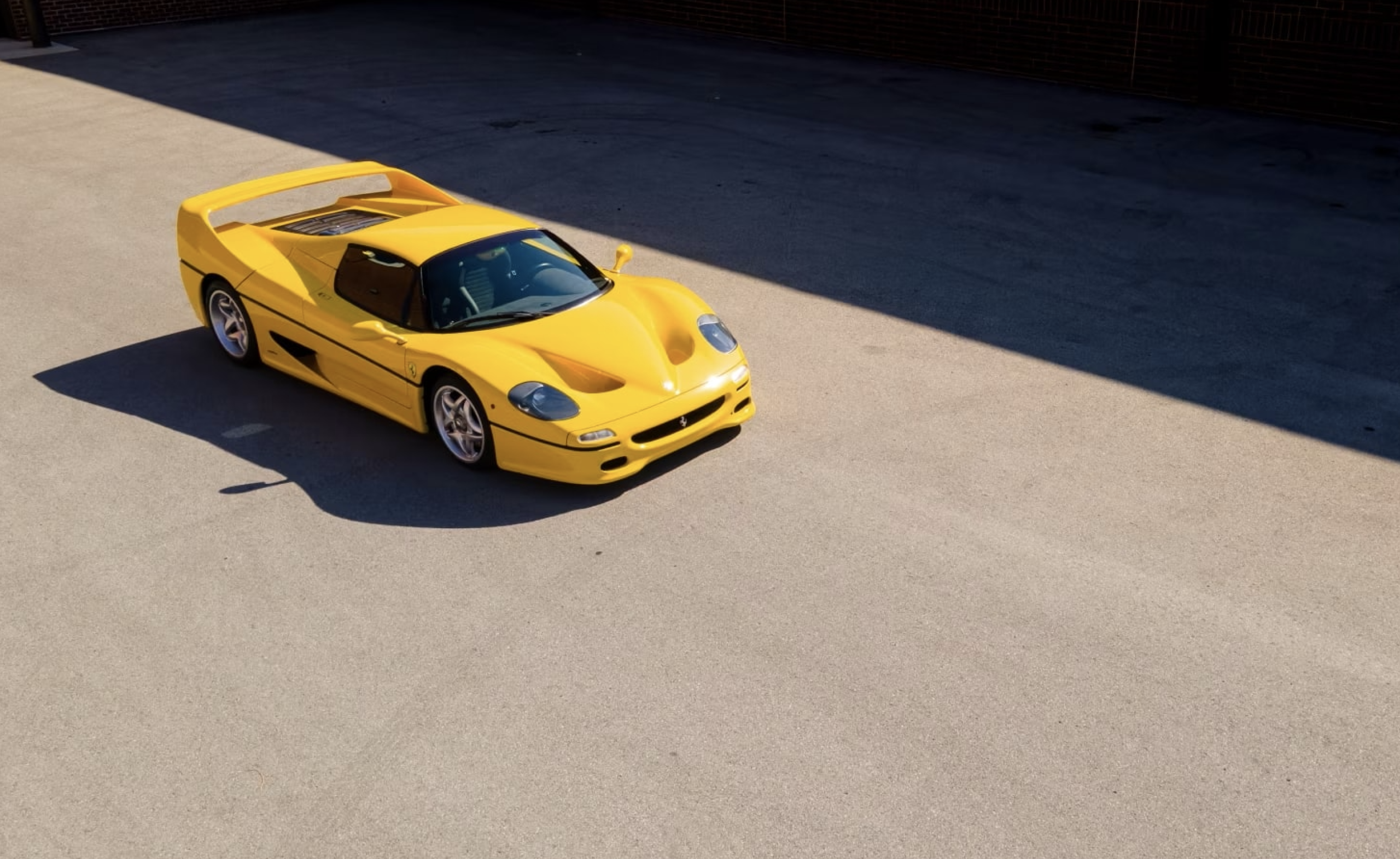
Two Ferrari F50s crossed auction blocks during Monterey Car Week this year, roughly 72 hours and a few miles apart, and the one without a heavyweight boxing champion in its ownership history won by $2.47 million. On August 15, Mecum Auctions sold a 1996 F50 finished in Giallo Modena for $14,575,000, a number that now stands as the most money anyone has publicly paid for a Ferrari F50. Three days earlier, RM Sotheby’s had sold a different F50, one Mike Tyson bought new and sold again before the year was out, for $12,105,000. Same model, same 349-car production run, same era. The gap between them says a lot less about Tyson’s fists than about what actually moves Ferrari values in 2026.
Chassis 106690 is not just any F50. Mecum’s listing places it as the 239th of the 349 examples built between 1995 and 1998, delivered new to Switzerland rather than the United States, and finished in Nero over that exceedingly rare Giallo Modena paint. It has covered 7,253 kilometers, roughly 4,500 miles, since new, and it carries a Ferrari Classiche Red Book confirming its engine, transaxle, and bodywork are all original to the chassis. The car came with the kind of paperwork trail serious collectors chase: original books and manuals, a tool kit, an emergency air compressor, a three-piece Schedoni luggage set, and the flight case Ferrari built so owners could swap between the F50’s targa-top berlinetta configuration and its open-air barchetta mode. Whoever specced this car also held onto its original TOD’S driving boots, size 7.5, made specifically for F50 owners, which is either the most niche collectible in the hobby or proof Ferrari’s merchandising department had a sense of humor in the mid-1990s.
Why Yellow Beat Tyson
The Mike Tyson car, chassis 104220, sold by RM Sotheby’s, had the better story on paper. Tyson bought it new through Beverly Hills Sports Cars in 1996, not long after reclaiming the heavyweight title, and sold it back within the year. It changed hands several more times over the next three decades, earned its own Classiche certification in 2008, and rolled onto the block with 6,196 miles and a pair of autographed Everlast gloves thrown in. That is exactly the kind of celebrity provenance that usually adds a premium at auction. This time it did not matter. The Giallo Modena car outsold it by roughly 20 percent, and the reason is scarcity math that has nothing to do with fame: only 31 of 349 F50s left the factory in that shade, against several hundred finished in the far more common Rosso Corsa. When a manufacturer builds fewer than a dozen cars a year in a given color, collectors start treating the paint code itself as an option worth six or seven figures. There is also a quieter factor at work. This F50 was built for the European market rather than federalized for U.S. sale, sparing it the extra bumper reinforcement and lighting changes Ferrari had to make to satisfy American regulators in the mid-1990s, a detail some purists weigh more heavily than most owners would admit.
An Engine With an F1 Résumé
The F50 earns its price tag mechanically as much as cosmetically. Ferrari built the car around a carbon-fiber tub borrowed straight from Formula 1 construction practice, then bolted in a 4.7-liter V12 whose lineage traces back to the naturally aspirated engine Ferrari raced in Formula 1 in 1992 before further developing it for the 333 SP sports prototype that spent years winning IMSA and FIA sports car titles. Detuned for street use, it made 513 horsepower and 347 lb-ft of torque, enough to push the F50 to 60 mph in 3.6 seconds and on to 202 mph. Pininfarina wrapped that hardware in a body that could run as either a berlinetta or a barchetta depending on whether the owner bolted in the removable targa panel, a party trick the F40 never offered. Ferrari built the F50 as its answer to a decade of customers asking for something closer to a Formula 1 car with license plates, and three decades later, that F1-engine connection is still the biggest reason engineers and collectors treat it differently than contemporaries like the Diablo or the 911 GT2.
What the F50 Market Is Actually Telling Us
Track the F50’s public auction results and the trend line is almost absurd. Cars that fetched $1.4 million to $2.4 million at Gooding & Company sales in 2013 were bringing $4.6 million by the early 2020s. RM Sotheby’s sold one for $8,805,000 in Arizona this past January, then watched that number get broken twice more within eight months, once in France and now, decisively, in Monterey. That kind of appreciation curve rewards buyers who do their homework and punishes the ones who do not. Classiche certification, matching-numbers originality, and a documented ownership history are doing more work than horsepower figures at this point, because every F50 already makes the same power. What separates a $5 million example from a $14 million one is paperwork, paint, and how many previous owners resisted the urge to swap in aftermarket wheels. Anyone circling this segment should also budget well beyond the purchase price. Agreed-value collector insurance is mandatory at this level since no standard policy will touch a car worth eight figures, and service work on a 30-year-old, motorsport-derived V12 is not priced like a trip to the local dealer’s oil-change bay.
Monterey Car Week 2026 produced plenty of eye-catching hammer prices, but the F50 story is the cleanest data point to come out of it. Three decades on, Ferrari’s most overlooked halo car has quietly become one of its most expensive, and the market just proved it cares more about a rare paint code than a boxing champion’s autograph.
About the Author