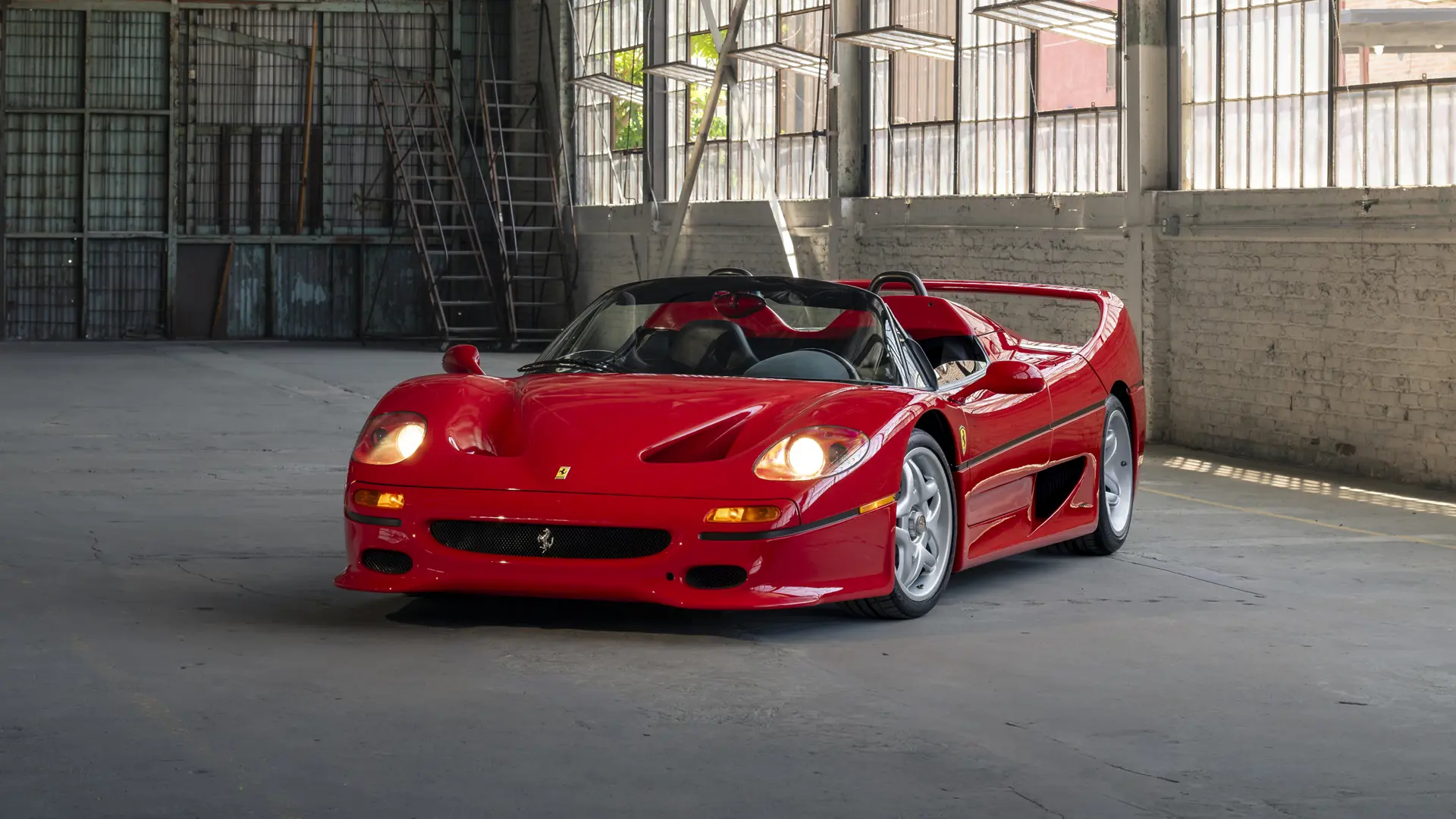
In February 1996, a brand-new Ferrari F50 rolled off a truck at Beverly Hills Sports Cars, got flipped almost immediately through a Fountain Valley broker, and landed in the garage of newly reunited heavyweight champion “Iron” Mike Tyson. By the end of that same year, the car was already back with the dealer. Tyson’s ownership of chassis 104220 lasted less than twelve months, a blip compared to the three decades of stewardship that followed under a rotating cast of collectors scattered from Seattle to Atlanta to New Jersey. Yet it’s Tyson’s name doing the heavy lifting on the auction listing, because RM Sotheby’s is putting this car across the block at its Monterey sale this August with an estimate of $7 million to $9 million, offered without reserve.
That’s the headline. The more interesting story is what Ferrari actually built here, and why it still matters three decades later.
Ferrari’s own literature on the F50 describes it bluntly as a car built with no power steering, no brake servo, and no ABS. Sit with that for a second: a mid-1990s road car making 513 horsepower with zero brake assist and zero steering assist, arriving at the exact moment Ferrari was adding exactly those conveniences to its lesser models. Every ounce of feedback through the wheel and pedals is real and unfiltered, occasionally to the point of exhausting the driver, which was precisely the intent. Ferrari wanted a road car that drove like a Formula 1 car with license plates, not a comfortable grand tourer with an oversized engine.
Compare that philosophy to how today’s boxing-adjacent celebrities shop for Ferraris. Jake Paul’s recent one-off widebody Ferrari Purosangue leans on every driver aid Maranello can bolt to a chassis. The F50 predates that entire approach by a generation, and every panel of it shows.
The V12 behind the two seats isn’t a clean-sheet design. It’s the F130B, a 4.7-liter evolution of the engine Ferrari raced in its 1992 Formula 1 car, later stretched and further developed through the 333 SP sports prototype that won championships in IMSA GT and FIA competition through the back half of the 1990s. It’s mounted as a fully stressed structural member of the chassis, the same way an actual Grand Prix car is built, with no rubber engine mounts and no isolation, just aluminum and carbon fiber holding a race-bred V12 directly to the tub. That appetite for repurposed F1 hardware isn’t unique to this car; a similarly wild turbocharged Ferrari F1 engine from an earlier era surfaced for sale earlier this year, at a fraction of the F50’s price.
The tub itself is a carbon-fiber monocoque, a direct transplant of F1 construction technique into a road car, wrapped in Pininfarina bodywork built from carbon fiber, Kevlar, and Nomex honeycomb. Power reaches the pavement through a 6-speed manual gearbox with a dual-plate clutch, no automated shifting, no paddles, nothing electronic between the driver and the gearset. That’s worth dwelling on given Ferrari’s current trajectory. A rumored V12 manual project tied to Lewis Hamilton reportedly never made it past internal discussion this year, a reminder of just how rare a Ferrari manual gearbox has become at any price, let alone one wearing this kind of provenance.
Ferrari built 349 F50s total between 1995 and 1998, with only 55 specified for the US market, chassis 104220 among them. The scarcity wasn’t an accident. Ferrari had taken criticism for building 1,315 examples of the F40 and diluting the exclusivity that made it desirable, and the F50’s production run was capped deliberately in response. Today the model sits alongside the 288 GTO, F40, Enzo, LaFerrari, and F80 in what Ferrari refers to internally as its “Big Six” hypercar lineage, six cars built roughly a decade apart, each one a snapshot of Maranello’s best available race technology at the time it was built.
Following Tyson’s brief stint, the F50 passed through a Simi Valley collector, a Seattle tech executive who showed it at the 2004 Kirkland Concours d’Elegance, an Atlanta owner who had it serviced by Ferrari specialist Francorchamps of America, an Ohio collector who installed a new fuel tank, and eventually a New Jersey owner and a second private buyer before landing with an RM Sotheby’s client who passed away a few years after acquiring it. His estate is now the seller. Every stop along that chain is documented in a history report compiled by marque authenticator Marcel Massini, and the car carries a Ferrari Classiche Red Book, factory certification issued in January 2008 confirming the chassis, engine, transaxle, and bodywork are all original and matching. For anyone shopping at this end of the market, that paperwork trail matters more than any celebrity connection. A Classiche-certified, Massini-documented car removes most of the guesswork that otherwise makes six and seven-figure Ferrari purchases so risky, and it’s a major reason estimates hold up decades after a car’s most famous owner has moved on.
Selling without reserve means the estate has guaranteed the car finds a new owner regardless of where bidding lands against that $7 million to $9 million estimate, a common move on estate consignments where certainty of sale often matters more than chasing the very top of a range. It crosses the block during RM Sotheby’s 29th running of its Monterey sale, the auction that traditionally sets the tone for the entire collector car market each August. This year’s Car Week has already produced its share of headlines, from Hennessey’s manual-only Venom F5 LF to RM Sotheby’s own slate of provenance-driven lots, including Ayrton Senna’s first Formula 1 car, all crossing the block within the same few days at the Monterey Conference Center.
Whatever the autographed boxing gloves included in the sale fetch as a footnote, they aren’t why this car will clear seven figures. A thirty-year-old Ferrari with no ABS, no power steering, and a manual gearbox bolted to a Grand Prix-derived V12 is a genuinely demanding, occasionally intimidating thing to drive quickly, and that’s exactly why collectors keep paying more for it every year. Anyone bidding at this level should budget well beyond the hammer price, too: agreed-value collector insurance, climate-controlled storage, and Ferrari Classiche-authorized service aren’t optional at this valuation, and parts support for an F1-derived engine is its own specialty market entirely. The F50 was never built to be easy to live with. Judging by where its values keep heading, that’s precisely the point.
About the Author