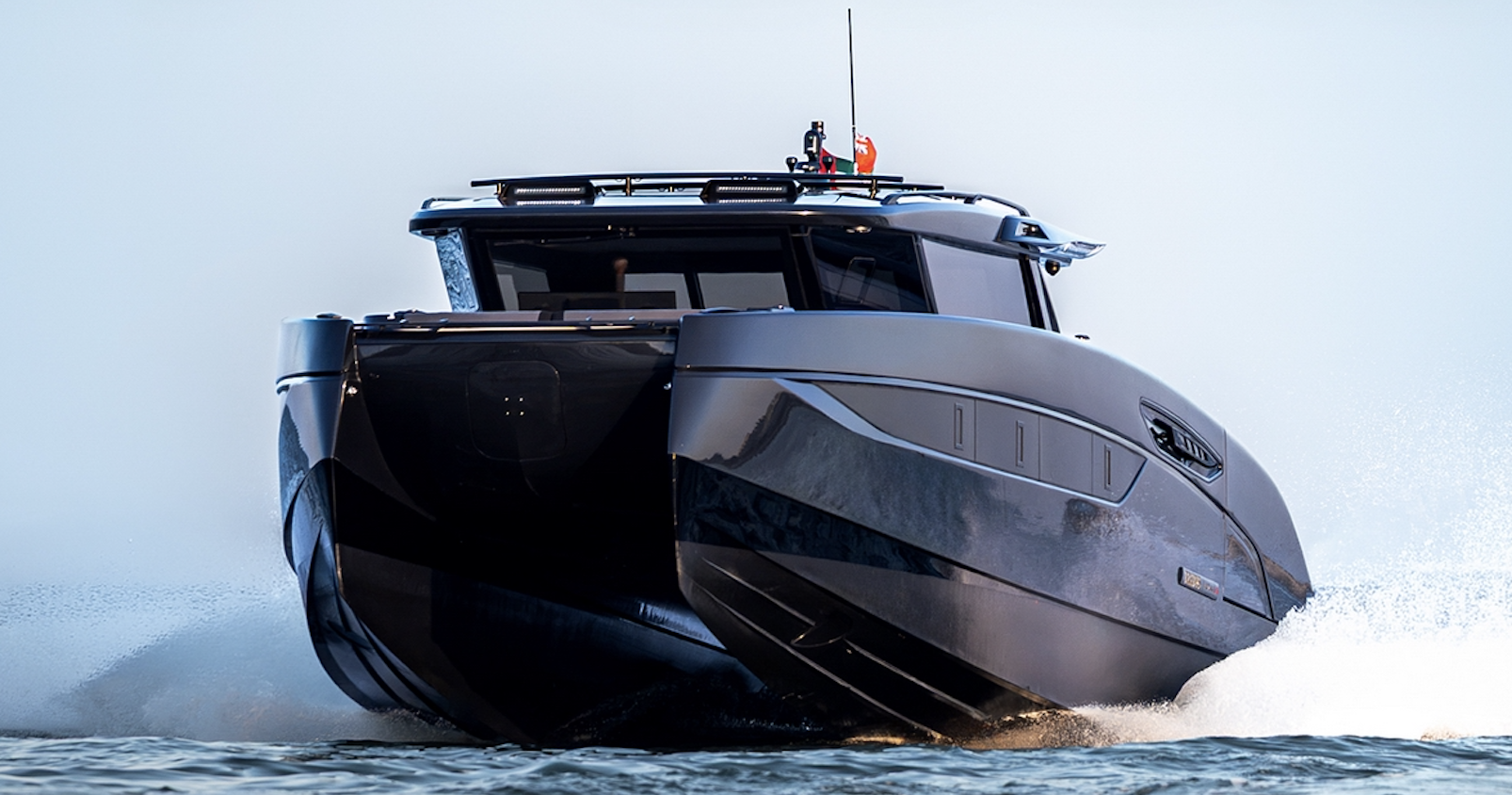
BRABUS has spent almost five decades bolting big horsepower and wide carbon-fiber body kits onto Mercedes-Benz models, turning already quick cars into something closer to rolling dares. Weeks after showing off its 900-hp Bodo 77 coupe in Monaco, the Bottrop, Germany-based tuning house revealed it’s aiming that same design obsession somewhere with a lot more water and a lot fewer traffic laws. Working with luxury multihull builder Sunreef Yachts, BRABUS just unveiled the ULTIMA 55, a 55-foot performance catamaran that uses hydrofoils to lift itself above the surface at speeds exceeding 40 knots.
This is the first product from a new collaboration between the two companies, and it reads less like a rebadged sailboat with a body kit bolted on and more like BRABUS decided its design language needed a bigger, wetter canvas.
The Hardware: 725 Horsepower Per Side, and a Foil System Doing the Real Work
The ULTIMA 55 is powered by twin six-cylinder engines producing 533 kW, or 725 hp, each, enough combined output to push the 17-meter catamaran past 40 knots, or roughly 46 mph. That’s a genuinely quick pace for a boat carrying up to six guests, a crew member, and full fuel and water tanks. But horsepower isn’t really the headline feature here. The hydrofoil system is.
Catamarans already hold a stability edge over monohulls because their two hulls spread weight across a wider footprint, but that width comes with a drag penalty since more hull surface pushes through the water. BRABUS and Sunreef address that with a foil system that generates lift as speed builds, physically raising the hulls off the surface. Less wetted hull means less drag, the same physics that lets America’s Cup sailboats and foiling dinghies post speeds that seem to defy their sail area. The payoff the companies describe is virtually zero heel, the leaning sensation that usually comes with a multihull pushing hard through a turn, along with a smoother ride through chop.
None of that comes free from a maintenance standpoint. Foil struts, hydraulic actuators, and the control systems that manage them in real time add mechanical complexity beyond what a standard catamaran owner deals with, and it’s worth factoring into any conversation about service intervals, haul-out procedures, or insurance underwriting before signing on the dotted line. High-performance foiling craft don’t get treated like an ordinary 55-foot catamaran on a hull policy, and owners should expect that reflected in premiums.
Carbon Fiber Everywhere, Because Of Course
Visually, there’s no mistaking the ULTIMA 55 for a standard Sunreef product. The exterior uses exposed carbon-fiber front and rear wings, pillars with illuminated BRABUS logos, a custom roof rack, and carbon-fiber LED roof lighting, finished in either Graphite Black or optional Phantom Gray. It’s the same visual vocabulary BRABUS applies to cars like the Rocket GTC or the BRABUS 1000, just stretched across a hull instead of a fender.
Practicality got attention too. Lateral folding platforms extend the beam from 18.4 feet to 24.9 feet at the stern, turning the aft deck into a substantially larger lounging area once at anchor, complete with transformer sunpads, an extendable carbon-fiber table, an electric grill, and wet bar modules. That’s a meaningful detail, since deck space is usually the first thing sacrificed for speed on a performance-oriented multihull. The deck itself uses Esthec decking instead of traditional teak, a synthetic material that trades some old-world yacht charm for better UV resistance, lower maintenance, and more secure footing when wet.
An Interior That Escaped From a BRABUS Showroom
Step inside and the automotive fingerprints get harder to miss. The saloon uses BRABUS’s Moonstone Masterpiece leather finished with the brand’s signature Triangle stitching pattern, the same detailing found in its road-going interiors, along with an Alcantara headliner and exposed carbon-fiber trim around the helm station. A widescreen navigation and control display centralizes vessel systems, a 43-inch television rises electrically out of the countertop and disappears when not in use, and Bowers & Wilkins supplies the marine-spec sound system.
The galley includes an induction cooktop, electric oven, refrigeration, and ice makers, and buyers choose between two layouts: a four-guest configuration with one master suite, one VIP stateroom, and a crew cabin, or a six-guest version with three guest cabins plus crew quarters. Either way, a crew cabin is included standard, which matters for anyone assuming they’d be running a boat with 1,450 combined horsepower themselves without paid help.
What It Signals
Neither company has published pricing, which is typical for a first-of-its-kind flagship like this. Expect that conversation to happen directly between BRABUS, Sunreef, and prospective buyers rather than in a press release. The more interesting detail is how BRABUS is framing the launch: the company describes the ULTIMA 55 as expanding into a completely new category of its marine business, not starting one from scratch, which suggests boats have quietly become a bigger part of BRABUS’s portfolio than most car enthusiasts probably realize.
For Sunreef, partnering with a tuning house built on excess is a direct play for the buyer who already owns something absurd on four wheels and wants their boat to match, down to the stitching pattern. It’s the same overlap in customer base you see when a Koenigsegg gets craned onto a $75 million superyacht for a Monaco weekend, or when a 50-foot turbine catamaran can hit 157 mph at a charity poker run. The car and boat worlds increasingly share the same buyer, the same garage, and the same social media feed.
Whether the ULTIMA 55 delivers that 40-knot foiling performance in real-world conditions, fully loaded with guests, fuel, and water, is something only independent sea trials will confirm. For now, this is a debut, not a test.
About the Author