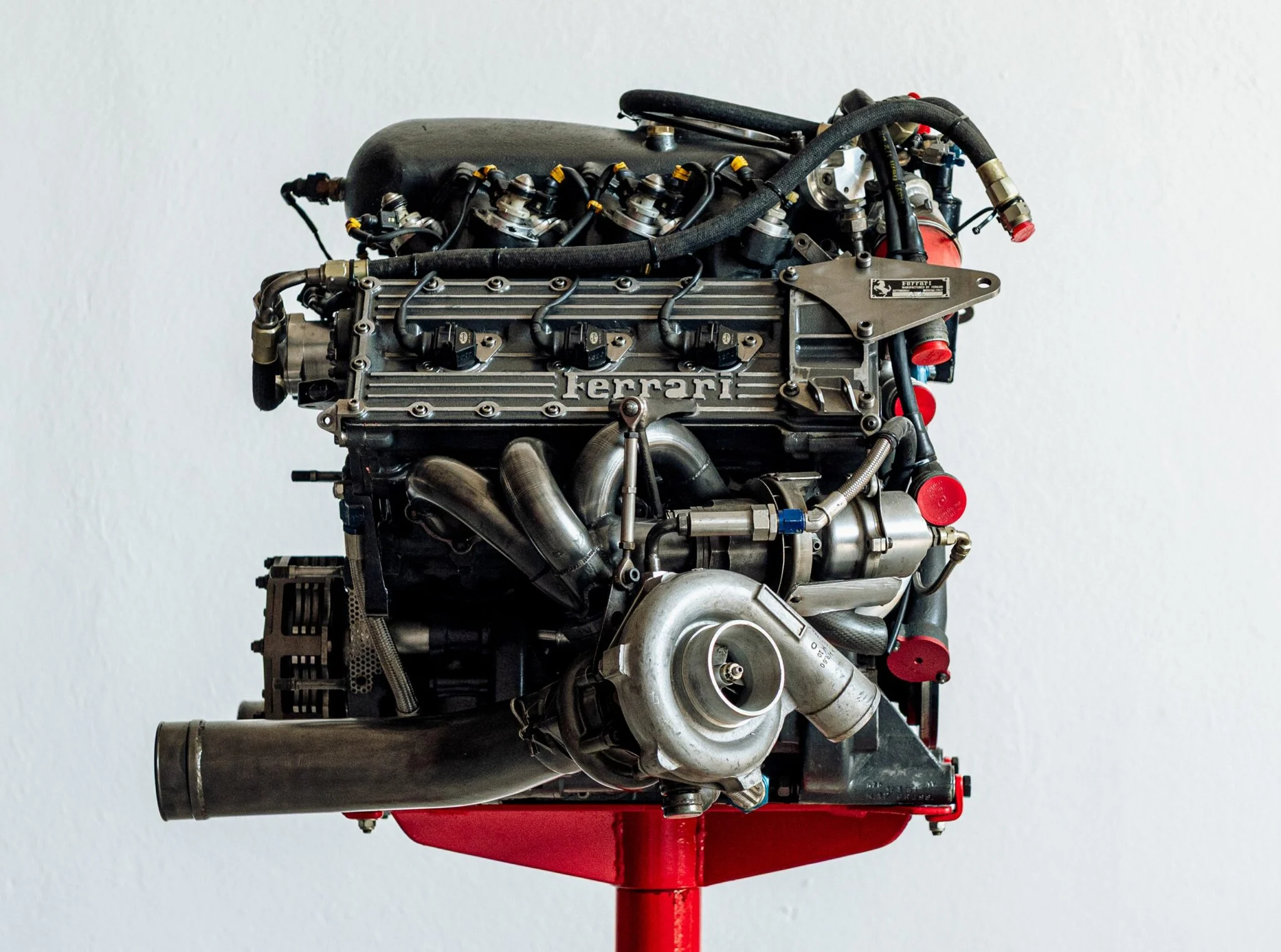
There’s something a little surreal about seeing a Formula 1 engine from the most chaotic era of the sport sitting on a display stand, waiting for a buyer, not locked away in a museum or sitting in a Maranello vault, just quietly for sale. And not for millions, either. That’s what makes this listing worth a second look. What’s on offer is a genuine 1987 Ferrari Tipo 033 engine, the twin-turbo V6 that powered the F1/87 during one of the most intense stretches in Formula 1 history. In qualifying trim, it could push close to 950 horsepower, from just 1.5 liters of displacement.
Ferrari’s Tipo 033 was a complete rethink of the company’s previous engine design, born out of a major internal shakeup in 1986. Ferrari brought in John Barnard from McLaren as Technical Director, and alongside him came Jean-Jacques His, who arrived from Renault’s turbo program to take charge of the engine side. Rather than sticking with Ferrari’s long-used 120-degree V6 layout, His pushed the design in a different direction entirely, adopting a tighter 90-degree V6 configuration that made packaging easier within the newer, slimmer chassis designs of the period. It wasn’t just a power play. Aerodynamics were evolving quickly, and Ferrari needed an engine that could work with the car, not force the car to work around it.
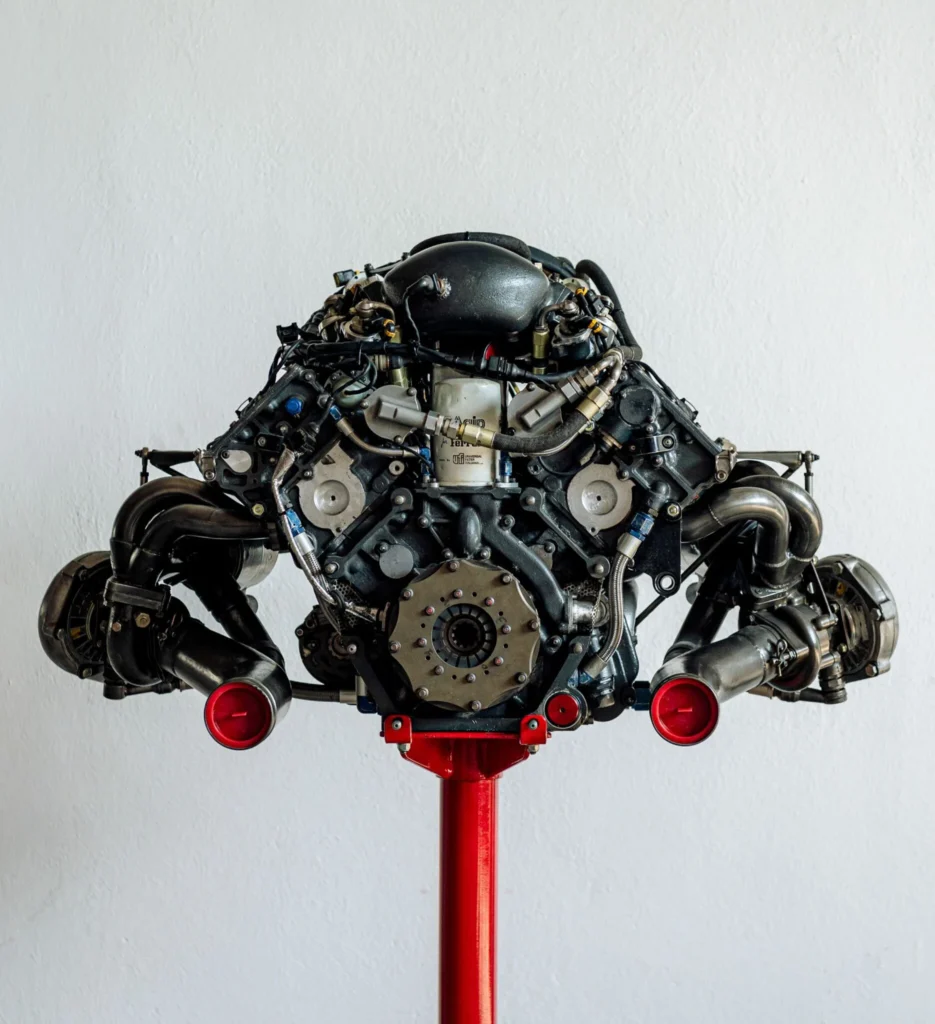
Underneath the bodywork, the setup was brutally purposeful: a cast iron block, alloy heads, four valves per cylinder, twin overhead cams driven by gears, twin injectors per cylinder feeding Weber-Marelli electronic injection, and twin Garrett turbochargers forcing air into the system under serious pressure. Compression stayed low, around 8:1, to handle that boost. The result was an engine producing roughly 880 horsepower in race trim at 11,500 rpm, climbing to approximately 950 horsepower in qualifying spec with everything turned up, a staggering figure even by today’s standards given the tiny displacement.
The engine’s potential didn’t always translate cleanly to results. The F1/87 chassis it powered had its own struggles, with Michele Alboreto and Gerhard Berger spending much of the 1987 season fighting understeer and balance issues while Ferrari pushed a steady stream of updates trying to get the chassis to match the engine’s capability. Things eventually clicked in the second half of the season, and Berger’s strong qualifying pace turned into real results, including pole position at Estoril and back-to-back wins in Japan and Australia to close out the year. The win in Japan carried extra weight, snapping a Ferrari winless streak that stretched back to 1985.
This engine is tied directly to a genuine turning point for the team. At Monza that same season, just weeks after Enzo Ferrari’s death, the team delivered an emotional 1-2 finish, the only race McLaren failed to win all year. Then 1988 arrived and the rules tightened sharply: regulations cut allowable boost levels and reduced fuel capacity, forcing every turbo team to rethink its approach. Ferrari didn’t start from scratch, instead updating the Tipo 033 with higher compression to compensate for the reduced boost, but power dropped significantly to somewhere between 620 and 720 horsepower. The cars stayed fast in a straight line, with Berger clocking 328 km/h at Hockenheim, but fuel consumption became a real problem and throttle response couldn’t match the Honda engines that dominated the field that season. Ferrari had speed but not the efficiency needed to keep pace, and McLaren went on to have one of the most dominant seasons in F1 history. After 1988, turbocharged engines were banned from Formula 1 entirely starting in 1989, and machines like the Tipo 033 were pushed into history almost overnight.
Which brings things back to the present. The engine currently up for sale is one of the original units from the 1987 season, and visually it looks complete: the intake system is intact, ignition components remain in place, the exhaust manifolds and turbochargers are still bolted on, and even the clutch remains attached. It isn’t a stripped-down shell, it’s a full piece of hardware preserved essentially as it last raced. Internally, though, it’s an open question. There’s no documented information on internal condition and no claim that it runs, and it’s being sold strictly as a display piece, which seems like the appropriate expectation for a four-decade-old F1 engine with an unknown service history.
Even with that caveat, the price is what really grabs attention. The auction guide sits between $23,500 and $47,000. For an engine that once produced nearly 1,000 horsepower in top-level Formula 1 competition, that range feels almost absurdly low. Nobody buying this is getting a running engine. They’re buying a documented piece of motorsport history, a snapshot from an era when engineering pushed boundaries with little regard for comfort, cost, or longevity. This isn’t about practicality or even performance anymore. It’s about owning a physical piece of one of the most extreme eras in racing, when 1.5-liter engines produced absurd power, drivers wrestled genuinely unpredictable machines, and teams spent every season balancing outright speed against basic survival. Now one of those engines sits on a stand, waiting for someone willing to take that history home.
Source
About the Author