Newfound Gap is the high point where U.S. 441 crosses from Tennessee into North Carolina inside Great Smoky Mountains National Park, and on Saturday evening, August 15, it showed exactly why that stretch of road demands respect. A vehicle traveling near the top of the pass left the roadway, went over the embankment, and dropped roughly 200 feet through the tree line before it finally stopped, caught by a tree that kept it from falling any farther.
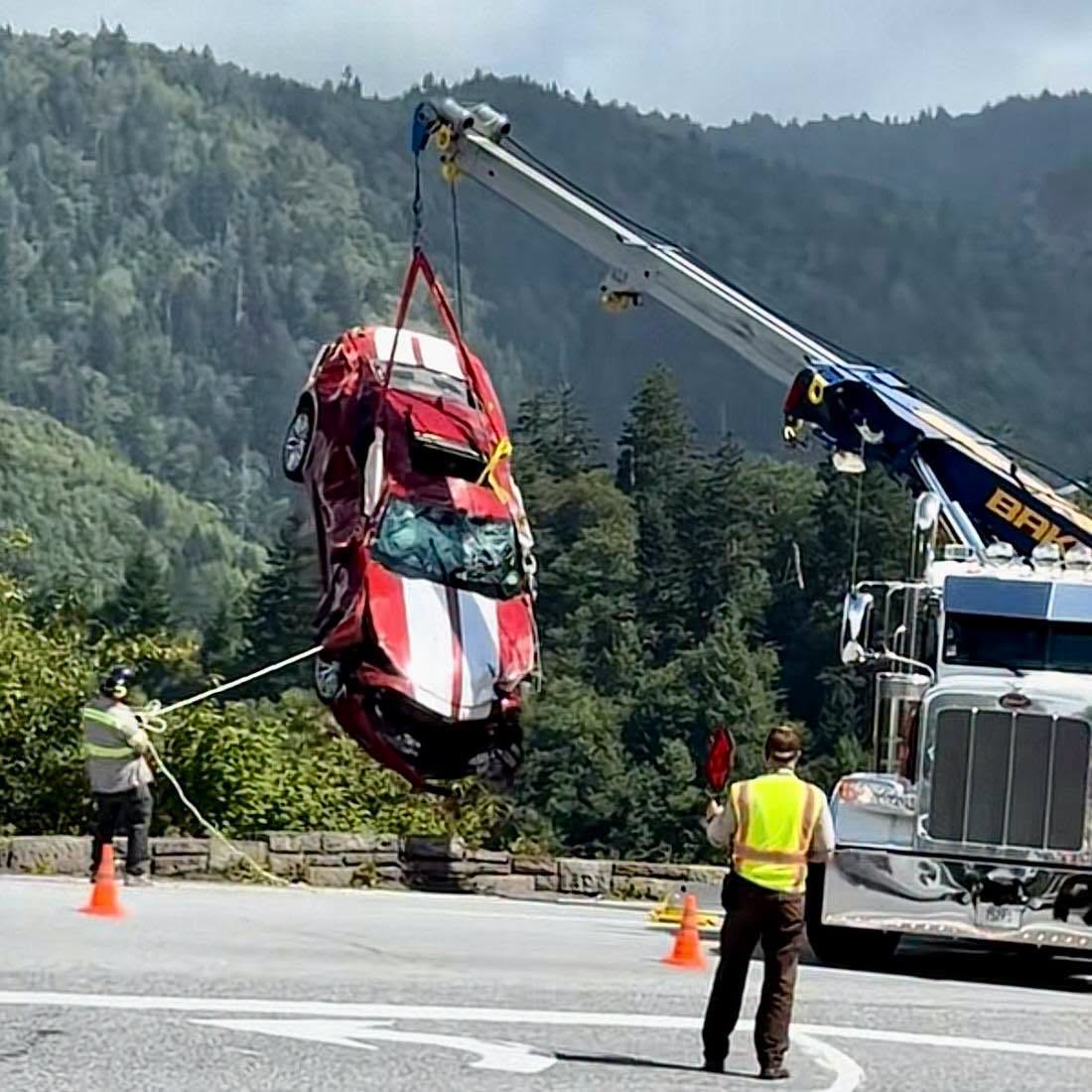
Photos taken at the scene the next morning show a car folded almost in half, its roof and hood crushed flat and the windshield caved in around the frame. At least one occupant was extracted from the wreck and taken to a hospital, and word passed around by people who witnessed the recovery was that the driver survived. Great Smoky Mountains National Park had not issued a public statement on the crash as of this writing. That’s not unusual: a single-vehicle wreck without a fatality typically doesn’t generate its own press release, even one this dramatic.
Getting the car back up to the road took longer than the crash itself. The National Park Service called in Baker’s Wrecker Service, a heavy-duty towing outfit based in Sevierville, Tennessee, and the crew went to work Sunday morning pulling the vehicle out of the trees below the shoulder.
Why This Recovery Needed a Rotator, Not a Hook
This wasn’t a job for a flatbed. Baker’s used its heavy rotating wrecker, a Century 1150 rotator body mounted on a Peterbilt 389 chassis, which is purpose-built for exactly this kind of recovery. A conventional tow truck only winches in a straight line back toward the truck itself. A rotator’s boom turns independently of the chassis and can lift a load straight up while repositioning it in nearly any direction, which is the only practical way to pull a crushed vehicle up a wooded slope without a clear path to drag it. Crews typically rig multiple anchor points, free the vehicle in stages to avoid a sudden shock load on the cable, and use the rotator’s winches, rated well into the tens of thousands of pounds, to walk the load up the embankment a few feet at a time. It’s a far cry from the recovery fails that usually make the rounds online; we keep a running roundup of vehicles that ended up worse off after a bad tow, but the underlying hardware is the same idea: leverage and patience beat brute force every time.
The Terrain That Makes This Stretch Unforgiving
Newfound Gap Road is the only route that cuts all the way through Great Smoky Mountains National Park, linking Gatlinburg, Tennessee to Cherokee, North Carolina with a long climb followed by an equally long descent on the other side, much of it without guardrails along the outside edge. The park describes itself as the most visited national park in the country, and a huge share of that traffic funnels through on this one road, plenty of it unfamiliar with mountain driving. Long downhill grades like the one leaving Newfound Gap create a real risk of brake fade: ride the brakes continuously instead of downshifting to control speed, and the pads and rotors can overheat to the point where the pedal goes soft and stopping power drops off fast. Nobody outside the investigation can say whether that played a role here, but it’s a well-documented hazard on exactly this kind of terrain.
The Bill and the Paperwork Don’t End When the Tow Truck Leaves
Because Newfound Gap Road runs entirely through federal park land, a crash here falls under the jurisdiction of National Park Service law enforcement rangers rather than Tennessee or North Carolina state troopers, a detail that catches a lot of people off guard. Whatever caused this crash will likely live in a park report rather than a state highway patrol file, and reports like that tend to be where the real detail eventually surfaces, the same way a Missouri crash report recently filled in the full picture of what happened when a Ford Bronco crossed into a semi’s lane. Serious single-vehicle wrecks don’t always end quietly with a shop repair bill, either. We’ve covered a rollover crash that ended with a court-ordered driving ban instead of jail time after the driver survived a lower-speed version of this same basic mistake. On top of any legal exposure, technical recoveries like this one aren’t cheap. Pulling a vehicle out of a wooded embankment with a heavy rotator, rather than chaining it to a flatbed in a parking lot, gets billed at specialty rates that can run into the thousands of dollars, a cost that lands on the vehicle’s owner or their insurer well after the scene has been cleared, and one that standard liability coverage alone won’t touch.
The tree that caught this car wasn’t guardrail, and it wasn’t designed to stop anything. It just happened to be there, and it probably kept a bad afternoon from becoming a fatal one. Great Smoky Mountains National Park keeps pulling in visitors chasing the exact view that makes this road dangerous, and the fix isn’t complicated: downshift before the descent, cover the brake early, and drive every blind curve like there’s something coming the other way, because on Newfound Gap, there usually is.
Image via embedded Facebook post
About the Author