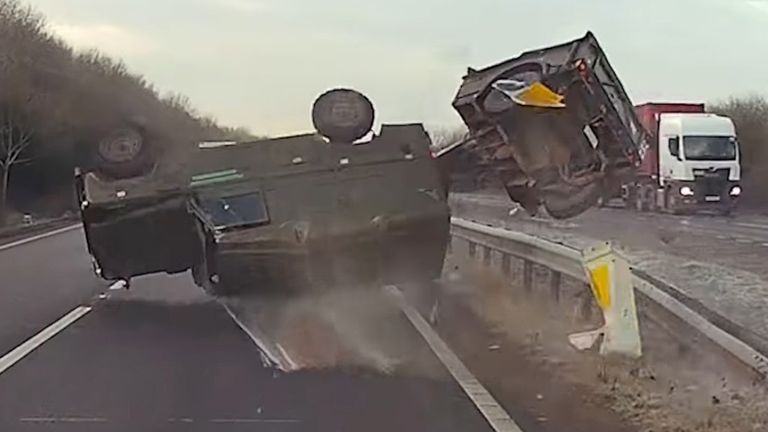
It takes seconds to ruin everything on a highway. That’s the uncomfortable truth behind a crash that left a military Land Rover overturned and two men seriously hurt, and what makes it harder to accept is how avoidable it was, and how quickly a normal drive turned into something violent.
The crash happened on January 10 along the A43 near Hulcote in Northamptonshire, a dual carriageway with fast-moving traffic, nothing unusual about the setting itself. One driver in an Audi Q2 made a move that, on paper, might not seem dramatic. Crenguta Aruxandei, 44, slowed down and shifted from the outside lane across into the inside lane as she approached an exit, the kind of maneuver that happens every day on roads like this. The problem wasn’t just the lane change itself, it was the timing, the positioning, and the fact that a Land Rover Defender towing a trailer was already occupying that space.
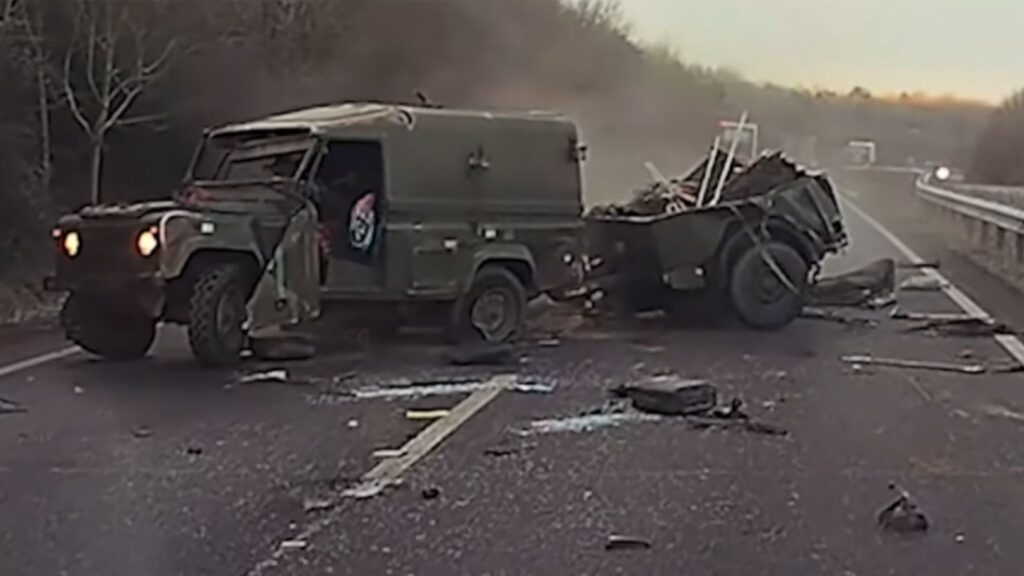
That Defender wasn’t just any vehicle. It was a military-spec Land Rover, heavier and less forgiving when thrown off balance, and it was towing additional weight behind it. When the Audi cut across its path, the Defender’s driver had to react immediately, with no time to think it through. He swerved to avoid a direct collision, a decision that likely prevented one kind of impact but triggered another. The sudden maneuver destabilized both the vehicle and the trailer, and from there things escalated fast. The Land Rover lifted, flipped, and rolled across both lanes, not a small spin or a slide but a full, violent rollover that scattered momentum across the road, coming to rest only after tumbling through the crash.
The driver, a 36-year-old man, was thrown from the vehicle during the crash and suffered a suspected fractured back, requiring immediate hospitalization. His 31-year-old passenger was also injured, taken separately for treatment with a serious head injury. Two people, completely removed from the initial mistake, ended up paying the price for someone else’s poorly timed lane change.
Dashcam footage later released by police makes the sequence painfully clear: the Audi slows and moves across, the Land Rover reacts, and then everything breaks loose at once. No mystery, no complicated chain of events, just one decision followed by consequences that couldn’t be reversed. Watching it removes any illusion that this was somehow unpredictable. The crash wasn’t a freak incident, it was the direct result of a poorly timed maneuver in exactly the wrong place at exactly the wrong moment.
Aruxandei was charged with two counts of causing serious injury by careless driving. She initially indicated she would go to trial but changed her plea to guilty before proceedings got fully underway, a decision that likely influenced how the case ultimately concluded. Earlier this month, she was sentenced at Northampton Crown Court to a six-month prison term, suspended for 18 months, meaning no immediate jail time. Alongside that came a one-year driving ban, a required extended driving test before she can get back behind the wheel, and a financial penalty.
And that’s where it gets complicated. Given the severity of the crash, the injuries involved, and what the footage shows, plenty of people are going to question whether that punishment lines up with the damage done: a man with a suspected broken back, another with a significant head injury, a vehicle flipped violently across a major road. Yet the person responsible avoids prison, at least for now. There’s a legal framework behind that outcome, of course. Suspended sentences are meant to act as a warning, a line in the sand: cross it again, and the consequences escalate sharply. For the victims, though, that distinction might not feel like much of a trade-off. The driving ban is more straightforward: twelve months off the road, followed by an extended test before any return, signaling that authorities want proof the driver can operate safely again before being trusted with a license.
Still, the bigger issue here isn’t just one case, it’s what it says about everyday driving behavior generally. Lane changes don’t get much attention, they’re routine, almost automatic. But on roads like the A43, where speeds are high and vehicles vary widely in size and stability, a careless move isn’t just a minor mistake, it’s a trigger, especially when larger or more complex vehicles are involved. The Land Rover Defender in this case wasn’t built for quick evasive maneuvers at speed while towing a trailer, and few vehicles are. Once it was forced into that position, physics took over: weight shifted, balance disappeared, and recovery became nearly impossible. That’s not about blaming the vehicle, it’s about understanding the real limits of what any driver can control once things go wrong.
Police have made clear they see this as avoidable, and that word matters. Avoidable means there was a moment where a different choice, a glance, a pause, a delay of just a few seconds, could have stopped everything that followed. Instead, the decision was made, and the outcome played out exactly as anyone would expect at highway speed.
There’s also a broader push behind cases like this. Law enforcement has been increasingly vocal about removing unsafe drivers from the road, not just punishing incidents after the fact but trying to prevent repeat occurrences, which is why the extended test requirement stands out. It isn’t just about waiting out a ban, it’s about proving competence again before returning to the road. Still, none of that undoes what happened on that stretch of highway. Two men were injured, one vehicle destroyed, and a moment that never needed to happen turned into something that will stick with everyone involved for a long time. That’s the hard truth here: on a busy road, there’s no margin for careless decisions. There’s no redo at 70 miles an hour.
Via Northamptonshire Police/PA
About the Author