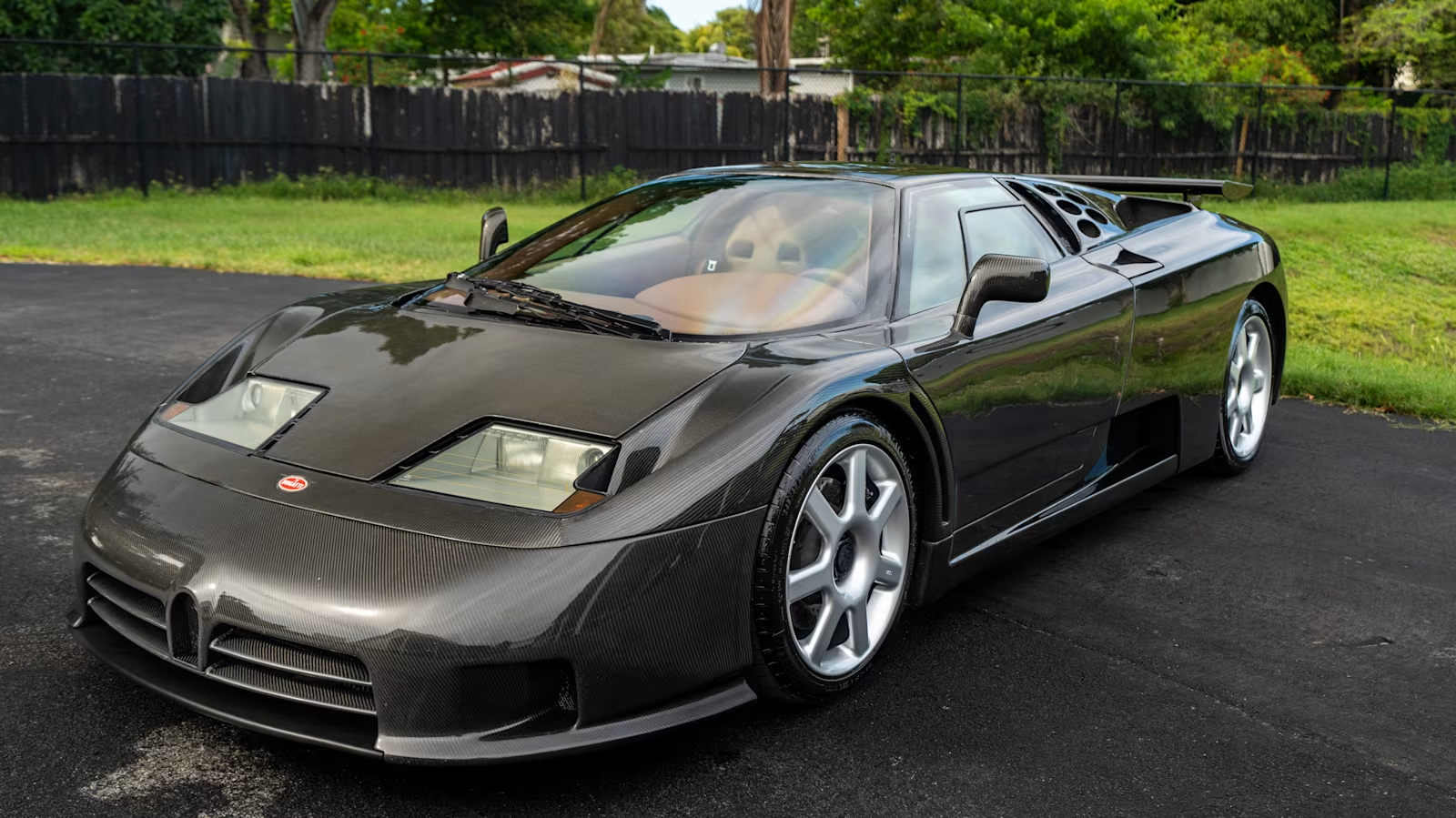
Mecum’s Monterey sale wrapped up with the usual parade of seven-figure metal, but the lot that had the room leaning forward on Saturday wasn’t a Ferrari or a Miura. It was a 1994 Bugatti EB110 Super Sport Lightweight built by a German tuner most casual enthusiasts have never heard of, wearing a body of raw, clear-lacquered carbon fiber instead of paint. Bidding climbed to $5.5 million. The gavel never dropped. The car rolled off stage under Mecum’s “The Bid Goes On” status, meaning the seller and the underbidders get to keep talking privately after the cameras stop rolling.
That’s a strange outcome for a car that just put up serious money in front of a packed auction floor, and it says more about how thin the market is for genuinely one-off hypercars than it does about the car itself.
One of Five, and the Only One Left Bare
Lot S110 crossed the block on August 15th carrying VIN ZA9AB01E0NCD39151 and just 6,026 miles on the clock. According to Mecum’s own listing, it’s one of five EB110 Super Sport Lightweights built by Dauer Sportwagen of Nuremberg, and the only one of that quintet left with its carbon fiber structure exposed under clear lacquer rather than hidden under paint. Everything else on the car — the saddle leather interior, the BBS center-lock wheels, the cross-drilled Brembo brakes, the adjustable rear wing — is standard Dauer-spec. The bare weave is what makes this specific chassis a one-of-one inside a car that was already absurdly rare.
Exposed structural carbon on a road car built in the mid-1990s is worth pausing on. At the time, hand-laid carbon bodywork was still mostly a Formula 1 and Le Mans prototype trick; putting it on public display, unpainted, on a street car was as much a statement about manufacturing confidence as it was about weight savings. It’s the same impulse that later showed up on cars like the Pagani Zonda and, decades on, McLaren’s entire product line — except Dauer got there first, in Nuremberg, without anyone really noticing at the time.
Dauer’s Second Life for a Dead Bugatti
The EB110 itself debuted on September 15, 1991 — Ettore Bugatti’s 110th birthday — with a quad-turbocharged, 60-valve V12 good for 553 horsepower. The Super Sport variant arrived roughly six months later with a lighter chassis and 611 horsepower. It didn’t matter. Romano Artioli’s revived Bugatti Automobili S.p.A. collapsed into bankruptcy by the mid-1990s, taking one of the era’s most technically ambitious supercars down with it.
Dauer Sportwagen, a small Nuremberg outfit better known in period for turning the Porsche 962 into a street-legal car, bought up the leftover EB110 parts inventory during the liquidation and built five additional Super Sport Lightweights on its own terms. Dauer bumped the turbo boost, fitted a Remus sport exhaust, remapped the ECU, and pushed output to 705 horsepower — all sent through a six-speed manual to all four wheels. Extensive carbon fiber use shaved roughly 500 pounds off the aluminum-bodied original, and the combination reportedly pushed top speed to 230 mph, up from 220 mph for the factory Super Sport and 207 mph for the base EB110. In other words, a bankrupt company’s leftover parts bin produced the fastest, lightest EB110 ever built — and this is the only one you could see the carbon on.
What “The Bid Goes On” Actually Means
Mecum’s “Bid Goes On” designation isn’t a euphemism for a car that flopped — it’s a formal outcome specific to reserve auctions. When bidding stalls below a confidential minimum the consignor set in advance, the auction house can close the live bidding but keep the top offer on the table for private negotiation after the event, sometimes for days or weeks. No sale is recorded, no ownership changes hands, and the high bidder has no binding claim to the car unless a deal gets worked out separately. It’s a face-saving off-ramp for both sides: the seller isn’t forced to accept a number they consider too low, and the house doesn’t have to publish a “no sale” next to a car that just drew a record-setting crowd reaction.
There’s a practical wrinkle for whoever eventually buys this EB110, too. Mecum’s own listing notes the car hasn’t been through a California smog check and must go to an out-of-state resident or a licensed dealer — a reminder that even at the $5-million-plus level, emissions paperwork doesn’t care how exotic the carbon fiber is. Anyone planning to register a car like this in California specifically needs to budget for that compliance headache before wiring any money.
Why $5.5 Million Wasn’t Enough
The EB110 has quietly become a million-dollar classic over the past decade, but it’s never traded in the same league as its contemporaries from Maranello or Sant’Agata, and that history makes price discovery genuinely difficult for a one-off like this. There’s no direct comp for “the only exposed-carbon Dauer Lightweight” — every other EB110 sale is, by definition, a different car with a different story. Bidders were willing to push to $5.5 million on emotion and rarity; the consignor apparently wanted more, and with only four other Dauer Lightweights on earth to point to as evidence, there was no spreadsheet either side could point to that settled the argument.
That’s the recurring problem with ultra-low-production cars at auction: uniqueness that drives desirability also removes the comps that would normally build confidence on both sides of the bidding. It’s the same dynamic that’s played out with other forgotten-then-rediscovered Bugattis that quietly appreciated into millionaire territory while nobody was paying attention. Expect this EB110 to resurface at another marquee sale — Scottsdale, Amelia Island, or back at Monterey next year — with the owner hoping the next room full of bidders closes the gap.
Monterey Car Week had no shortage of other storylines worth tracking this year, from Honda’s championship-winning race car display providing a reminder that motorsport heritage sells tickets even without a hammer price attached, to modern hypercar money showing up in the form of Gordon Murray’s newest low-volume creation making the rounds on the concours circuit. Mecum’s own Harrisburg sale earlier this year proved rarity doesn’t need a European nameplate to matter, either — a numbers-matching Chevelle LS6 with its original paperwork tucked under the seat pulled real attention for the same reason this Bugatti did: verifiable, undeniable originality. And for buyers who’d rather skip the reserve-auction guessing game entirely, no-reserve sales like the Mike Tyson-owned Ferrari F50 crossing the block with no floor at all remain the more predictable route to actually driving away with the car.
Whether this particular EB110 finds a buyer behind closed doors or shows up again next season, it’s already accomplished one thing: reminding the collector market that Dauer’s leftover-parts experiment produced something rarer, and in this case more visually honest, than almost anything wearing a Bugatti badge before or since.
Photo: Mecum Auctions
About the Author