Kawasaki did something more revealing than another slick CORLEO video this year: it kept filing paperwork. A stack of Japanese patent applications tied to the hydrogen-powered, four-legged CORLEO concept has been surfacing in Kawasaki’s own technical publications, and buried in the drawings and captions is the actual engineering logic behind a machine that, at a glance, looks like cosplay for a motorcycle company. Skip past the “robot horse” headline and there is a genuinely interesting lesson in how you would build a legged vehicle if you actually had to make one work.
CORLEO first stood on a stage at Expo 2025 Osaka, Kansai in April 2025, presented then as a speculative “2050 concept model” inside the expo’s “Future Life Expo: Future City” pavilion. It was an odd thing for a motorcycle manufacturer to show off: four legs, a saddle, no wheels, and a name borrowed from the lion its silhouette is meant to recall. Kawasaki credits the reveal with roughly 1.2 billion cumulative social media impressions, the kind of number that either gets a concept quietly buried or gets it a budget. CORLEO got the budget. In December 2025, Kawasaki Heavy Industries confirmed it was moving the project from show-floor curiosity toward actual commercialization, standing up a “SAFE ADVENTURE Business Development Team” that reports directly to the company president, with a goal of running CORLEO as an on-site mobility vehicle at Expo 2030 Riyadh and reaching full commercial release by 2035.
It is the same pattern that has played out recently with Honda’s supercharged V3R and Ducati’s next Monster: manufacturers say relatively little in official statements, then their own patent filings do the talking. CORLEO’s paperwork breaks the machine down subsystem by subsystem, and none of it reads like marketing copy. It reads like the work of engineers who had to solve the same problems horses solved with muscle and instinct, using canisters, actuators, and control software instead.
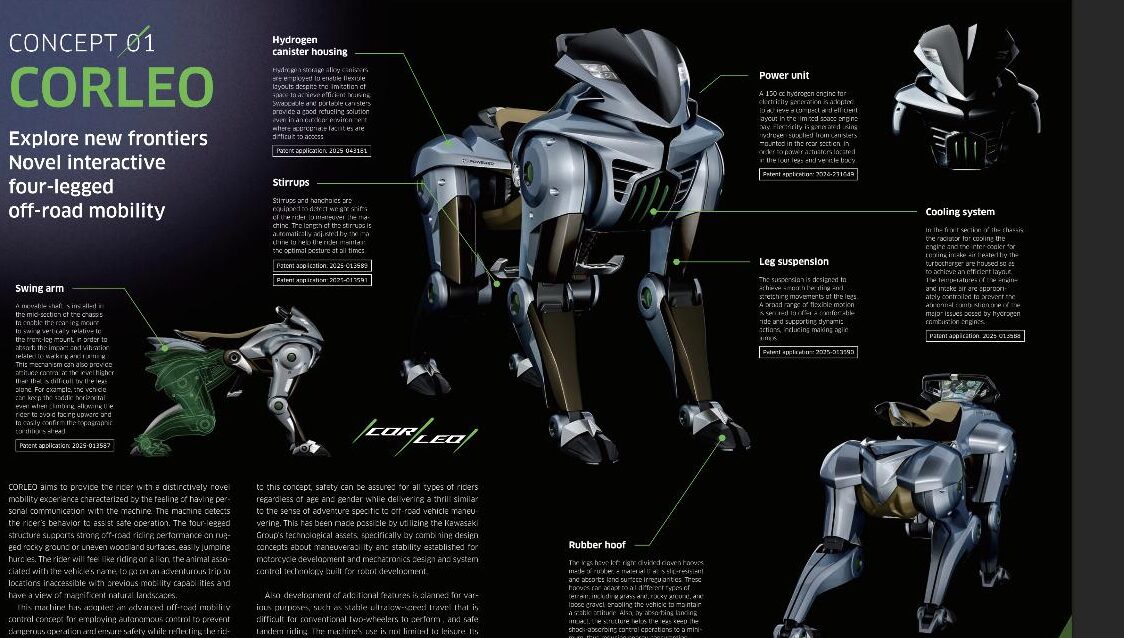
Start with what actually moves the thing, because it is not what the concept art implies. CORLEO does not burn hydrogen to punch pistons that turn legs directly. It uses a compact 150cc hydrogen engine, mounted up front, purely as a generator: burning hydrogen to spin an alternator that produces electricity, which then powers electric actuators built into all four legs and the body. The hydrogen itself lives in swappable, portable alloy canisters tucked into the rear leg housing, chosen specifically so the machine can be refueled in the field rather than requiring a fixed hydrogen station. In other words, CORLEO is a series-hybrid legged robot, not a hydrogen-combustion horse. That distinction matters mechanically: decoupling the engine from the legs means Kawasaki can package the powerplant wherever it fits best and drive each limb independently, at the cost of the energy lost converting fuel to electricity and back to motion, a tradeoff familiar to anyone who has priced out a hybrid powertrain.
That generator creates a second problem hydrogen engines are notorious for: abnormal combustion. Hydrogen’s wide flammability range and low ignition energy make it prone to pre-ignition and knock if intake air temperatures run too high, which is exactly the kind of failure mode that has shaped hydrogen-engine testing everywhere from small-displacement prototypes to record-chasing machinery like JCB’s Hydromax. Kawasaki’s patent filings address it with a radiator and intercooler packaged into the front of the chassis, positioned specifically to keep combustion temperatures in check. It is a small detail, but it is the kind of unglamorous plumbing that separates a running prototype from a stage prop.
The legs themselves lean hard on motorcycle engineering that has nothing to do with hydrogen. A movable shaft in the mid-section of the chassis, functionally a swingarm, lets the rear-leg mount pivot vertically independent of the front-leg mount, absorbing impact and vibration the way a dirt bike’s rear suspension does. Kawasaki’s own documentation notes this also provides attitude control beyond what the legs alone can manage, letting the machine keep its saddle level even while climbing so the rider is not thrown backward and can still see the terrain ahead. A separate suspension patent covers a broad range of motion in each leg, built to support both a comfortable ride and abrupt, dynamic actions like jumps.
Riding it is where the horseback-riding comparison actually earns its keep. Rather than handlebars, CORLEO uses stirrups and handholds fitted with sensors that detect the rider’s weight shifts and translate them into steering inputs, with the stirrups automatically adjusting their own length to keep the rider in an optimal posture at all times. Layered on top of that is an autonomous control system designed to prevent dangerous inputs while still trying to honor what the rider is actually asking the machine to do, a balance Kawasaki’s engineers describe internally as the trade-off between safety and joy in off-road riding. The legs end in rubber hooves split left and right like a real cloven hoof, chosen because that shape resists slipping and absorbs surface irregularities on grassland, rock, or loose gravel, and because the shock the hoof soaks up on impact is shock the suspension and control system do not have to spend energy managing.
Kawasaki has already sketched out where that capability goes next: stable travel at extremely low speeds, something wheeled two-wheelers are mechanically bad at, along with safe tandem riding for two people. The company is also framing CORLEO’s ruggedness as suited to disaster rescue and relief work in terrain that would strand a conventional off-road vehicle, a considerably more useful pitch than another toy for the trailhead crowd, even if it will still make for one hell of an addition to anyone’s off-road recovery kit list.
The commercialization plan reveals a company hedging a very long bet. Kawasaki is building a CORLEO riding simulator targeting completion in 2027, years before any customer could plausibly buy the real thing, and plans to license the motion-capture data, 3D models, and control software developed for it to the gaming and esports industries. That is a smart way to generate revenue and public interest from a project with a 2035 commercial target, effectively turning a decade of R&D into a product before the physical vehicle is finished. Alongside CORLEO, the SAFE ADVENTURE program also covers a smartphone-based navigation layer that reads weather, temperature, road-surface conditions, and wildlife activity to route people around mountain hazards, suggesting Kawasaki sees the robot horse as one piece of a broader safety business rather than a standalone novelty.
Kawasaki is not building small-displacement hydrogen combustion in a vacuum, either. It is one of several Japanese manufacturers, alongside Honda, Suzuki, Toyota, and Yamaha, that have pooled research into hydrogen-fueled small engines through a joint technical association formed in 2023. CORLEO’s 150cc generator engine is the strangest place that shared research has surfaced so far, but it did not come from one company’s skunkworks working entirely alone.
None of this makes CORLEO something you will finance at a Kawasaki dealership next spring, or even next decade’s spring, probably. It is a rolling research program with a business unit, a launch date a decade out, and a monetization plan that starts with video games rather than showroom floors. What the patents actually show is more valuable than a firm ship date: a legacy motorcycle manufacturer applying decades of swingarm and suspension knowledge to a problem nobody asked it to solve, and doing the unglamorous engineering work of cooling systems and sensor-laden stirrups to make a genuinely strange idea plausible instead of just photogenic.
About the Author