Photo: California Highway Patrol – Auburn
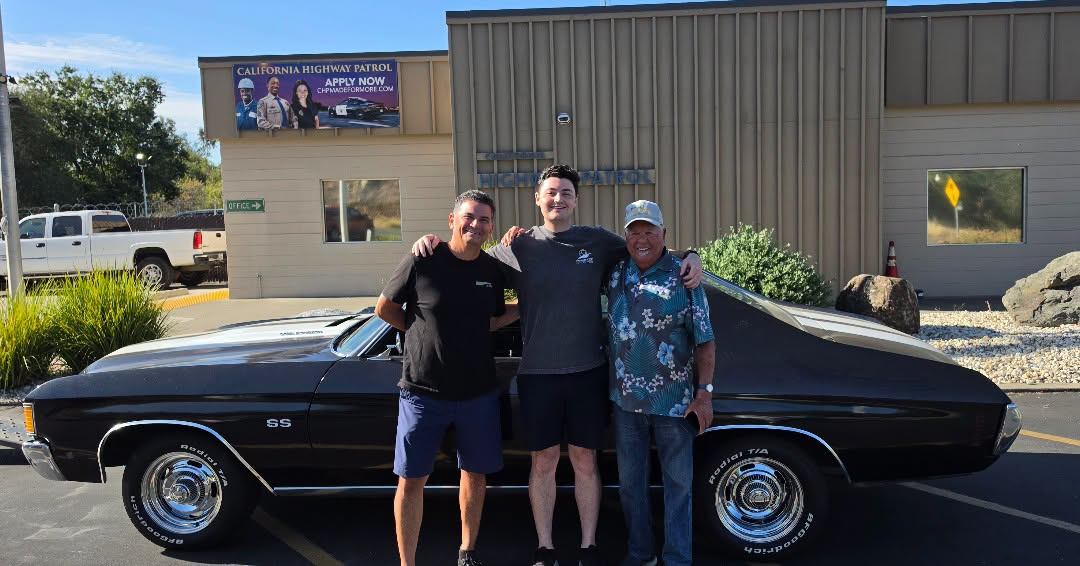
There is a photograph circulating out of the California Highway Patrol’s Auburn Area office: three men, arms around each other, grinning in front of a black Chevrolet Chevelle wearing an SS emblem in the grille, chrome Rally-style wheels, and a set of BFGoodrich Radial T/As that are almost certainly younger than the theft report. CHP – Auburn posted it on August 13. The car, the agency says, was stolen in San Mateo County in 1993 and never turned up — until officers ran a VIN inspection and something didn’t line up.
“During a VIN inspection, officers with CHP Auburn noticed something that warranted a closer look,” the agency wrote. With help from the San Mateo Police Department, investigators confirmed the car’s history and handed it back to the person who owned it before anyone had heard of a DVD.
Lovely story. But the reunion is the least interesting part of it. What should get your attention is how the car surfaced: not a plate reader, not a database hit, not an insurance flag. A person with a flashlight and a state form. For anything built before 1981, that is essentially the only mechanism that still works — and once you understand why, a lot of the classic car market starts looking a little exposed.
The 17-digit VIN is younger than the Chevelle
Everybody treats the VIN as a permanent, universal fingerprint. It isn’t, and it hasn’t been for very long. NHTSA published the final rule creating the standardized 17-character VIN on August 17, 1978, and it applied beginning with the 1981 model year. Before that, FMVSS No. 115 required passenger cars to carry a VIN starting in 1969, but the format was whatever the manufacturer felt like using. A 1971 Chevelle wears a 13-character number that encodes series, body style, engine family, model year, assembly plant, and sequence — and nothing that a modern system was designed to parse.
That single fact quietly disables most of the consumer-grade theft screening people rely on. The National Insurance Crime Bureau’s VINCheck — free, fast, the tool enthusiasts reach for first — requires a correct 17-digit VIN and only reflects theft and salvage records voluntarily contributed by participating insurers. NICB says outright that it is not a comprehensive vehicle history report and that a car can be stolen and still not appear. Feed it a 13-character muscle car number and you don’t get a clean result; you get no result at all. NMVTIS, the federal title system, is built on state title records, which means its usefulness for a car that changed hands repeatedly before the system existed is thin.
Translation: a pre-1981 car has almost no digital immune system. It has a human one.
What a California VIN verification actually involves
California’s DMV states plainly in its Vehicle Industry Registration Procedures Manual that it “may require a physical inspection of a vehicle (verification of vehicle) prior to completing a vehicle registration application.” The instrument is the REG 31 Verification of Vehicle. The person doing it — an authorized DMV representative, a licensed vehicle verifier, a trained auto club employee, or a peace officer — records the VIN’s location and condition, whether the number appears authentic, the federal certification label, body type, model year, and odometer reading. The form itself lists where to look: through the windshield, on the left or right body, in the engine compartment, on the door frame or door post, on the steering column, on the firewall.
Certain vehicles can’t skip it. DMV’s manual specifies that a vehicle previously junked or salvaged in California or another state must be inspected by an authorized DMV employee or referred to CHP before it can go back on the road. CHP hasn’t said which category triggered this particular inspection, and it doesn’t especially matter. The mechanics are identical: somebody compares the number on the car to the number on the paper — and then compares the numbers on the car to each other.
That second comparison is where old cars give themselves up. A 1971 GM A-body doesn’t carry one identifier; it carries a dash-mounted VIN plate, a body number plate on the firewall, and partial VIN derivatives stamped into structure and driveline. Faking one of them is a weekend project. Making all of them agree — with matching age, matching corrosion, matching stamp depth and font, matching fastener disturbance — is not. We’ve seen how much a driveline can say about a car’s real history when a stolen 1968 Camaro RS/SS resurfaced decades later wearing a completely different engine.
A 33-year-old report that nobody had closed
The other quiet lesson here is that the 1993 report was still findable in 2026. A stolen-vehicle entry doesn’t evaporate on a schedule; it sits in the system until an agency clears it. Which means the failure mode for long-lost cars is rarely “the record expired.” It’s that the record was wrong — a transposed VIN character, a plate number entered where the VIN belonged, a case administratively closed by a department that assumed the car was crushed.
If you’re the owner of a car that vanished years ago, that’s your actionable item: call the agency that took the report and ask two questions. Is the entry still active, and is the VIN in it character-for-character correct? Recoveries are a paperwork exercise far more often than a detective story — a point that comes through clearly in how vehicle recoveries actually work, and in the case of the stolen Highlander that crossed two borders before the documents caught it.
Here’s the wrinkle: “SS” isn’t in a 1971 Chevelle’s VIN
The photo shows SS badging, so it’s worth knowing what that does and doesn’t prove. For 1971, the Super Sport was not a model. It was RPO Z15, the SS Equipment option applied to a Malibu, and it could be ordered with engines running from the L65 350 two-barrel to the LS5 454. Only the 454 obligated you to take Z15. Nothing in a 1971 Chevelle’s VIN records whether the option was on the car when it left the plant.
So the emblem in the grille is evidence of nothing. Documentation is the only thing that settles it — build paperwork, a Protect-O-Plate, a window sticker, a dealer invoice. That’s why a 1970 Chevelle LS6 that hid its own proof under the front seat for 55 years is worth a different order of money than an identical-looking car without it.
Same discipline, two applications. Investigators identifying a car after three decades work from stampings and paper, because badges are bolt-on. Buyers should work from exactly the same material — and anyone advertising a “1971 SS” who gets vague when you ask for documentation is quoting you Malibu money plus about four hundred dollars of trim.
Somebody in this chain just lost a car and isn’t in the photo
A thief conveys no title. That principle is the entire reason this case ends the way it does, and it’s brutally indifferent to good faith. Whoever bought this Chevelle in 1996, or 2004, or last spring, bought nothing — regardless of what they paid, how legitimate the seller seemed, or how clean the registration looked. A “clean title” is a statement about a state’s records, not a statement about ownership, which is precisely the gap exploited in schemes like the Pennsylvania “tag guy” case, where stolen supercars were papered into clean titles. The last innocent buyer’s only recourse runs backward against whoever sold to them, which after this many transfers is usually a name on a bill of sale that no longer exists. It’s the same trapdoor that swallowed the guy who won a stolen Jeep at a salvage auction.
Then there’s the party nobody photographs: the insurer. If a comprehensive claim was paid on this car back in 1993, the carrier — not the original owner — likely acquired ownership of it through subrogation at the moment the check cleared. Long-delayed recoveries frequently end with the original owner buying their own car back from an insurance company, or with the carrier releasing its interest because pursuing a 33-year-old salvage claim costs more than the file is worth. CHP says the Chevelle went home to its original owner, so whatever that negotiation looked like, it got resolved.
Owner takeaway, and it’s a specific one: if a vehicle of yours is recovered years after a paid total-loss claim, your first call is your insurance carrier, not the storage yard. Storage fees accrue daily against a car you may not legally own yet.
What to do before you buy anything built before 1981
- Read every number yourself. Dash plate, firewall body plate, and the partial VIN derivatives on structure and driveline. You’re not verifying that they’re present — you’re verifying they agree, and that nothing around them has been disturbed.
- Don’t rely on the free VIN apps. They’re built for 17-character numbers. On a 1971 car, “no records found” means the tool didn’t understand the question.
- Ask the state to run it. A law-enforcement or DMV query against stolen-vehicle records is the check that would have caught this Chevelle, and it’s the one buyers skip.
- Pull the registration history, not just the current title. Rapid transfers, out-of-state hops, and a recent title issued on a bond are all worth a conversation.
- Verify options with paper. Badges, stripes, and a cowl hood are parts-catalog items. Z15 is a documentation question.
- Assume any pre-1981 car can still be re-identified. Thefts of that era are still being closed out — see the Vietnam veteran’s Camaro that came back after 17 years, and the 1985 Camaro Z28 stolen before it ever reached a dealer.
The Chevelle in Auburn got caught by the one process that still looks at a car instead of at a string of characters. That’s worth sitting with, because classic theft hasn’t slowed down — a six-figure 1970 Chevelle disappeared out of a Centereach driveway not long ago, and nothing about a 55-year-old car makes it harder to move today than it was in 1993. What changed is that somebody, somewhere, eventually has to fill out a form.
Fill yours out carefully.
About the Author