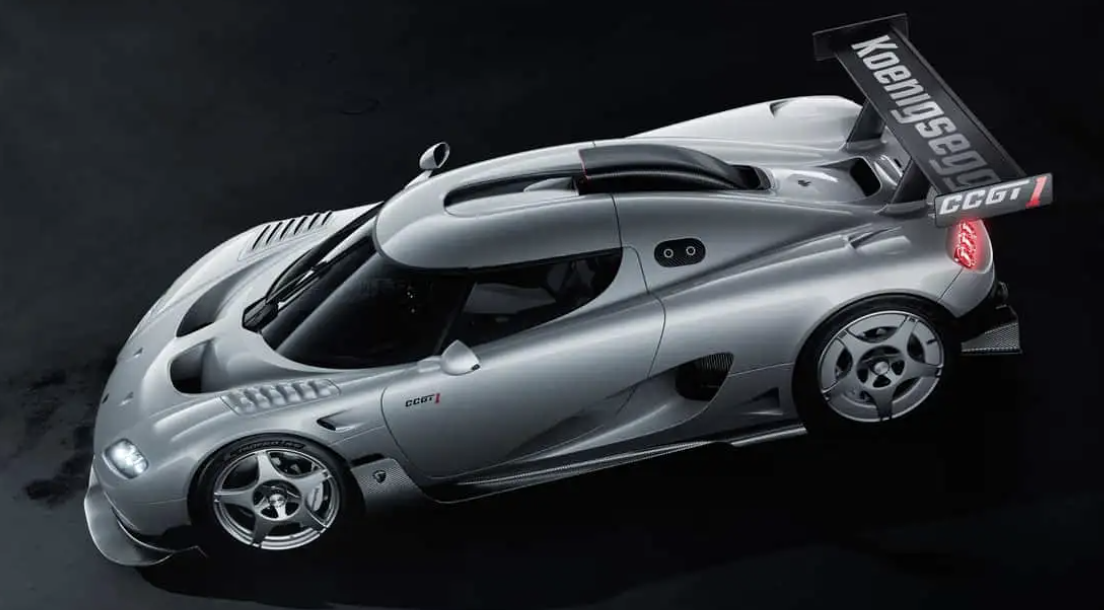
Koenigsegg spent Monterey week doing something it has never really done before: apologizing to itself for a decision the FIA made two decades ago. The result is the CCGT1, a 70-unit, road-legal machine wearing a wing the size of a picnic table, and it sold out before most of us had seen a photo of it.
Start with what it actually is, because the “new model” framing undersells the engineering. The CCGT1 is built on the CC850 platform, and per Koenigsegg’s own technical brief, only the doors and the removable roof panel survive from the donor car. Everything else is new bodywork chasing two goals — downforce and cooling — which is exactly the pair of problems that separates a fast road car from something you can flog for a full 25-minute session without cooking it.
The program that never got a green flag
The original CCGT was Christian von Koenigsegg’s actual shot at Le Mans. According to the company’s origins document, he’d studied the GT1 rulebook while designing the first CC prototype, scaling its width and frontal area to fit the class so a race version wouldn’t need re-bodying later. That’s not marketing hindsight — it explains why the CC8S and CCR look the way they do. Working with fabricator Dag Bölenius, Koenigsegg built the car to roughly 1,000 kg against a 1,100 kg class floor, leaving ballast room to tune balance. A naturally aspirated 5.0-liter V8 targeting the class-capped 600 hp drove through a magnesium sequential box, and the aero package made over 600 kg of downforce.
Related Articles
- Porsche Built One 911 Flachbau RS, Then Homologated It Like a Production Car
- California Just Handed Kodiak a Learner’s Permit for Driverless Semis
Loris Bicocchi set it up. It was quick. Two months into shakedown, the FIA rewrote GT1 to admit only higher-volume production cars, and a company building a few dozen cars a year was out. One CCGT was ever built.
Here’s a detail worth correcting: Koenigsegg’s release says the car was offered at Goodwood in 2024. Bonhams’ records put chassis YT9M1GOV8 007012 across the block on 14 July 2023, where it sold for £3,319,000 including premium — enough to top a sale that grossed £10.65 million. The seller was Bård Eker, then Koenigsegg’s largest shareholder, who kept it in climate-controlled storage on its original slicks with twice-yearly engine runs. Its new U.S. owner has had it refurbished by Koenigsegg’s Legend Division and it’s now bound for historic GT1 grids.
Read the spec sheets side by side
This is where the CCGT1 stops being a homage and starts being a different car. Compare Koenigsegg’s CC850 specs with the CCGT1 sheet and the changes are structural, not cosmetic.
The CC850 runs 8.71:1 compression at 1.5 bar of boost (1.7 on E85) for 1,185/1,385 hp. The CCGT1 goes to 9.0:1 compression at 1.7 bar, and 2.2 bar on E85 — about 32 psi — for 1,280/1,600 hp. Raising compression and boost simultaneously is the interesting part. You normally trade one against the other because the combination invites detonation. Ethanol’s knock resistance and its evaporative charge cooling buy back the margin, and the enlarged oil cooler plus the new roof scoop keep intake and lubrication temperatures from eating it again. Peak torque climbs to 1,500 Nm (1,106 lb-ft) at 5,100 rpm, with 1,000 Nm available from 2,700 to 6,170 rpm.
Less discussed: the CCGT1 adds active rear-wheel steering and Triplex dampers front and rear, where the CC850 lists Triplex at the rear only. Steering goes from 2.5 to 2.9 turns lock-to-lock — slower, which sounds backward until you remember what 800 kg of downforce at 250 km/h does to steering effort and to the consequences of a twitchy rack. The car also grew: 114 mm longer, 34 mm wider, 33 mm taller. The tribute to a car shaped around a rulebook no longer fits inside it.
A sequential shifter that doesn’t need to be one
The Koenigsegg Sequential Shift interface is the headline cockpit change, and it’s a fascinating piece of deliberate self-limitation. The Light Speed Transmission is nine forward gears operated by seven wet multi-disc clutches, which is why it can jump from seventh to fourth without walking through the gears in between. KSS asks that gearbox to behave like a dog-engagement racing box: clutch pedal for takeoff, one gear at a time, ignition cut on every pull.
An ignition cut in a real sequential exists to unload the dogs so the ring can slide. Here there are no dogs to unload — the shift happens by swapping clutch pressure. The cut is character, not necessity. Koenigsegg has essentially built a haptic and acoustic simulation of a 2007 racing gearbox on top of hardware that doesn’t need one, and I mean that as a compliment. The CC850’s gated six-speed ESS remains available at no extra cost, still using six of the nine ratios.
The E85 asterisk
That 1,600 hp figure comes with homework. Retail E85 in the U.S. isn’t a fixed recipe — the Department of Energy notes pump blends run 51% to 83% ethanol depending on region and season, and there are just over 4,200 public stations in 43 states. Koenigsegg says its in-house engine management handles any blend of the two fuels, which is the only sane approach, but it also means your winter fill in a cold-climate state is a different fuel than your summer one, and the ECU will adjust output accordingly.
Then there’s the tank. It’s still 72 liters — about 19 gallons — and E85 carries less energy per gallon than gasoline. On a road trip, that’s an inconvenience. On track at 1,600 hp, it means planning fuel around your session length rather than the other way around. The air jacks in the track package suddenly look less like showing off and more like an admission about pit stops.
Ghost Fibre and the repair bill nobody’s mentioned
The white bodywork revives the idea behind the 2009 CCXR Trevita, whose Diamond Weave process coated individual fibers to turn black carbon silvery-white and proved so slow to produce that Koenigsegg killed it. Ghost Fibre is described as a fresh development — a crystal-white aramid/carbon matrix that’s tougher, quieter and lighter than a carbon-only layup.
Related Articles
- The Triumph TF 450 Recall Swaps Entire Cylinder Heads — And Canada Found Out First
- Disney and F1 Extend Their Partnership Through 2028, and Lightning McQueen Finally Gets Grid Time
Aramid genuinely does add impact toughness and damping. It also fuzzes when you cut it, dulls tooling, resists clean sanding and is more moisture-sensitive than carbon. Exposed-weave panels with no paint to hide a repair make that worse, since any patch has to match the weave visually as well as structurally. Translation for the seven owners who will actually drive these hard: budget for factory panel replacement rather than local composite repair, and make sure your insurer understands the difference before you need to find out.
Track package, real-world caveats
Koenigsegg’s first factory track kit includes a carbon roll cage, HANS-compatible seats, fire suppression, race exhaust, air jacks, track suspension and brake setup, a second set of wheels on track rubber, and telemetry. Critically, it ships separately and any certified dealer can install or remove it.
That reversibility is doing a lot of work. A caged car driven on the street with four smart airbags and no helmet is a worse place to have a road accident than an uncaged one — bare tubing near your head doesn’t care how much the car cost. It also matters for coverage: standard personal auto policies almost universally exclude timed or competitive events, so owners need an agreed-value policy for the car and separate track-day coverage for the days it wears the kit. Being able to hand the cage back to the dealer on Monday morning is a genuinely useful feature, not a footnote.
Where this lands
Seventy cars, all allocated before the public saw them — the same run length as the CC850, which Koenigsegg expanded from 50 in 2022 after demand outran the original plan. Koenigsegg hasn’t published a price and doesn’t need to.
The market read is straightforward. A CC850 with the Jesko’s full engine tune, rear-wheel steering, a dedicated aero package and a shifter that exists nowhere else is a materially different car than the one it’s based on, and buyers of the base car know it. The one to watch is the original CCGT, which has now gone from a museum piece with no purpose to an eligible historic racer with a factory-restored provenance and a brand-new 70-car halo pointing back at it. Whoever bought it in 2023 made a very good call.
Images Via: Koenigsegg
About the Author