
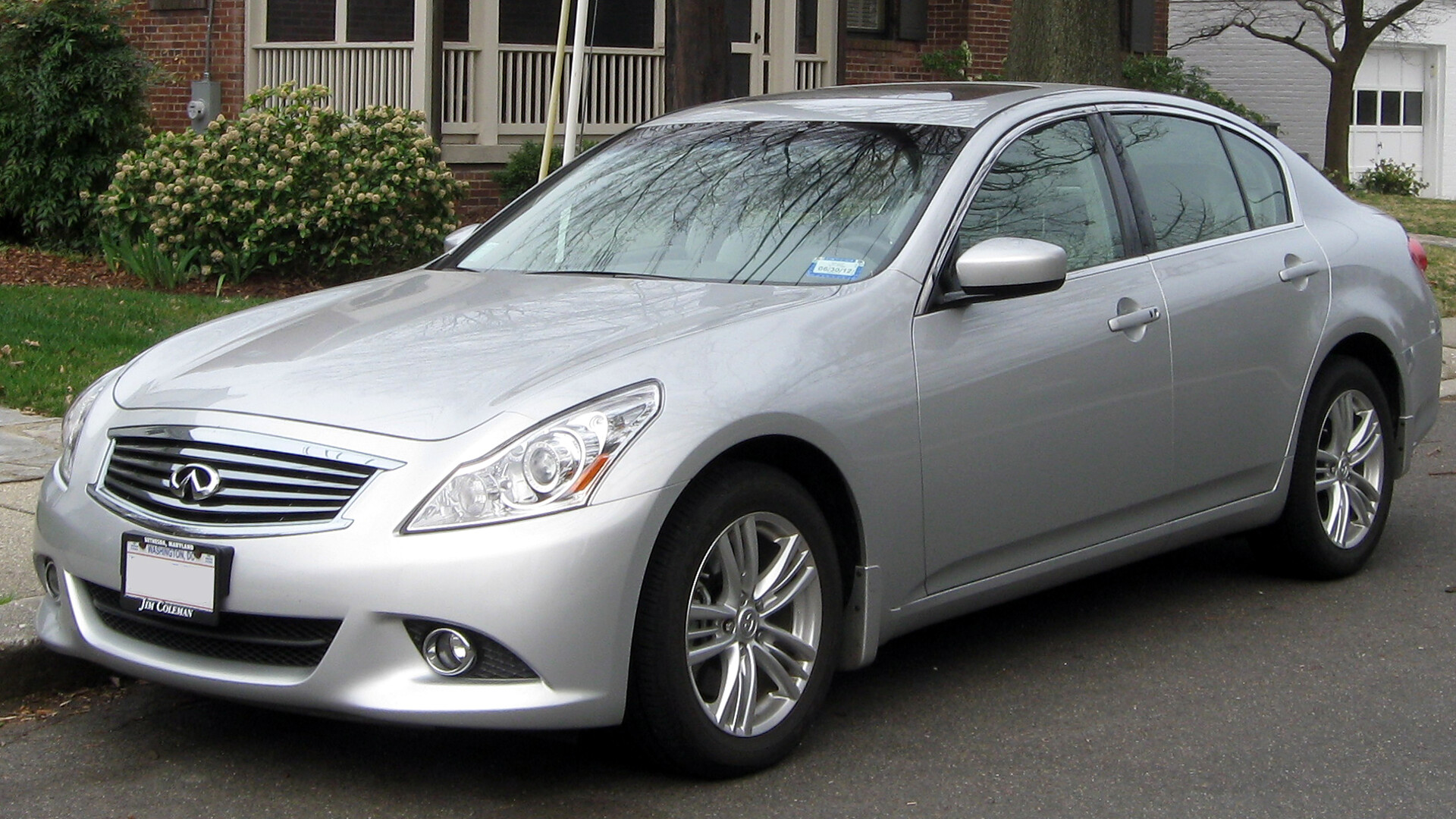
An Infiniti G37 sedan. File photo: IFCAR / Wikimedia Commons (public domain)
An off-duty police captain in Saddle Brook, New Jersey, called 911 shortly before 11:30 p.m. on Saturday, Oct. 17, to report two people with flashlights in his father’s driveway across the street from his own house. When he saw a car backing out, he ran out to stop it, and the car knocked him to the ground, NBC New York reported, relaying the account of Police Chief John Zotollo Jr. The captain hurt his right leg, went to a hospital as a precaution and was released. The car, his father’s gray 2011 Infiniti G37, drove away.
The department had no arrests and no suspect descriptions to release as of Sunday afternoon, according to that report, and Backfire News found no later announcement. This story does not name the captain.
New Jersey’s carjacking statute reaches a driveway
The two men have not been identified, let alone charged, so nothing here describes an accusation. What the statute says is a separate matter, and it is not intuitive. N.J.S.A. 2C:15-2 defines carjacking as inflicting bodily injury or using force on a person “in the course of committing an unlawful taking of a motor vehicle.” The statute counts an attempted taking, and it makes carjacking a first-degree crime with an ordinary prison term of 10 to 30 years.
The word “carjacking” suggests a driver pulled out of a seat. The state judiciary’s model jury charge says otherwise: the person the force is aimed at must be an occupant or a person in possession or control of the vehicle, and “the person need not actually be inside the motor vehicle when force is employed or threatened.” Whether the captain, standing in the street beside his father’s car, counts as someone in control of it is for a court to decide. No prosecutor has had to yet. A plain theft of a parked car is graded by what was taken. A theft that injures a person on the way out can be charged under a statute with a first-degree penalty range. The alternative is robbery under 2C:15-1, which is generally second degree.
What the force-for-property statute allows a private person
The reports say the captain ran toward the car and was struck. None says he used force on the men. For any New Jersey resident who does, N.J.S.A. 2C:3-6 allows force against a person only when the actor reasonably believes it is necessary to prevent what he reasonably believes is an attempted theft, and the limits that apply generally include first asking the person to stop, unless that would be useless or dangerous. The statute also says deadly force to defend personal property is not justified unless another provision of the chapter justifies it. The reports do not address whether the captain’s police training or off-duty status changes any of that.
Owners who reach their cars first
Backfire News has followed other owners who ended up face to face with the people taking their vehicles, including a Memphis man who found his stolen 2014 Corvette before police did, and the arrest of a North Carolina man accused of using a cloned key on a Charger Scat Pack. The Saddle Brook case differs in one respect that matters in court: the injured person is the owner’s family member, in the owner’s driveway, with a car already moving.
What to watch in the Saddle Brook case
The department has not released descriptions of the men or of any video. If someone is charged, the complaint will show whether prosecutors chose carjacking, robbery or theft counts, and that choice sets the exposure at anywhere from a 10-to-30-year first-degree range to something far lower.
A knocked-down captain, a rolling Infiniti, a driveway. Is that a 10-to-30-year carjacking, or a theft that got someone hurt?
About the Author