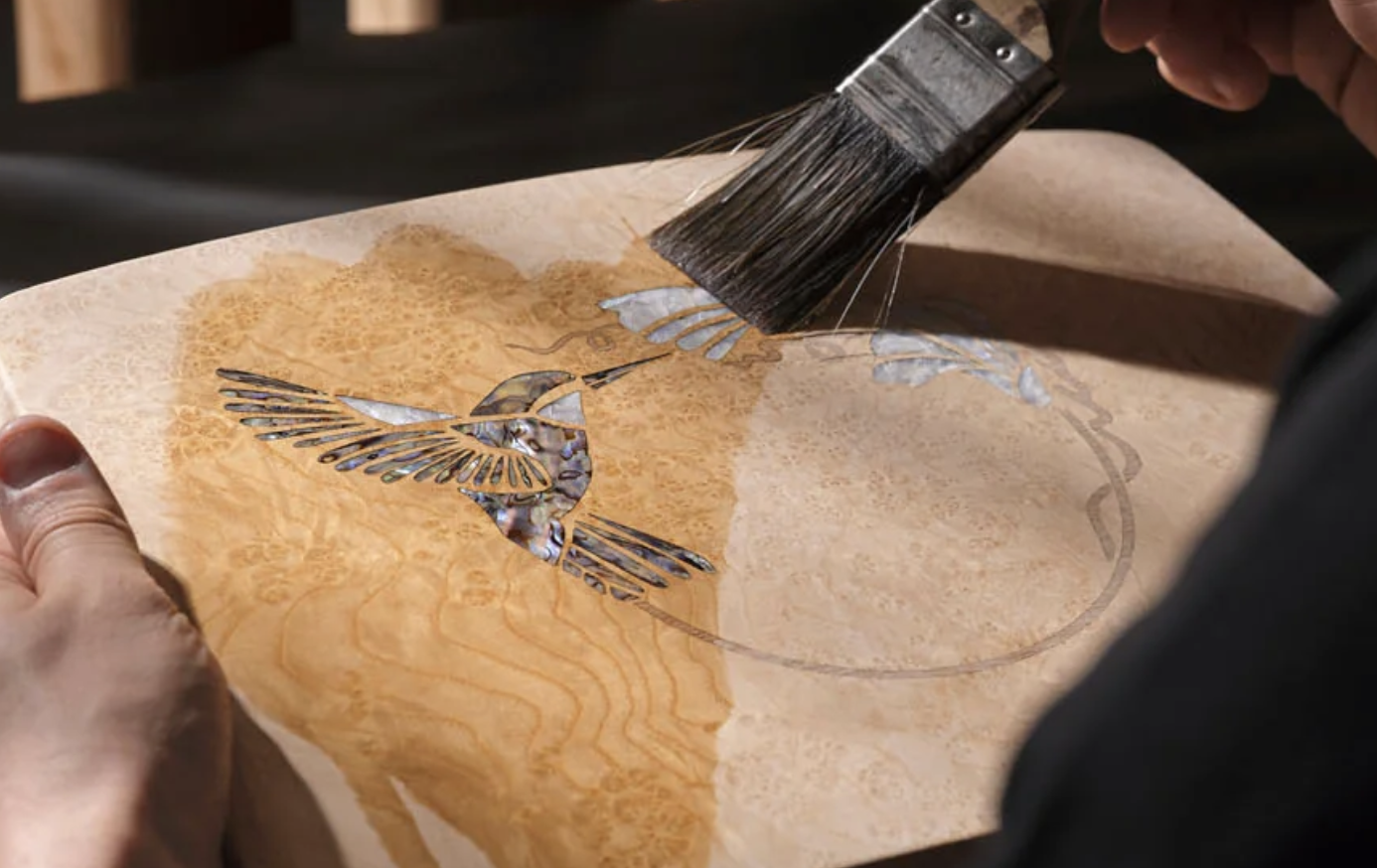
The number worth remembering from the new Rolls-Royce Phantom Hummingbird isn’t 53, or 84, or the nine months of development. It’s 0.06 millimeters — roughly two-thirds the width of a human hair, and the amount of extra material Goodwood had to leave on every single fragment of shell before cutting it. A laser beam has width, and it burns away material as it travels. Cut to the finished dimension and the piece comes out undersized. So every piece was cut oversized on purpose, then filed back down by hand, edge by edge, until it met its neighbor with no visible seam. One hundred ninety pieces, three panels, one car.
That is the real story of the first Rolls-Royce ever built with abalone shell marquetry, and it’s a materials-engineering story dressed up as a bird.
The car is a one-of-one Phantom Extended, commissioned through Rolls-Royce’s Private Office in Dubai as a gift from a client to his wife. Two hummingbirds take flight across the picnic tables on the backs of the front seats, each assembled from 53 individual pieces of abalone and mother-of-pearl, with 18 of those pieces packed into the wings alone. An 84-piece botanical composition unfurls on the Rear Waterfall panel between the rear seats. Outside, a hand-painted hummingbird rides the coachline separating a Wildberry lower body from a White Sands upper.
A Seashell Is About the Worst Thing You Can Bolt Into a Car Interior
Nacre — the iridescent lining of a mollusk shell — is not a pretty rock. It’s a natural composite: microscopic tablets of aragonite, a crystalline form of calcium carbonate, stacked in overlapping layers and glued together by a thin protein matrix. Picture a brick wall built at a scale measured in fractions of a micron. That architecture is why nacre is dramatically tougher than the chalky mineral it’s made of, and it’s also why the material glows the way it does.
There is no blue-green pigment in abalone. The color comes from light bouncing between those stacked aragonite layers and interfering with itself on the way back out — the same trick that makes an oil slick shift colors. Which makes the choice of subject unusually literal: a hummingbird’s feathers aren’t pigmented either. Their color comes from nanoscale structures in the barbules that split and reflect light. Rolls-Royce built a structurally colored bird out of a structurally colored material. As design puns go, that one actually works.
The problem is that everything which makes nacre beautiful also makes it a nightmare inside a motor vehicle. It’s a ceramic. It’s brittle, it’s thin, and it has effectively zero tolerance for flex. The wood veneer it’s being set into does the opposite — timber breathes, swells and shrinks with humidity and temperature, and a parked car in a Dubai summer is a thermal cycling chamber that would make a test engineer nervous. Put a rigid mineral into a substrate that moves, and physics eventually wins.
Rolls-Royce says it took six separate attempts to land on a technique that worked. The solution was to thin the shell down before setting it, so each fragment could seat gently rather than being forced into place, then lock the whole assembly under lacquer. Thinner shell means less stiffness fighting the substrate and less mass to crack. The lacquer becomes a structural skin rather than a finish. That’s not decoration — that’s a durability fix, and it’s the reason this particular commission took nine months while the actual assembly of all three panels consumed just 45 hours.
Watchmakers and luthiers have been inlaying nacre for centuries, but they get an easier brief: a dial is small, flat, climate-controlled on a wrist, and nobody folds it out over their lap. A picnic table hinges, swings, gets loaded with a laptop and gets slammed shut by a passenger in a hurry.
The Wood Is Doing More Work Than It Looks Like
All three panels use Ash Burr as the background, with Silver Birch forming the motifs on the picnic tables. The detail most people will skim past is that the Silver Birch was cut entirely from a single log, selected and inspected specifically so the grain pattern would run correctly through the composition.
That is standard practice in high-end marquetry for a reason. Two logs of the same species will differ in color, density and figure, and once those differences sit next to each other under gloss lacquer in direct sunlight, they are impossible to unsee. Burr veneer — sliced from the gnarled growths on a trunk — is the least predictable material in the shop, full of swirling grain and voids, which is exactly why it makes a good backdrop and a terrible foreground.
There is an ownership consequence buried in that sentence, too. When that log is used up, it’s used up. A future repair that needs a grain-matched replacement is no longer a parts order.
What Happens the First Time Someone Cracks a Picnic Table
Nobody in a press release wants to talk about this, so let’s talk about it. Bespoke commissions of this kind have no part number. There is no shelf at Goodwood holding a spare Hummingbird picnic table. A damaged panel means the Bespoke Collective recreating the piece from scratch — sourcing shell with compatible iridescence, cutting it on the same laser with the same 0.06 mm allowance, hand-filing every edge again, and finding veneer that still matches a log that may no longer exist.
Owners of ordinary Rolls-Royces already learn the hard way what routine repair bills look like on these cars. Multiply that by a component that exists in a quantity of two worldwide. From an insurance standpoint, this is the textbook argument for an agreed-value policy with a stated-value schedule covering the interior specifically, because a standard actual-cash-value settlement has no mechanism for pricing 45 hours of handwork built on nine months of process development. Anyone commissioning at this level should be having that conversation with an underwriter before the car ships, not after a wine glass tips over.
Underneath the Shell, It’s Still a Phantom Extended
The mechanical package is unchanged: the long-wheelbase Phantom and its 6.75-liter twin-turbocharged V12, riding on the aluminum spaceframe Rolls-Royce built for this car and nothing else. Rolls-Royce lists the commission at 373–362 g/km of CO2 on the WLTP combined cycle, with fuel consumption of 17.2–17.7 mpg. That’s an imperial gallon, which is worth knowing before anyone gets excited — converted to US measure, it works out to roughly 14.3 to 14.7 mpg.
Worth clarifying the vocabulary, too, because the three tiers get conflated constantly. Bespoke covers the personalization anyone can order through a dealer. Coachbuild means an entirely new body, and Rolls-Royce builds a handful per decade. A Private Commission like this one sits between them: a production shell with a genuinely original interior program developed for one client. The Phantom Hummingbird is the middle tier operating at the top of its range.
Why Goodwood Keeps Doing This
Follow the business logic and the nine months of development stops looking indulgent. Rolls-Royce delivered 5,664 cars in 2025 and now runs five Private Offices — Goodwood, Dubai, Seoul, Shanghai and New York — where commissions more than doubled year over year. The company also has a site expansion at Goodwood running north of £300 million.
That is not a company chasing volume. It’s a company raising the ceiling on what a single customer can spend, which is a far more durable strategy when the broader luxury market softens. Every new technique — 3D marquetry, gold leafing, and now shell — is another line item on a menu that has no published prices. It also explains why Rolls-Royce is so protective of who gets to put a name on one of its cars; a scrapped collaboration is now the subject of a $5 million lawsuit, and the marque’s design language has been fiercely guarded since the late Ian Cameron shaped the modern Phantom.
For buyers further down the ladder, the practical takeaway is that factory craftwork of this kind travels better than aftermarket customization. A heavily specified Phantom bought new retains an auditable Goodwood build record. A Hellcat-swapped Silver Shadow is a great deal of fun and an appraisal headache. Both have their place; only one of them comes with a build book.
The One Question the Release Doesn’t Answer
Rolls-Royce describes the material as abalone shell. It does not say which species, or where the shell came from. That matters more than it might sound, because abalone is one of the most heavily poached marine resources on earth. South Africa’s Haliotis midae was placed under CITES Appendix III trade controls in May 2007, requiring export permits, before South Africa withdrew the listing in 2010 — a decision conservation groups objected to at the time and are still objecting to now.
None of that implies anything improper here. The overwhelming majority of nacre used in watchmaking, jewelry and instrument building comes from farmed shellfish or food-industry byproduct, and a company that publishes the provenance of a single log of Silver Birch almost certainly knows the provenance of its shell. It just didn’t say so. Given that Rolls-Royce is introducing this material to its catalog and will presumably use it again, naming the source would cost nothing and settle the question permanently.
What This Actually Predicts
Treat the Phantom Hummingbird as a process milestone rather than a design statement and it gets considerably more interesting. Goodwood now owns a repeatable method for setting a brittle biomineral into moving wood veneer and keeping it there. Techniques do not stay locked to one commission at Rolls-Royce; they get refined and then offered to the next client with an idea and a budget.
Expect shell to start turning up on dashboards, clock bezels and door cappings across the range. The bird was the brief. The method is the product.
Source: Rolls-Royce Motor Cars press materials, September 15, 2026.
Your Turn: Is this the kind of detail that would win you over, or overkill in your book? Let us know in the comments.
About the Author