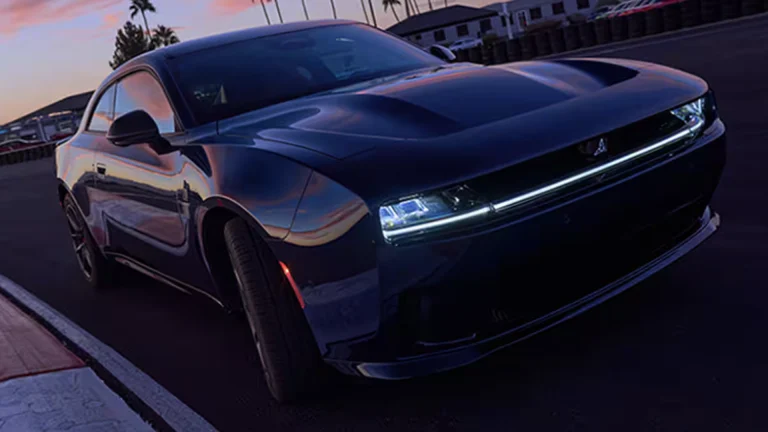
McLaren spent fifteen years telling anyone who would listen that paddles are quicker, that a dual-clutch is the only honest way to put supercar torque on the ground, and that a clutch pedal is a nostalgia tax. This week the company posted a video captioned “Inspired by our legacy” with a reveal time of 14 August, 1300 BST, and the enthusiast internet immediately concluded that Woking is about to eat those words in public.
It probably is. The more interesting question is how — because “manual” now means at least three different things, and the difference is worth several hundred kilos of engineering.
The heritage cue is doing the heavy lifting
The teaser leans on the M6GT, and that’s not a random archive grab. McLaren has been building toward this all year: MSO finished a ground-up M6GT restoration and put it on the hill at Goodwood in July as the opening act of a new heritage programme.
The original matters here. McLaren’s own account of the car describes a prototype registered OBH 500H, running a Bartz-tuned Chevrolet V8, good for an estimated 165 mph and 0–100 mph in eight seconds, with butterfly doors, a monocoque, and pop-up lamps you raised by hooking your fingers into holes in the pod. Bruce drove it to work. The plan was 250 production cars. He died at Goodwood in 1970 and the plan died with him.
Related Articles
- How Police Legally Drove An Uninsured £3.7m Ferrari Through London
- Hero’s First Electric Motorcycle Arrives 2027 On All-New Platforms
So a new McLaren that invokes the M6GT is claiming a specific bloodline: the road car McLaren never got to build, not the one it eventually did. That framing gives Woking permission to do something deliberately less advanced than its current flagship. Which is convenient, because a genuine three-pedal setup on a modern McLaren is not a trim option. It’s an architecture decision.
Why torque, not nostalgia, decides this
Look at the current halo car. McLaren’s W1 press pack lists 1275PS and 1340Nm going to the rear wheels only, through an eight-speed transmission with electric reverse and a hydraulic electronic differential. There is no production H-pattern gearbox on earth that will take 1,340Nm from a standing start, repeatedly, through a driver’s left foot, and survive a warranty period. Clutch disc diameter and pressure-plate clamp load scale with torque; so does gearset face width, shaft diameter, and synchro capacity. Build a manual that strong and you’ve built something heavy enough to undo the point of the exercise.
That leaves McLaren two honest paths.
Path one: build a lower-torque car. Drop the hybrid, keep a combustion V8 in the 600–800Nm neighbourhood, and a conventional gearbox becomes viable. This is the Gordon Murray answer, and it’s also why cars in this category tend to be lighter and less powerful than their paddle-shift stablemates rather than more.
Path two: fake it convincingly. Koenigsegg’s Engage Shift System puts a gated six-speed shifter and a clutch-by-wire pedal on top of a nine-speed multi-clutch transmission — and will still let you stall it. Ferrari did its own version last month with the 12Cilindri Manuale, pairing a lever and clutch-by-wire pedal with the existing eight-speed DCT, limited to 1,499 cars.
Both are legitimate engineering. Neither is a mechanical linkage. If the P50 keeps meaningful hybrid torque, expect path two — and expect the comment sections to go feral about it.
The stuff nobody mentions in the teaser
A third pedal is a homologation event, not a parts-bin swap. You need a clutch master cylinder, a redesigned pedal box, and revalidation of pedal intrusion behaviour in a frontal impact — in a carbon tub where the footwell is a structural member, not sheet metal. Steering column and bulkhead packaging shift. Firewall penetrations move.
There’s also a small regulatory detail that catches people out: under Regulation 65/2012, an M1 vehicle with a manual gearbox sold in Europe must carry a gear shift indicator telling the driver when to change up. Yes, on a hypercar. The rule’s definition of “manual gearbox” is broad enough that a by-wire manual mode doesn’t automatically escape it either. Somewhere in Woking, someone has already had the conversation about where to put a little upshift arrow on an instrument cluster in a two-million-pound car.
What owners should actually plan for
A clutch is a consumable, and on a mid-engined car with a structural tub, getting to it means dropping the powertrain. That’s a labour bill measured in days, not hours, and it isn’t a warranty item once the disc is worn.
How fast can that happen? One of the thirty factory-manual Ferrari 599 GTBs had its clutch replaced at 9,954 km, per its own auction catalogue. These cars get driven by people who don’t drive manuals daily anymore, and the hardware notices.
Related Articles
- VinFast Rasad Maxi-Scooter Appears On India’s Design Register
- NASCAR’s Wheatley Vodka Clash Returns To Daytona For 2027, Ending A Six-Year Venue Experiment
The by-wire approach quietly solves some of this. When the ECU sits between the lever and the gearset, it can veto a money shift — the third-to-second downshift at 8,000 rpm that turns a naturally aspirated V8 into shrapnel. A mechanical linkage will happily let you do it, and your insurer will happily explain that mechanical breakdown from driver error is not a covered peril. If you get an allocation, get it written on an agreed-value policy before delivery and confirm whether track-day use is excluded, because most standard high-value policies exclude it by default.
The market case is already proven
Ferrari’s own numbers make the argument. The catalogue for chassis 187007 — said to be the last manual Ferrari built — lays out the collapse: every 550 Maranello was a manual, then 246 manual 575Ms, then 43 manual 575 Superamericas, then just 30 manual 599 GTBs, and reportedly three manual Californias out of the entire run. Nobody wanted them. Now they’re among the most valuable modern Ferraris in existence.
That is the entire commercial thesis behind a manual McLaren, and it’s a good one. Fewer than a hundred cars, a price above the W1, and a buyer pool that already understands scarcity plus analogue equals appreciation. Woking gets a high-margin halo without spending flagship money on a clean-sheet powertrain.
We’ll know on Friday at 1300 BST. Watch the pedal box, not the shifter — three pedals with a real hydraulic clutch line tells you one story. A clutch pedal with a wire coming out of it tells you a very different one.
About the Author