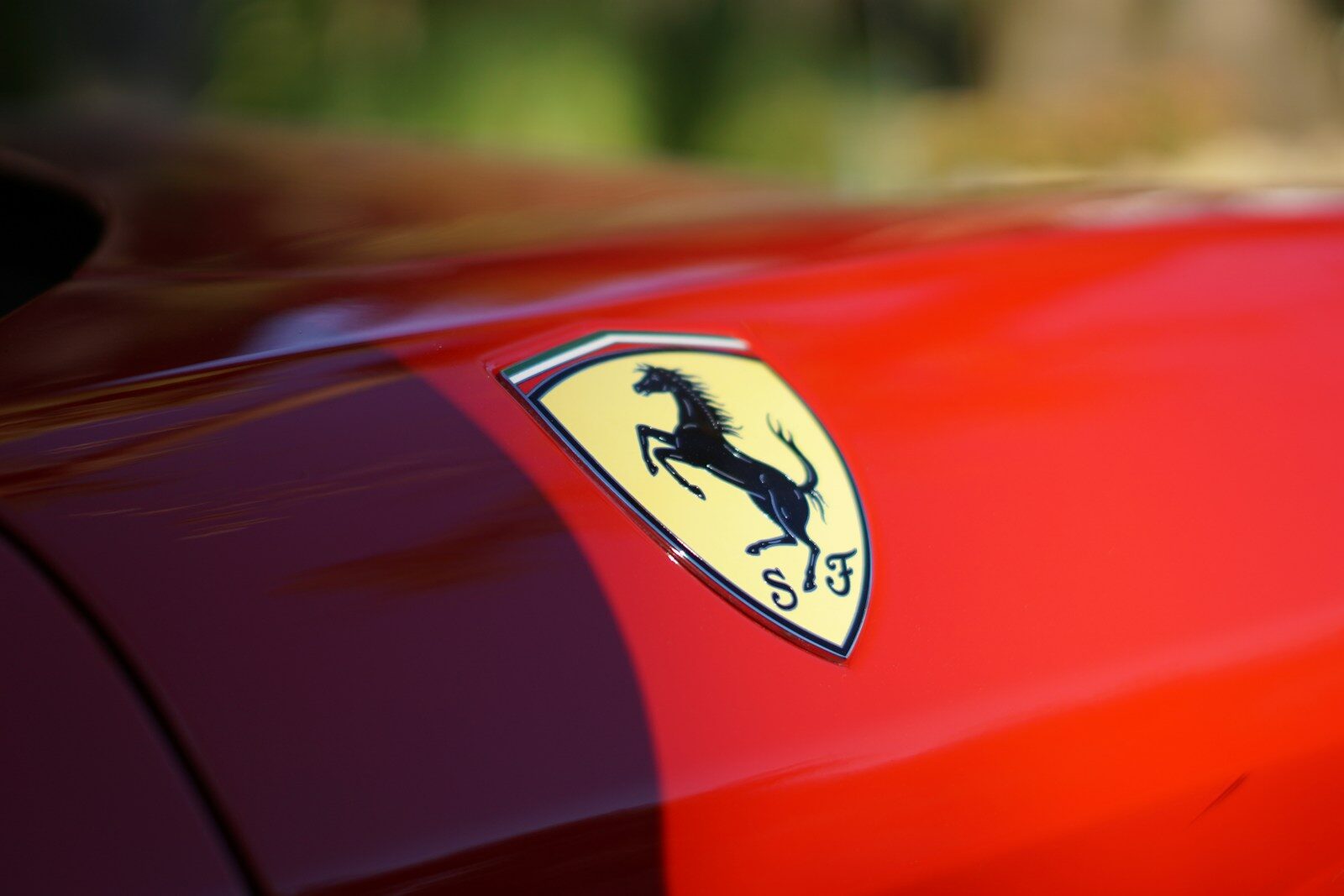
Ferrari’s legal department has been busy again, and this time it left behind a four-character breadcrumb that has the Ferrari-literate corner of the internet doing arithmetic.
The mark is FERRARI LC67, filed by Ferrari S.p.A. and now sitting in the international trademark register as a pending record. It’s not a name that maps onto anything Maranello currently sells, which is precisely why it’s interesting — and precisely why it’s worth understanding what a filing like this actually is before anyone starts sketching renderings.
What the filing is, mechanically
Ferrari routes its model-name protection through the Madrid System, which lets a single application administered by WIPO reach dozens of national and regional offices at once. That’s the reason these things surface in aggregated databases like TMview weeks before any human at Ferrari says a word publicly. The company files early, files wide, and files in every Nice class it can plausibly justify — vehicles and structural parts in Class 12, but also apparel, model cars, and downloadable digital goods. Scroll Ferrari’s registration history and the pattern is monotonous: same firm, same classes, name after name.
Related Articles
- NASCAR’s New Stage-Break Rule Doesn’t Fix Its Real Time Problem, Says a 23XI Spotter
- A Stolen Car Stop in Kansas City Turned Up Two Baby Goats, and a Lesson in How Vehicle Recoveries Actually Work
A filing is a legal reservation, not a product announcement. It costs Ferrari a rounding error to protect a name it may never bolt to a car. Case in point: Ferrari registered Ferrari Milano and Ferrari Milano Spider in December 2023. The front-mid-engine V8 2+ coupé that eventually replaced the Roma was called Amalfi when it landed in July 2025, with the Spider following in March 2026. Milano remains a name on a certificate and nothing else.
So treat LC67 as evidence of intent, not proof of metal.
The number is doing more work than the letters
Here’s where it gets fun. “67” is not a random pair of digits at Ferrari. Nineteen sixty-seven is arguably the single most commercially exploitable year in the company’s history.
On 6 February 1967, Ferrari put a 330 P3/4, a 330 P4 and a 412 P across the line at Daytona in a 1-2-3 formation on Ford’s home soil. Ferrari already monetized that image once, with the Daytona SP3.
But 1967 is also the year the NART Spider reached America. Luigi Chinetti — Ferrari’s US importer and the man whose North American Racing Team badge went on the tail — leaned on Enzo Ferrari and Sergio Scaglietti to cut the roof off the 275 GTB/4 because his clients wanted a proper open V12 after the 250 California Spider went away. Ten were built. One of them, chassis 10709, sold for $27,500,000 in 2013 — a 300 bhp, 3,286 cc four-cam twelve on a 94.5-inch wheelbase, five-speed, four-wheel independent suspension, single family ownership from new, proceeds to charity.
LC. Luigi Chinetti. 67. You do the math.
Before anyone declares that settled, note the other precedent. Ferrari’s Special Projects one-offs have used client initials outright — the SP3JC exists because Ferrari built it for John Collins, and Maranello has said as much in its own words. “LC” could belong to a living collector who wrote a very large cheque. Ferrari has not commented, and won’t until it suits them.
Why Ferrari hoards names in the first place
There’s a defensive logic here that most coverage skips, and it turned into actual case law recently.
Under EU trademark rules, a registered mark can be revoked if it hasn’t been put to “genuine use” for five continuous years. That’s how Ferrari nearly lost Testarossa. EUIPO revoked the mark on non-use grounds covering 2010–2015, and Ferrari had to go to Luxembourg to get it back. In July 2025 the General Court annulled those decisions, holding that resale of second-hand Testarossas through authorised dealers, sales of parts and accessories, and Ferrari’s own certification service — which verifies the commercial origin of a car’s main components — can all constitute genuine use.
That ruling is worth understanding if you own an older Ferrari, not just if you follow trademark law. It puts legal weight behind Classiche certification and the factory parts channel. Maranello now has a documented, court-endorsed reason to keep supporting cars that stopped rolling down the line decades ago, because letting that support lapse is how you lose the name. Heritage parts availability isn’t charity; it’s asset protection.
Related Articles
- JCB’s Hydromax Just Set a 406-MPH Hydrogen Land Speed Record With an Engine You Can Still Buy in a Backhoe
- Triumph Replaces Its Commercial Chief With Two Executives And A BMW Hire
It also explains the shotgun approach to filings. Registering LC67 costs almost nothing. Losing control of a name Ferrari wants in 2029 costs a great deal.
What this tells a buyer
If you’re trying to time anything off a trademark filing, the useful reference points are Ferrari’s own. It announced the name Luce in February 2026 and unveiled the car in Rome that May — but the registration work was done well before either. Figure on a lead time measured in quarters to years, not weeks, and figure on roughly half of these names never surfacing at all.
Two practical notes if LC67 does turn out to be something limited and V12-shaped. First, allocation for cars in that tier isn’t a purchase decision, it’s a relationship — Ferrari picks. Ferrari has been feeding that customer group steadily, including the 1,499 examples of the 12Cilindri Manuale announced in July, so a Chinetti-flavoured open V12 would slot neatly into an existing pipeline rather than appearing from nowhere.
Second, if you’re buying anything in the 275/NART orbit on the strength of a rumour, get it appraised and get it on an agreed-value policy before it moves, not after. Actual-cash-value coverage on a seven- or eight-figure car is how people discover their insurer’s definition of “market” differs sharply from theirs.
For now, LC67 is a string of characters in a database. That’s all. But Ferrari doesn’t usually pick digits by accident, and 67 is a very deliberate number to reach for.
About the Author