McLaren spent 2026 dropping hints that something bigger was coming, and a private meeting with its own dealers just put numbers, names, and price tags on it. Automotive News, which reviewed the presentation given to McLaren retailers, says the automaker is planning at least one new model every year through 2028, headlined by a mid-engine hybrid V6 supercar, a front-engined 2+2 grand tourer, and, brace for it, a genuine SUV.
None of this should shock anyone who has been watching what McLaren actually did this year rather than what it said. In July, the automaker closed out its 720S/750S/765LT bloodline with the 788HS, a 777-bhp, 614-bhp-per-tonne send-off limited to 200 cars split evenly between coupe and spider. Weeks later, it hired David Woodhouse as its first Chief Creative Officer, a role built specifically to keep everything from showroom carpet to infotainment menus feeling like one company made them, a hire we broke down here. Then, at Monterey Car Week, McLaren revealed the McL 6GT, a concept built around a manual transmission, the brand’s first since the F1 in 1992 and a gearbox decision worth its own explainer, designed as a tribute to founder Bruce McLaren’s unbuilt M6GT road car. Three moves in three months, one obvious direction: McLaren wants to be known for more than lap times.
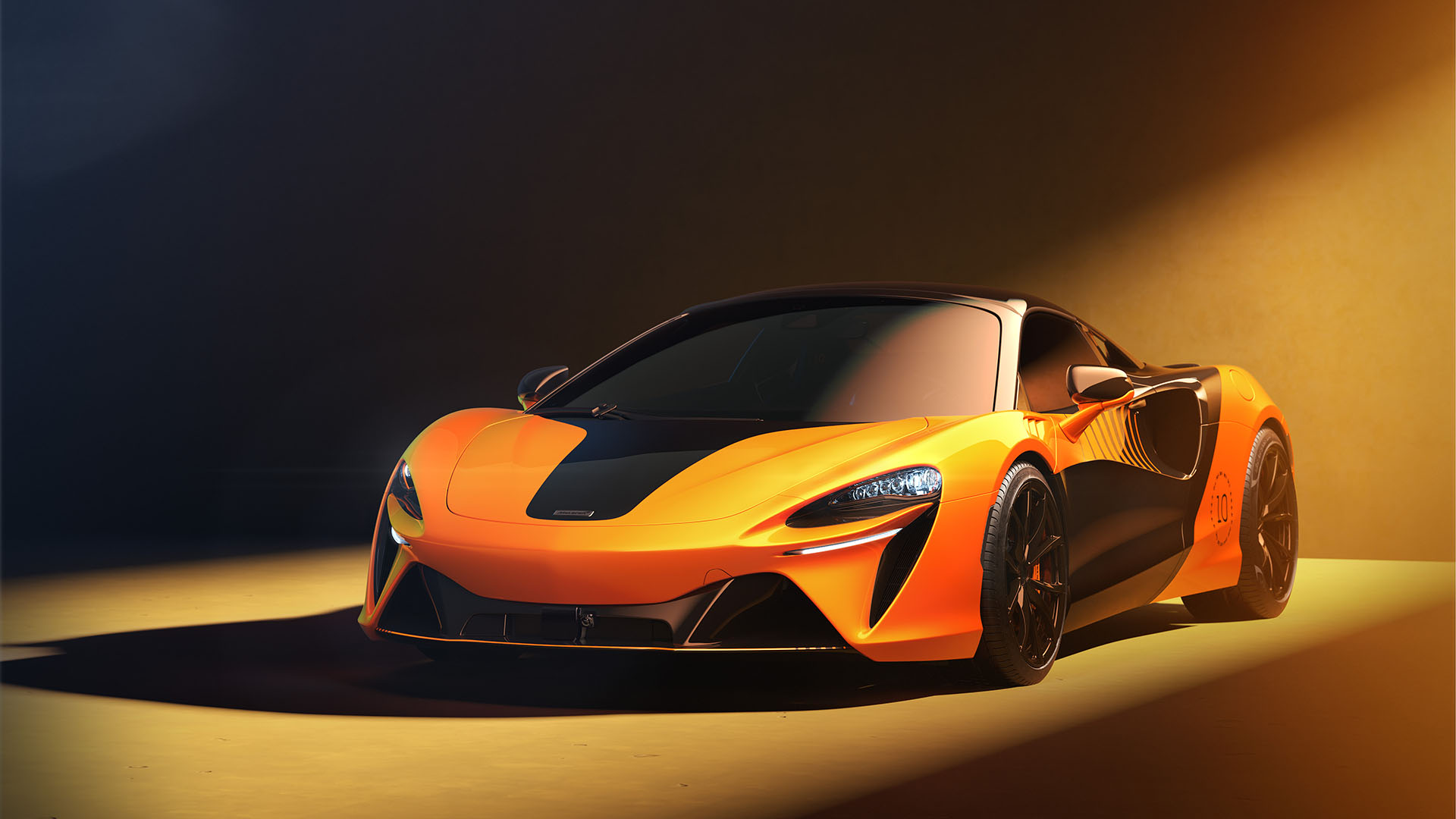
The dealer presentation apparently fills in what comes next. First up, arriving in 2027 under the placeholder designation “P34,” is a mid-engine hybrid supercar built around a twin-turbo V6 rated at roughly 810 horsepower and 800 lb-ft of torque, using an entirely new in-house engine and transmission. That is the direct successor to the Super Series slot the 750S and 788HS just vacated, and at a reported starting price of about $313,000, it actually undercuts the outgoing 750S’s roughly $370,000 ask, an odd thing to say about a car that reportedly outguns everything that came before it in that lineup. Design cues shown to dealers include proportions longer than today’s Artura, an F1-inspired wedge nose, aniline leather and Nappa upholstery, and a tempered-glass engine cover, specs that read less like a track weapon’s build sheet and more like a fashion house’s mood board, which tracks with McLaren reportedly telling dealers to think Louis Vuitton and Burberry rather than Nürburgring lap times.
That framing matters more than it sounds like it should. McLaren has spent fifteen years being brilliant at building millisecond-obsessed, carbon-tubbed missiles and merely adequate at the unglamorous stuff, interior quality, electronics, dealer service, that actually makes owning one pleasant day to day. The roadmap tries to fix that at the retail level: dealers are reportedly being asked to invest at least $1 million apiece into store renovations and grow service capacity by 25 percent, numbers that line up with a first-year sales target of 1,000 units for the P34 alone. For current and future owners, that is arguably the most useful detail in this entire story: a low-volume supercar brand actually funding the boring plumbing of ownership tends to show up later in resale values and warranty experience, long after the launch hype fades.
The SUV, tentatively “P47,” is the one that will actually test brand loyalty. Slated for 2028 with four doors and five seats, dealers were reportedly told to expect something larger than a Porsche Cayenne Turbo GT with a fastback silhouette in the vein of a Lamborghini Urus, wrapped around 24-inch wheels and styling meant to read as muscular supercar rather than generic crossover. McLaren isn’t inventing a category here. Porsche, Lamborghini, and Aston Martin all learned that a tall, practical model can outsell a low-volume brand’s entire sports car lineup combined, but McLaren has been the last of the analog-purist marques to hold out, and its badge has never had to answer for anything but outright speed. A front-engined 2+2 GT, effectively replacing the GTS line, is reportedly pencilled in for around 2029 if the one-model-a-year pace holds, aimed at buyers who want a McLaren they can live with daily rather than one they schedule a drive around.
None of this is officially confirmed by McLaren. The automaker hasn’t issued a press release naming P34, P47, or attaching pricing to either, and every figure on specs, sales targets, and dealer investment traces back to that private presentation as described to Automotive News. But the direction lines up with everything McLaren has actually put its name on this year, and it lines up with who is paying for it: McLaren Automotive now sits under McLaren Group Holdings, established last year and backed by Abu Dhabi’s CYVN Holdings, which also holds a stake in McLaren Racing. A holding structure with that kind of capital behind it doesn’t bankroll a heritage-driven overhaul out of sentimentality. It does it because one flagship supercar line, however good, doesn’t generate enough volume to fund the next one.
Whether McLaren can sell a Cayenne-sized SUV and a leather-swaddled GT without diluting the thing that made the badge worth caring about is the actual question here, and it’s the same one that greeted the Cayenne, the Urus, and the DBX before each of those brands got over it. McLaren’s advantage is that its core products are still genuinely excellent, the 788HS made that case a month before any of this leaked, and cars carrying the badge already turn up in the kind of celebrity garages that sell lifestyle as effectively as any ad campaign. Turning that cachet into volume without losing the plot depends entirely on whether the P34 still drives like a McLaren once buyers start cross-shopping it against luggage capacity instead of lap times.
Your Turn: Which of McLaren’s three new models would you actually order? Let us know in the comments.
About the Author