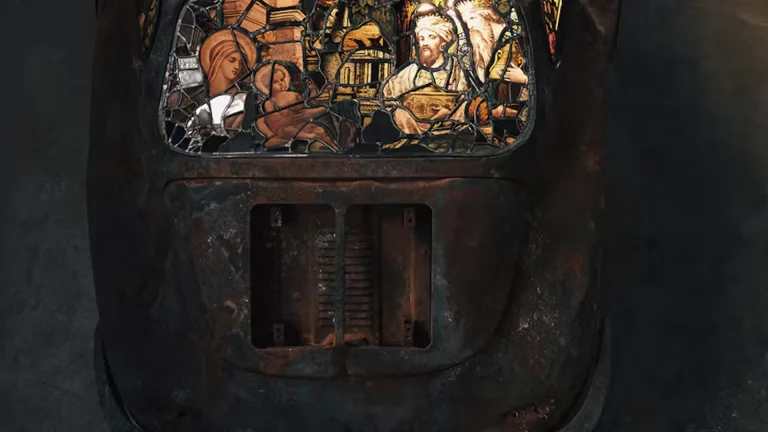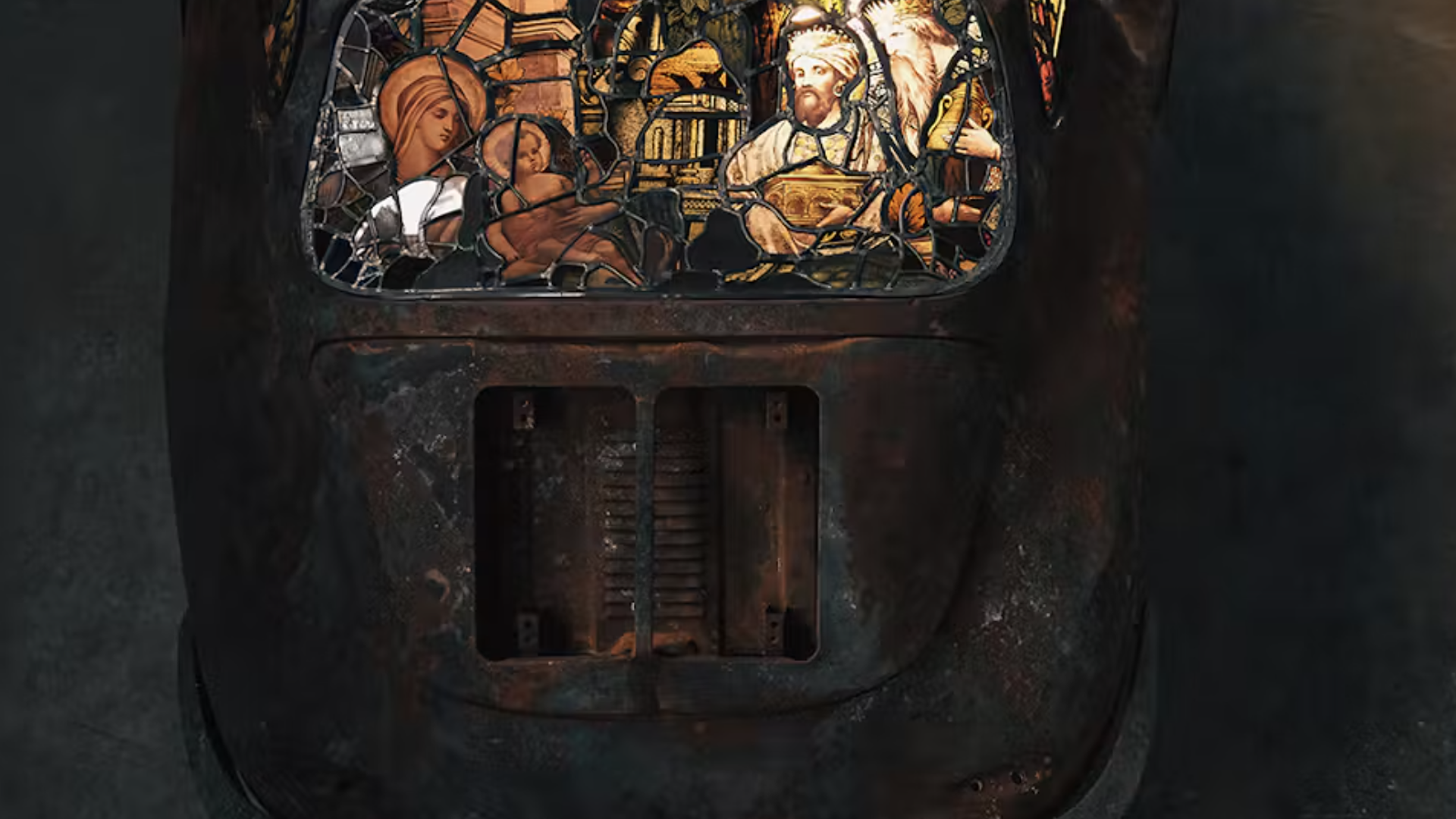
When the Los Angeles wildfires burned through, they left behind a lot of classic Porsches reduced to blackened steel. Most of those cars took the usual route: flatbed, scrapyard, shredder. Two of them ended up somewhere else, in a family glass studio, where their empty window openings were filled with 150-year-old European church glass.
The man behind them is Ben Tuna, an LA stained glass artist. In an interview published by Porsche last week, he explained how a trained kindergarten teacher ended up turning fire-damaged 356s and 911s into sculpture.
The Accidental Glassmaker
Tuna did not plan on this career. He trained to teach kindergarten. After graduating he needed a job, and his father, a full-time glassmaker, hired him into the family studio at 21. That was 11 years ago and he never left, even though his father warned him the trade was tough and dirty.
The studio works in what Tuna calls cold glass. Sheets of glass are cut by hand rather than blown or melted. His father spent a 50-year career doing windows, lighting and architectural pieces for restaurants, homes and some religious buildings.
Related Articles
- VIN on a $6,500 eBay ‘Cuda Decodes to a Hamtramck-Built 340 Car With an Empty Engine Bay
- An 11-Year-Old Pleaded Not Guilty in Seminole County Court Over His 4,500-Watt Electric Dirt Bike
That background shows in Tuna’s sourcing. He says all the old glass he uses is European and that he keeps a warehouse full of it. His favorite is old German glass from Munich’s Mayer studio, which he says marks its 180th anniversary next year. So the glass in these cars predates the cars by roughly a century.
How a Rusty 911 Started It
The concept came before the fires. Late one night Tuna bought a rusty white 911 shell online, with no floor and no engine, sitting in a warehouse in Ohio or Indiana. It sat under a tarp in his yard for a year until he got the idea to fit it with salvaged church windows.
The fires hit soon after the first car was finished. Tuna watched burned classics on Instagram being hauled to junkyards. His explanation is short: “I didn’t want people to scrap these cars because they’re precious.”
A friend put him in touch with someone who had lost two Porsches in the fires and agreed to let Tuna have them. His crew trailered the cars out, cut away the debris, removed the ash, washed the shells, and then started glazing. One was a 1965 356 and the other a 1972 911 S.
The glazing itself was done without the usual tools. He had no light table, so each piece was held up to the light, cut, and placed one at a time. He describes it as working by feel. Wood-framed church windows never had to fit a 356’s curved window openings, so working this way was arguably the only realistic method anyway.
Why the 911 S Couldn’t Just Be Restored
Gearheads will ask the obvious question: why not restore the cars? The 1972 911 S points to two answers, one mechanical and one legal.
Mechanical. Porsche used magnesium crankcases on 911s built from 1968 through 1976. Magnesium is light, and it is also a metal that burns rather than simply melting. An engine case caught in a house fire is a total write-off. In fairness, the factory has made this survivable on paper: Porsche Classic now sells reissued magnesium cases for 2.0-, 2.2-, 2.4- and 2.7-liter engines, which makes it possible to build a completely new engine for most early 911s. But a new case doesn’t bring back a shell whose steel has been heat-cycled, its seals cooked, and its originality gone.
Legal. California has a specific category for this kind of wreck. State regulations governing nonrepairable certificates require the application to say whether the vehicle’s nonrepairable status came from a surgical strip, a burned hulk, or the owner’s own declaration. Once that paperwork is issued, the DMV’s REG 488C form is clear: a nonrepairable vehicle can’t be titled or registered for California roads, and ownership can only change hands twice on that certificate.
The Porsche interview doesn’t say which paperwork these two cars carry. For anyone thinking of buying a burned classic, though, the takeaway is simple: check the title status before you check the VIN plate. A “burned hulk” designation turns a project car into, at best, a piece of art.
The Insurance Angle
For owners of uninsured or underinsured classics, this is the part worth thinking about. Once an insurer pays out a total loss, the car typically belongs to the insurer, not to the person who loved it. A standard auto policy pays what a market-value table says the car was worth. It won’t cover sentimental value, and it won’t keep the shell out of a salvage auction.
Related Articles
- EPA Modeled Its Replacement for DEF Derates on a 90-Second Seatbelt Chime Study
- Resurrection Mary: The Girl in White Who Vanishes From Your Passenger Seat
If you own an appreciating air-cooled Porsche in wildfire country, consider two steps:
- Agreed-value coverage: Ask your insurer about agreed-value classic policies, which settle on a figure set in advance instead of a market estimate.
- Retained salvage: Ask whether the policy lets you buy back the salvage after a total loss. That’s the route that lets a burned car become a sculpture instead of scrap.
Where to See Them
The cars are going public. Porsche says both artworks will be shown at the Formula 1 United States Grand Prix in Austin over the October 2026 race weekend.
Porsche built the cars that burned, and it is now promoting what came out of the ashes. That’s a better use of a hulk than a shredder, and a reminder that a well-built steel shell can outlast the engine, the interior, and even the paperwork. If your classic burned, would you rather see it shredded or glazed in 150-year-old church glass?
Images Via: Porsche & Neal Lett @nealrlett
About the Author