Photo: Lamborghini
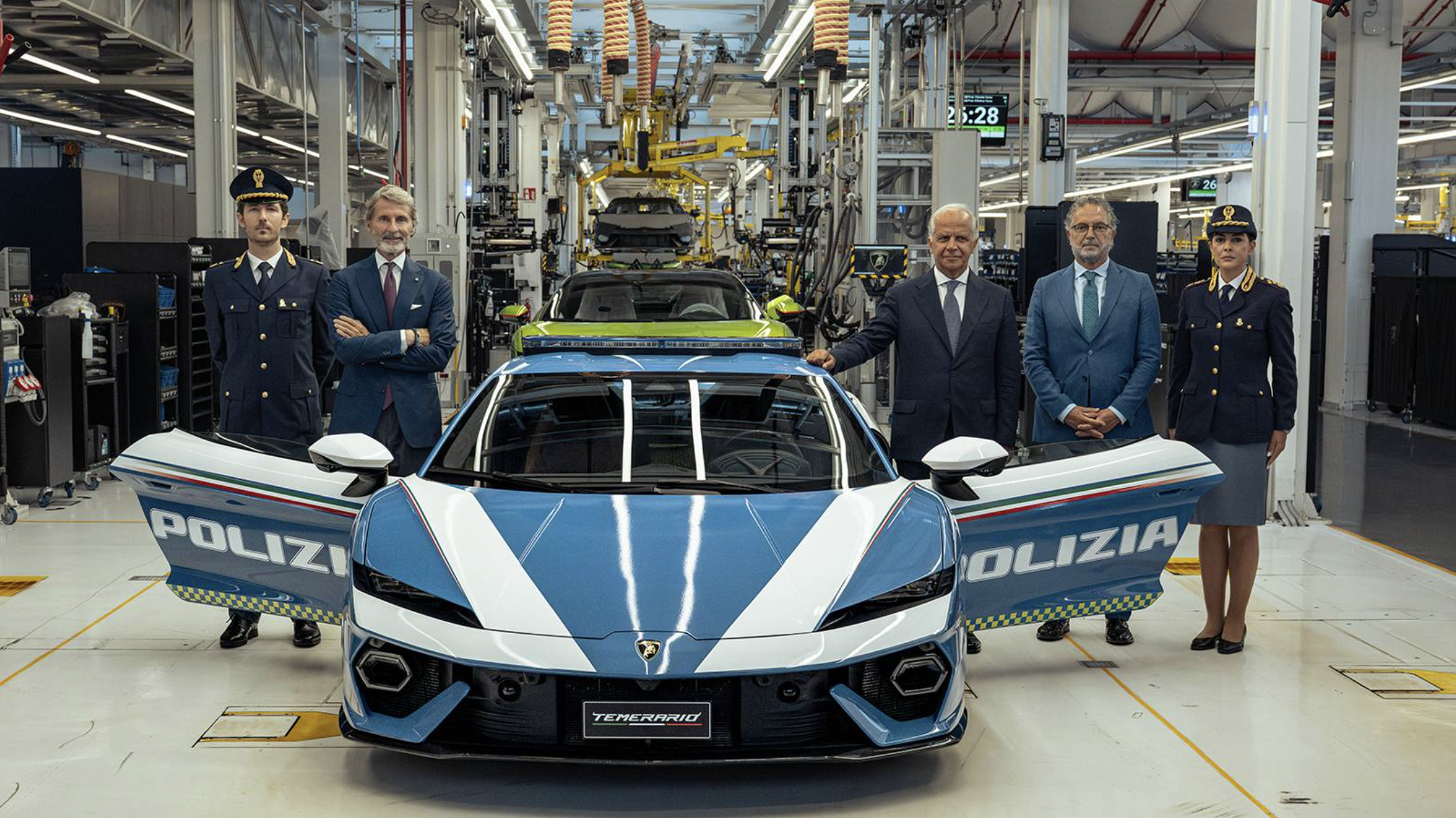
Lamborghini handed the Polizia di Stato a Temerario on September 4, and if your first thought was autostrada speed traps, adjust it. This car is a refrigerated courier with 920 CV, and the job it’s built for has a clock attached that has nothing to do with catching anybody.
The handover happened at Sant’Agata Bolognese with Interior Minister Matteo Piantedosi present, welcomed by chairman and CEO Stephan Winkelmann and the board. Prefect Renato Cortese, central director of the traffic, railway and special units police, attended on behalf of Chief of Police Vittorio Pisani. Lamborghini says the car will handle the most important services, including emergency transport of organs and medical supplies, joining the Lamborghinis already in service.
Why the clock matters more than the top speed
Transplant surgery runs on cold ischemia time, the window between an organ being cooled and being reconnected to a bloodstream. Published clinical work puts kidneys at the forgiving end, roughly 24 to 36 hours, with hearts at the brutal end at four to six. Beyond those windows, graft dysfunction risk climbs sharply. That’s the actual engineering brief here: not 0-100 km/h, but reliably compressing a several-hundred-kilometre transfer into a window measured in single-digit hours, at any hour, in any traffic.
Related Articles
- Brad Jones Racing’s Third Supra Build Is a Race Against the Bathurst Clock
- A 1966 Corvette’s Brakes Quit Mid-Showoff, Leaving Its Owner a Choice Between a Fence, a Lake, or His Own House
Italy’s geography makes that a real problem. A donor in Abruzzo and a recipient in Piedmont is not an unusual pairing, and Lamborghini’s own account of the fleet’s history describes a February 2023 run where the Emilia-Romagna Huracán collected a kidney from San Salvatore hospital in L’Aquila and delivered it to Le Molinette in Turin, saving a 57-year-old woman. That’s most of the peninsula’s length. Chief of Police Pisani has described the work as being carried out “in close collaboration with the National Transplant Centre,” which is the part people miss. These runs are dispatched through the national transplant system, not improvised because a squad car happens to be fast.
What’s actually different about this one
Every Lamborghini in this fleet has carried a refrigerated compartment with a display and data logger for continuous temperature monitoring, plus a defibrillator. The Urus that joined in 2023 added a secure weapon drawer, a collapsible message panel and a boot compartment for equipment. The temperature logging is the unglamorous part that matters most: a transplant centre needs a chain-of-custody record proving the organ never left its temperature band, and a cool box without a logger is just a picnic hamper.
The Temerario changes the hardware underneath. Lamborghini’s technical account of the powertrain describes a clean-sheet 4.0-litre twin-turbo V8 making 800 CV between 9,000 and 9,750 rpm, with 730 Nm from 4,000 to 7,000 rpm, three electric motors taking the total to 920 CV, 0-100 km/h in 2.7 seconds and 340 km/h flat out. The turbos sit inside the vee in hot-V layout. The 10,000-rpm capability comes from a flat-plane crank, titanium connecting rods and DLC-coated finger followers rated to 11,000 rpm.
Here’s the part worth thinking about if you’ve ever run a highly strung engine as a duty vehicle. The motor Lamborghini calls the P1 unit sits between the V8 and the gearbox and works as a torque-gap filler from low revs. For a courier, that’s more valuable than the headline power. An organ run starts with a cold engine in a hospital ambulance bay and ends with a cold engine at another one, and the segments that eat the most time are the low-speed urban ones at either end. A car that produces meaningful thrust below 4,000 rpm without the driver having to wring a race engine’s neck is easier on the hardware and, frankly, easier to drive smoothly with a cooler strapped in the nose.
Being a plug-in hybrid also gives this car something no previous police Lamborghini had: the ability to move under electric power alone. In a country full of restricted-traffic zones and hospital campuses where a 10,000-rpm flat-plane V8 is genuinely antisocial at 3 a.m., that’s a functional upgrade, not a marketing line.
The packaging problem nobody mentions
The cool box goes in the front. On the Gallardo and Huracán, that was straightforward. On the Temerario, Lamborghini quotes 112 litres of stowage under the front hood, and that space now shares the front of the car with two of the three electric motors driving the front axle. Every litre in that compartment is contested real estate.
The upside is thermal. Putting the hot side of the engine in the vee, at the back, keeps the heat about as far from a temperature-controlled medical container as a mid-engined car physically allows. If you were designing a cold-chain vehicle from scratch, a rear-mid engine with a sealed nose compartment is not a bad answer.
What it can’t do is police work in the conventional sense. Two seats, no cage, no partition, no room for a prisoner and ground clearance measured in millimetres. Nobody is doing a felony stop in this.
Twenty-two years, six cars, and a neat symmetry
Lamborghini counts six vehicles delivered since 2004, more than 200 organ transport missions and over 1,500 road safety education appearances. The fleet history is more interesting than the headline count. The first Gallardo went to the Stradale unit in Rome and covered roughly 140,000 km in four years, fitted with kit that could read plates and stream images to operations centres. A second car followed for Bologna in 2005, and that one got the refrigerated boot compartment. The 2008 Gallardo LP 560-4 worked the Salerno–Reggio Calabria motorway. Huracáns arrived in 2014 and 2017.
Related Articles
- Thieves Hit NASCAR Iron Man Dave Marcis’ Home, Made Off With Guns, Rolexes, and Irreplaceable Racing History
- The Dirty Duck Hit 213 MPH At The Lake Of The Ozarks Shootout, Flipped End-Over-End, And Both Guys Walked Away
Note what that arc looks like. The partnership opened with the first production Lamborghini to use the company’s V10, and it now takes delivery of the brand’s first V8-plus-triple-motor supercar. The fleet has quietly tracked the entire life and death of Sant’Agata’s naturally aspirated V10 era.
The practical read
For enthusiasts, the takeaway isn’t that Italy has a fast cop car. It’s that a manufacturer donation program has produced a two-decade dataset on running exotic hardware in genuine emergency service, complete with logged temperature data and mission counts. That’s rarer than the cars.
And unlike a decommissioned patrol sedan, none of these ever reaches the classifieds. Six cars in 22 years, all built to spec at the factory, all destined for museum duty rather than an auction block. If you want a police-liveried Lamborghini, you’re going to have to donate one.
Images Via: Lamborghini
About the Author