Photo: Greater Manchester Police
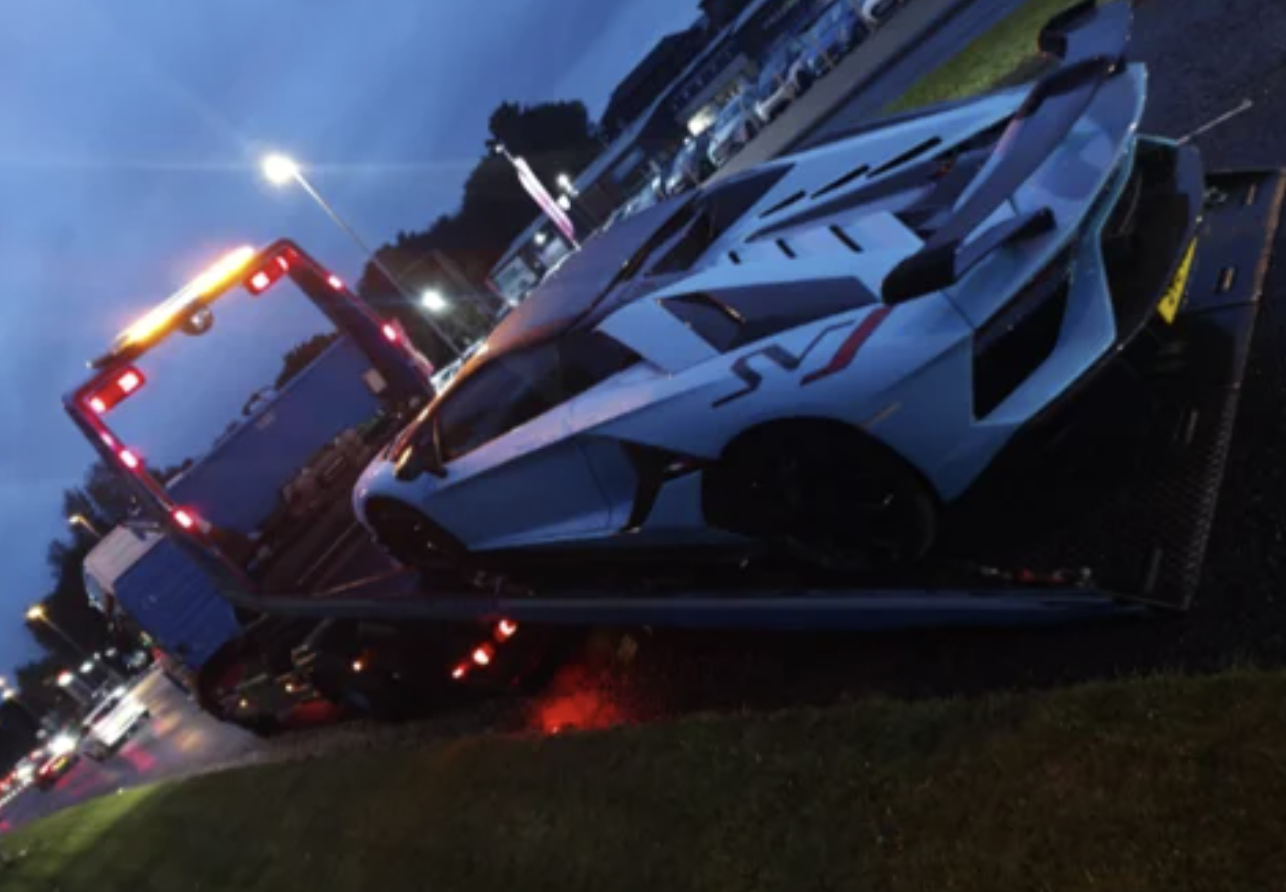
Greater Manchester Police pulled five Lamborghinis and a Mercedes G-Wagon off the road last week, and the detail worth chewing on isn’t the speed the convoy was doing. It’s the speed it wasn’t.
According to the force’s own account, its Roads Policing Unit was told on the night of Wednesday, 2 September that a group of high-powered cars was speeding, weaving between lanes, spinning wheels, and at points dropping to around 17 mph on the M66. Officers picked the group up again on the M62, stopped two of the Lamborghinis coming off the motorway, and used what GMP calls specialist tactics to bring the rest to a halt in Rochdale. Six cars went on trucks. The drivers were reported for a stack of offences. The force didn’t say which models were involved, and hasn’t named anyone.
Related Articles
- Bernie Ecclestone’s Shotgun Stop in Portugal Comes Down to One Document He Never Carries
- Dale Earnhardt Jr. Spent 20 Minutes With Tom Cruise at Daytona, But He’s Been Coaching the ‘Days of Thunder 2’ Writer for Almost a Year
Here’s the part that rewards a closer look. The seizure happened under Section 59 of the Police Reform Act 2002, and Section 59 doesn’t hang off dangerous driving at all. Read the actual text: a uniformed constable needs reasonable grounds to believe a vehicle is being used in a way that breaches Section 3 of the Road Traffic Act 1988, careless or inconsiderate driving, and that the use is causing or likely to cause alarm, distress or annoyance to the public. Dangerous driving under Section 2 isn’t the trigger. Careless and inconsiderate driving is.
Which makes the 17 mph the strongest card in the deck, not the weakest. The CPS’s published guidance on driving offences lists unnecessarily slow driving or braking as a textbook example of careless or inconsiderate driving, alongside misusing lanes to gain advantage over other drivers. Parliament even defined the test: a driver is inconsiderate only if other people are actually inconvenienced by the driving. A convoy of supercars corking three lanes of the M66 at 17 mph is about as easy an inconvenience case as a prosecutor will ever get handed. Speeding is a separate ticket. The crawl is what makes the cars themselves forfeit.
The warning that no longer exists
Until this summer, Section 59 came with a built-in second chance. Subsections (4) and (5) said an officer couldn’t seize unless the driver had already been warned and carried on anyway, or had picked up a warning in the previous twelve months. That warning attached to the vehicle as well as the person, and plenty of drivers treated it as a free strike.
It’s gone. Section 8 of the Crime and Policing Act 2026 deleted both subsections with effect from 29 June 2026. Chief Inspector Danny Kabal name-checked the change in GMP’s statement and said the force “will use this legislative change as part of our daily business.” Anything that happened before 29 June still gets judged under the old warning regime, but from that date forward the first strike is the only strike.
What it costs to get the car back
Recovery is governed by the Police (Retention and Disposal of Motor Vehicles) Regulations 2002, with the charge tables substituted in 2023. For a car of 3.5 tonnes maximum authorised mass or less, sitting upright on the road and not substantially damaged, removal is £192 flat. Storage runs £26 for each 24-hour period or part thereof. That’s a rounding error next to a Huracán payment, and it’s meant to be. The pain is procedural, not financial.
The clock is the real story. The Home Office consulted last year on cutting the window before police can dispose of a Section 59 vehicle and published its response in June. Officials floated 48 hours, got told by recovery operators that it wouldn’t work, and settled on seven calendar days across the board, down from fourteen. The stated policy goal, in the department’s own words, is to let forces crush or otherwise dispose of seized vehicles quickly enough to stop reoffending. Note also the shift from working days to plain days. A Friday seizure no longer buys you a weekend.
The person who loses isn’t always the driver
Section 59 takes the vehicle, not the licence holder. Under the 2002 regulations, whoever wants it out of the compound has to satisfy the authority that they own it and settle the charges. If the car was hired, borrowed, leased, or sitting on a PCP with a finance house as registered owner, that’s the party now dealing with a Greater Manchester recovery yard. UK supercar hire is a real industry, and a hire company facing a seizure plus a week of storage plus a customer who won’t answer the phone has a very short memory for repeat business.
Related Articles
- GM’s New Cabin Camera Software Won’t Spy for the Company — It Might Just Get You Sued Instead
- Range Rover Finally Builds an EV, and It’s Launching Straight Into the Company’s Worst Financial Year on Record
Then there’s the licence. Careless and inconsiderate driving carries the CD10 and CD20 endorsement codes, three to nine points each, and per GOV.UK those stay on the record for four years from the date of the offence. Insurers price on that record. For a driver already paying supercar premiums, a CD code plus a documented motorway convoy incident is the sort of thing that turns a renewal quote into a rejection letter.
The practical read for anyone who runs in convoys
Group drives aren’t illegal and nobody needs a lecture about enjoying a car. But the specific tactic on display here, bunching up to open a gap and then using it, is precisely the behaviour Section 59 was drafted to catch, and the Highway Code’s motorway rules are blunt about staying left unless overtaking. Britain has no minimum motorway speed, but there’s no defence in that. The offence isn’t a number on a speedo. It’s whether the people behind you were inconvenienced, and 17 mph in national-limit traffic answers that on its own.
Add one more thing to the risk calculation: GMP asked the public to send in dashcam and CCTV footage through Operation Snap. Half the cars on a British motorway are recording. The convoy was reported by other drivers before an officer ever saw it. On a road full of witnesses with SD cards, a rolling photo shoot is now the most expensive way to use a supercar badly.
Images: Greater Manchester Police
Lead image: Greater Manchester Police
About the Author