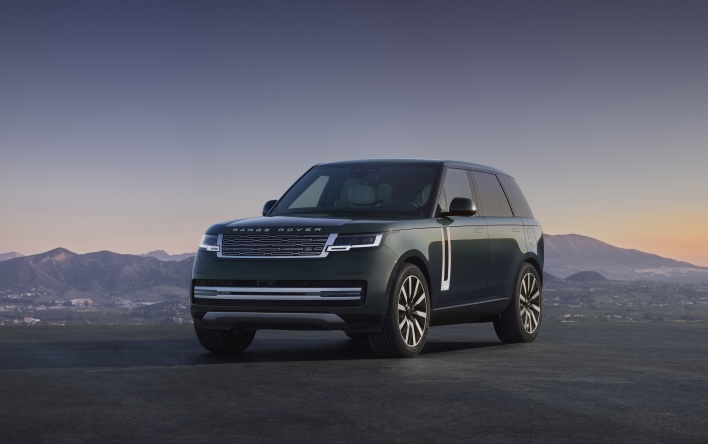
Range Rover just opened order books for its first fully electric SUV, and the timing is almost comically bad. Fifty-six years after the original Range Rover rolled out of Solihull with nothing but a V8 and a sense of purpose, the brand’s first EV arrives roughly a year later than originally planned, built by a workforce still recovering from a cyberattack that shut down production for weeks, backed by a parent company that just posted a profit of £14 million on £22.9 billion in revenue. That is not a typo. JLR’s pretax profit collapsed from £2.5 billion the year before to barely enough to cover a rounding error.
None of that changes what is actually sitting in Range Rover showrooms now. Order books opened September 2 for the Range Rover Electric, priced from £154,070 on the road in the UK. JLR has not locked in US pricing yet, even though American buyers get NACS ports and Tesla Supercharger access built in from day one.
Range Rover’s managing director, Martin Limpert, called the car “the result of a decade of considered engineering and technological development,” which, translated out of press-release speak, means this took considerably longer than JLR wanted to admit.
The Numbers That Actually Matter
Two permanent-magnet motors, one per axle, put out 260kW each for a combined 550PS and 850Nm of torque, more twist than any combustion Range Rover has ever produced. JLR says the motors generate 20 percent more torque than similarly sized units elsewhere, largely thanks to silicon carbide semiconductors that switch faster and waste less energy as heat. That is the same basic recipe Porsche and Lucid lean on for extra range and power density, and it suggests JLR did not just drop a generic EV skateboard under a Range Rover body and call it a day.
The battery is a double-stacked 118.5kWh lithium-ion pack built from 344 prismatic cells on an 800-volt architecture, which is what makes the charging numbers work: 10 to 80 percent in about 22 minutes on a 350kW DC charger, or 137 miles added in 10 minutes at peak rate. Range tops out at 372 miles on the WLTP cycle, with JLR’s own real-world figure, measured on a standardized route rather than a lab test, landing at 333 miles. That gap between claimed and real-world numbers is more honest than most of the industry bothers to be.
Zero to 60 comes in 4.3 seconds, and the 50-75 mph passing sprint takes 2.7 seconds, quick enough to embarrass plenty of things wearing a V8 badge, and quiet enough that JLR’s own marketing leans harder on silence than speed.
Keeping the Off-Road Cred Intact
Going electric usually means trading away the low-range gearing and mechanical feel that off-road purists care about, but Range Rover built two systems specifically to head off that complaint. Integrated Traction Management reads wheel slip and adjusts motor speed within 50 milliseconds, which JLR claims is up to 100 times faster than a combustion powertrain can react, while Intelligent Driveline Dynamics shifts rear torque anywhere from 100 percent to zero percent on the fly. Paired with a new Single Pedal mode, the SUV can claw up a rolling 45-degree slope or pull away smoothly on a 33-degree grade, and wading depth holds at 900mm, identical to the combustion models. It is the same basic philosophy other electric off-roaders like the BYD Yangwang U8 are leaning on: using instant torque response and independent motor control to do what a locking differential used to handle mechanically, just with software instead of gears.
A floor-mounted battery pack drops the center of gravity, and the twin-chamber air suspension is tuned around that new weight distribution. Lower center of gravity paired with faster torque response is a genuinely better recipe for high-speed stability and low-speed crawling than anything a combustion Range Rover has offered, even if enthusiasts will miss the noise.
JLR Actually Tested This Thing
JLR says the Range Rover Electric covered more than 1.5 million kilometers of physical testing, about 38 laps around the Earth, plus over 250,000 hours of virtual testing, more than any Range Rover built before it. Real-world testing included cold-soak runs at -40°C in Arjeplog, Sweden, desert heat in Dubai, and JLR’s own Eastnor Castle off-road proving ground in the UK. The company also filed 300 patent applications tied to this one vehicle, more than any single Range Rover model in the brand’s history, with a chunk of them covering a thermal management system called ThermAssist that JLR says adds up to 25 miles of range and cuts heating energy use by 40 percent in cold weather. That matters more than it sounds: thermal management inefficiency is the single biggest reason EVs lose range in winter, and it is an area where plenty of manufacturers still lag.
What Owning One Actually Looks Like
The electric propulsion system carries an eight-year, 100,000-mile warranty, and every vehicle comes with what JLR calls a Battery Digital Twin, a system tracking more than 900 diagnostic data points per car, paired with over-the-air updates that let JLR monitor battery health remotely. That is a meaningful detail for anyone worried about long-term degradation or resale value on a six-figure vehicle: JLR is building in enough telemetry to catch problems early, though owners should still budget for the reality that replacing an 118.5kWh pack outside of warranty will not be a cheap afternoon at the dealership.
North American buyers get NACS ports built in along with Tesla Supercharger network access, the same move Hyundai made with the IONIQ 5 N earlier this year, and one more sign that the charging-standard fight is effectively over. In the UK and Europe, JLR says owners can tap into more than a million public chargers, and there is a home charger option along with an app that handles remote lock, cabin purification, charge scheduling, and range prediction.
The Backdrop Nobody at the Launch Event Wants to Discuss
JLR’s own newsroom statements confirm the company shut down IT systems in early September 2025 after a cyberattack, then extended the production pause multiple times before beginning a phased restart later that month, a stoppage that rippled through the rest of the fiscal year. For the twelve months ending March 2026, JLR reported revenue of £22.9 billion, down 20.9 percent year over year, and profit before tax and exceptional items of just £14 million, a collapse from £2.5 billion the prior year. JLR attributes the drop to the cyberattack, ongoing US tariffs, soft demand in China, and the wind-down of the outgoing Jaguar lineup ahead of that brand’s own electric relaunch.
JLR still has no manufacturing footprint in the US, which matters given how much of its volume, and how many of its dealership relationships, like the one Group 1 Automotive just paid $1.3 billion to acquire in Atlanta, comes from American buyers exposed to import tariffs. In May, JLR signed a non-binding memorandum of understanding with Stellantis to explore joint US product development, a hedge against exactly the tariff exposure that has been eating into margins all year.
What’s Next
The Electric is not a one-off. JLR’s Modular Longitudinal Architecture was built to run battery-electric, plug-in hybrid, and combustion Range Rovers down the same production line, and a Range Rover Sport Electric is already confirmed to follow on the same platform, alongside JLR’s broader electric Defender plans. Separately, Range Rover has previewed the Range Rover GT, a lower, coupe-profiled electric grand tourer riding on JLR’s newer Electrified Modular Architecture, due as a 2027 model, the fifth member of the Range Rover family and its most dramatic departure yet from the traditional slab-sided silhouette.
Whether the Range Rover Electric is a betrayal of everything the badge stood for or the most logical move a luxury SUV maker could make in 2026 depends entirely on how attached you are to the sound of a supercharged V8 at idle. Mechanically, it is hard to argue JLR phoned this one in; the traction control alone is a genuine engineering leap over anything a combustion drivetrain can manage. Just do not go testing that 900mm wading figure against a boat ramp. We have already covered what happens when a Range Rover loses that particular argument with water.
About the Author