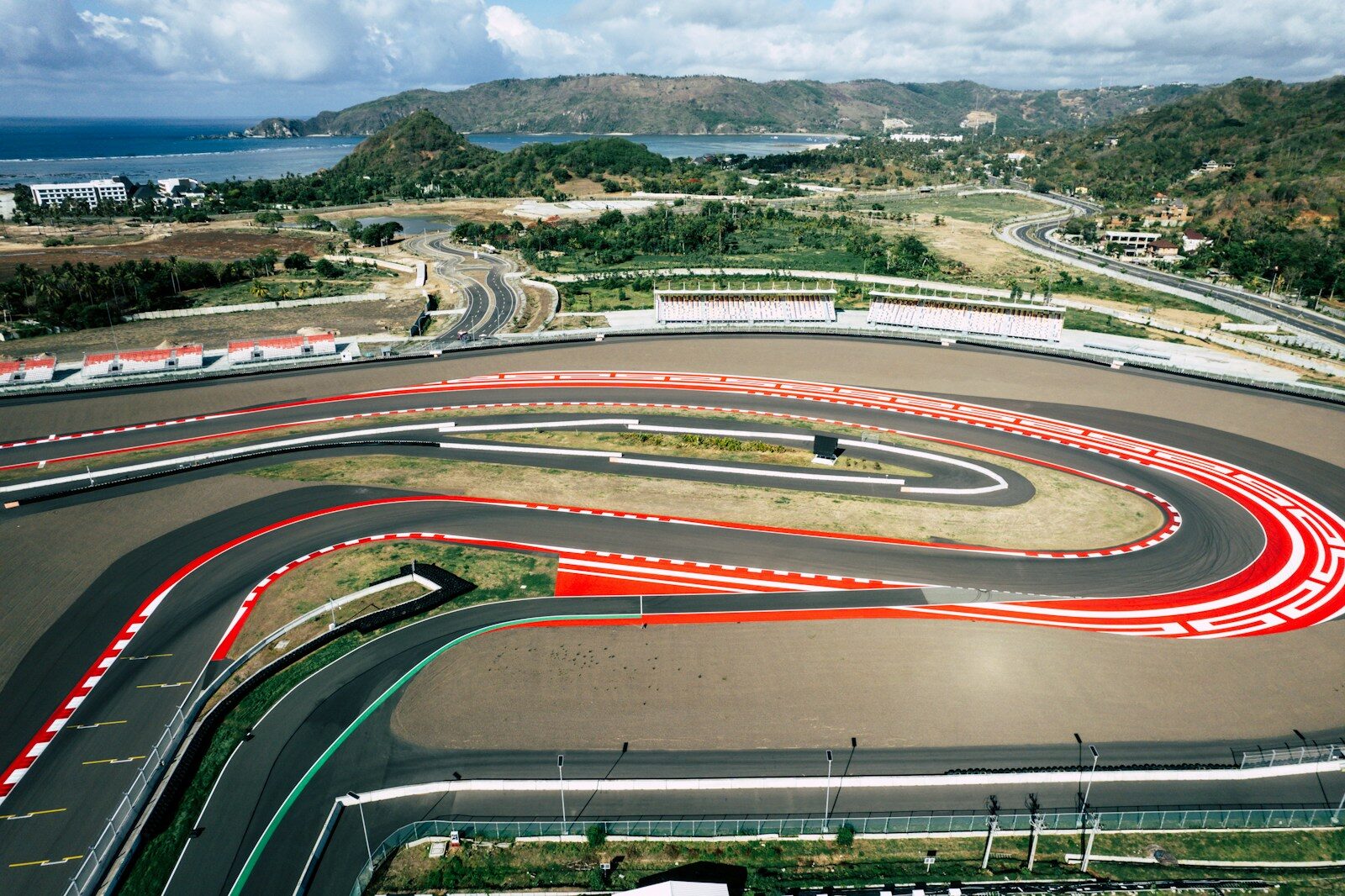
Photo: Afif Ramdhasuma / Unsplash
Boris Said wants to build a racetrack you can live on top of, on the shore of a lake best known for algae blooms and motocross. The plan is called Elsinore Ring, and the public materials are worth reading closely, because the interesting parts are the numbers that check out and the ones that aren’t there at all.
Start with the circuit. The project’s own page puts it at 3.2 miles with 22 turns and three configurations, built so the full lap can be split into independent sections and multiple groups can run simultaneously. Sessions would be sorted by experience level and vehicle category. That last bit matters more than it sounds. Splitting a lap into independent segments is how a club with a few hundred members actually generates track time, because a single 3.2-mile loop running one group at a time is a bottleneck no amount of clubhouse marble fixes. It also means twice or three times the marshal posts, timing loops, access roads and pit-out geometry. Multi-configuration circuits are considerably more expensive per mile than a single ribbon.
The FIA Grade 2 claim is a spec, not a credential
The materials say the circuit is designed to an FIA Grade 2 standard. Understand what that actually is. Per the FIA’s circuit safety page, a licence is issued only after an FIA inspector physically verifies the finished track, and the licence goes to the national sporting authority attesting the circuit meets minimum safety conditions for the categories named on it. A grade is what lets an event be registered on the international calendar. A private members’ club that never runs a sanctioned international race gets no competitive benefit from the paperwork.
Related Articles
- Lewis Hamilton’s Restored Ferrari F40 Rolls Out of Maranello Wearing His Number
- Lando Norris Just Bought His Way Onto the F3 Grid, and the Deal Explains How Junior Racing Really Works
What it does get you is the construction bill. Grade 2 geometry dictates run-off distances, barrier types, debris fencing, medical and rescue facilities, and pit and paddock provisions. Designing to that standard means buying land you’ll never drive on, because run-off is the single biggest consumer of acreage on a modern circuit. For members, that’s a genuine safety upgrade over the typical club track. For the developer, it’s the reason the site plan needs far more dirt than 3.2 miles of asphalt suggests.
Forty residences, and the math that quietly confirms itself
The number floating around is 40 units. The garage villas page is more specific: forty residences per building, twenty on each side, in a structure 525 feet long and 40 feet tall, with every unit facing the track. Each villa gets a 1,300 sq ft climate-controlled garage level for six to eight cars with lifts, a powder room down there, and a one-bedroom residence with an office, a 132-inch display and a 26-foot-wide balcony above. Each building also carries eight to ten penthouses on a third level, plus two rooftop helipads reserved for select penthouse buyers.
Run the numbers on that facade. Twenty units per side at 26 feet of balcony each is 520 feet, against a stated building length of 525. The plan is internally consistent, which is more than you can say for a lot of renderings. It also tells you these are narrow, deep units, essentially a row of luxury industrial condos stacked two levels over a showroom, which is exactly how this asset class works everywhere it exists.
What isn’t in the documents
Here’s the part that should govern how excited anyone gets. The project site names no parcel, no acreage, no construction start and no opening date. The team page lists Said as founder, Joseph DeJesus as partner and master developer, Timothy S. Loy on security and operations, and Finnish architect Seppo Mäntylä. There is no civil engineer, no entitlement consultant and no track designer named on it.
A search of CEQAnet, California’s official clearinghouse for environmental review filings, returns no Elsinore Ring project. And the site’s own banner says the plainest thing on it: they are not taking deposits yet, and when selection opens, members choose in the order they registered.
Why California makes this a long walk
Three specific hurdles apply here, and none of them are optional.
CEQA is the obvious one. A private motorsports facility with permanent residences and an event center for 500 guests is not squeaking through on an exemption. Expect a full EIR, and expect noise to be the fight. A track that runs Grade 2-capable machinery next to a lake with houses on the far shore has a sound propagation problem that no amount of berming fully solves.
Second, habitat. Lake Elsinore is one of the cities listed as a permittee of the Western Riverside County Multiple Species Habitat Conservation Plan. Projects inside the criteria area go through a Joint Project Review with the regional conservation authority before local approval, and undeveloped acreage large enough to hold a 3.2-mile circuit is exactly the kind of ground that triggers it.
Related Articles
- A New Mexico Security Guard’s Fake Traffic Stop Was Illegal Twice Over — Before Police Ever Showed Up
- Harley-Davidson’s Q3 Dividend Is Technically a Pay Cut — and Motorcycles Have Nothing to D
Third, geology. Riverside County’s own mapping notes that Alquist-Priolo Earthquake Fault Zones have been designated for the Elsinore, San Jacinto and San Andreas fault systems within the county, and that projects within those zones need a geologic investigation demonstrating buildings won’t sit across an active fault. The city is named for the fault. Multi-story residential buildings 525 feet long will need trenching and setback studies before anyone pours a footing.
The one thing genuinely working in its favor
The city wants this. Lake Elsinore’s council unanimously adopted an Action Sports Industry Growth & Attraction Plan running from 2026 to 2040, explicitly aimed at expanding facilities and attracting motorsports and outdoor recreation businesses. A municipality that has already written “come build action sports here” into policy is a materially easier partner than a city discovering the idea for the first time at a planning commission hearing. That doesn’t shortcut CEQA, but it does mean staff-level friction should be low.
If you’re thinking about writing a check
Nobody can write one yet, which is the correct posture for a project without an entitlement file. When deposits do open, the questions worth asking are the boring ones: what’s the parcel, what’s the HOA structure and annual dues, who holds the operating rights to the circuit and can they be sold, how many track days per membership tier, and what happens to your villa if the track never gets built or later goes quiet.
Two more that enthusiasts forget. Financing a garage condominium at a racetrack rarely looks like a normal mortgage, so find out what lenders are actually in the deal. And call your insurer before you tow anything through the gate, because on-track use is excluded from a lot of standard auto policies and the exclusion doesn’t care that the track is private.
Lead image: Afif Ramdhasuma on Unsplash
About the Author