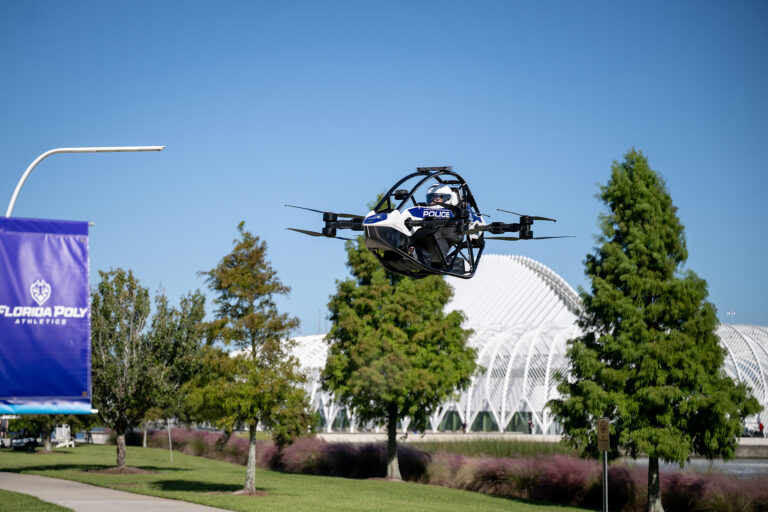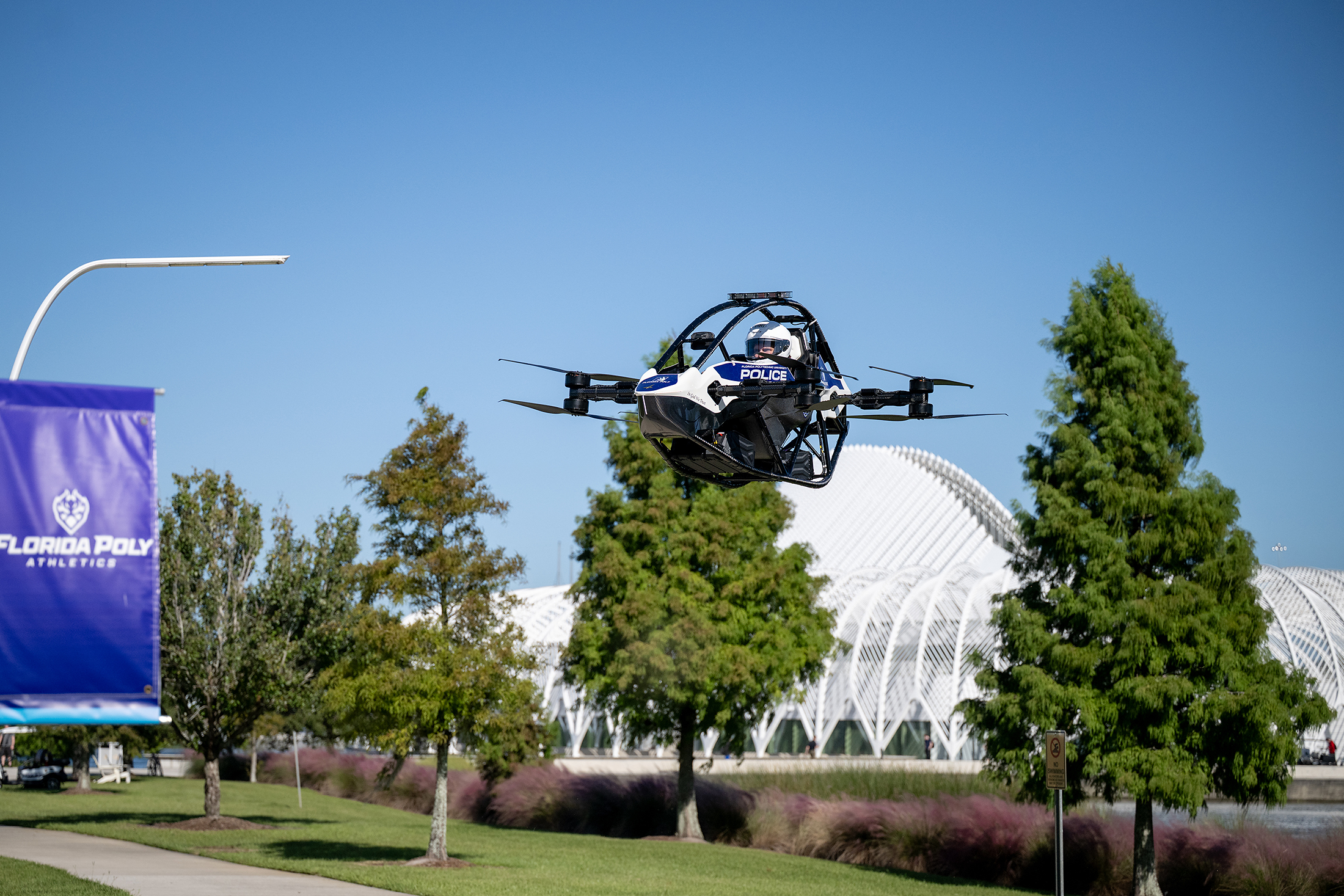
Astro, the Florida Polytechnic University Police Department's Jetson ONE, in flight on the Lakeland campus. Photo: Florida Polytechnic University via PR Newswire
Florida Polytechnic University’s police department owns a single-seat electric aircraft with eight motors, a police light set and a nickname, Astro. According to its manufacturer, it arrived at the Lakeland campus earlier this summer. It has not flown a police mission, because the Federal Aviation Administration hasn’t approved it for one.
The university announced Astro on Oct. 20 in a press release that calls its department “the first law enforcement agency in the nation” to integrate an eVTOL into its operations, and says Florida Poly is “in the final stages of seeking approval” from the FAA. Jetson, the California company that builds the aircraft, posted its own announcement the same day under a bigger headline, “World’s First Electric Flying Police Patrol Vehicle.” Its first paragraph then credits that description to the university.
Neither release gives a price or a date for approval. The university’s doesn’t say what kind of approval it needs. Jetson’s does, in two phrases: the university “required Part91 approval,” and the Jetson ONE is “a PART103 recreational platform.” Those two sets of federal rules explain why Astro can’t go on patrol yet.
The ultralight rules
Part 103 is the FAA’s ultralight regulation, and it is why Jetson’s product page can say “No pilot’s license required in the United States.” An ultralight needs no airworthiness certificate, no registration and no pilot or medical certificate. In exchange, the rule sets hard limits: one occupant, less than 254 pounds empty for a powered vehicle, and no more than 55 knots at full power in level flight. Jetson software-limits the ONE to 102 km/h (63 mph). That is 55 knots.
The same section only covers vehicles “used or intended to be used for recreation or sport purposes only.” A patrol is neither. Part 103 also bans flying over congested areas and flying between sunset and sunrise, which would rule out a storm-recovery flight after dark. When Jetson CEO Stéphan D’haene told the university his company had always looked for “the use case beyond the recreational intent,” he was describing a regulatory boundary as much as a business plan.
Leaving Part 103 puts the aircraft under Part 91, the general operating rules for most U.S. aircraft, which expect a registered aircraft with an airworthiness certificate and a certificated pilot. Government agencies have another option. The FAA says state and local bodies that own their aircraft and fly governmental functions, law enforcement among them, may qualify as public aircraft operations. Florida Poly is a member of the State University System of Florida. Its release doesn’t say which route it is taking.
Weight and the tail number
Jetson says the Jetson ONE has “plenty of empty weight allowance” for mission equipment and the light set. Its spec page lists the aircraft at 115 kg (253 lb) with batteries and 55 kg (121 lb) without, against the 254-pound ultralight ceiling. Jetson’s homepage gives a third number, an “all up weight” of 86 kg. The company doesn’t say which figure the allowance is measured from.
The pilot limit is 95 kg (210 lb), and the spec sheet doesn’t say whether an officer’s vest and duty belt count toward it. Flight time is listed as approximately 20 minutes.
Jetson also says Astro carries the registration N911FP. Ultralights don’t need N-numbers, so registering one is a step toward Part 91. When we checked the FAA aircraft registry on Oct. 21, it returned “N911FP is Deregistered,” and a name search for Florida Polytechnic returned no aircraft. The registry updates each federal working day, so the paperwork may not have posted yet.
Delivered and trained
Jetson says the department’s pilot-officers are “fully trained,” Police Chief Aaron Murray among them. The university’s release mentions neither the delivery nor the training. In it, Murray lists the jobs he has in mind: watching the campus and surrounding acreage, reaching places a patrol car can’t, helping after storms and delivering emergency supplies. The department also plans to offer Astro to other agencies in the region.
Florida Poly’s police added a drone unit recently, and drones already handle much of that list for departments elsewhere. Colorado Springs police used one to watch a stolen Taurus go the wrong way down Academy Boulevard last month. Astro’s difference is a seat for an officer. Murray compares it to bicycles, motorcycles and drones, all of which he says were once dismissed as toys before becoming standard police equipment.
Getting one took a favor. D’haene said Jetson moved Florida Poly ahead of a three-year waiting list because of the school’s STEM focus and the department’s public-safety purpose. Jetson’s site says it is now taking orders for 2028, and its first customer delivery went to Oculus and Anduril founder Palmer Luckey.
The aircraft also has an academic job. Florida Poly started an aerospace engineering degree this fall, and the university says faculty and students are already planning to use Astro’s real-time operational data for research and senior capstone projects.

Florida’s eVTOL push
On March 9, the FAA named the Florida Department of Transportation one of eight participants in its eVTOL Integration Pilot Program, with Archer, BETA, Electra and Joby among the state’s industry partners. FDOT’s SunTrax test facility in Auburndale, which the university puts four miles from campus, expects eVTOL testing to start by the end of 2026.
Astro’s next public appearance is set. Jetson says the aircraft will be at the public days of UP.Summit at Kennedy Space Center on Nov. 7 and 8. Neither the company nor the university has said whether the FAA will have signed off by then.
Is a 20-minute, single-seat ultralight a useful police tool, or should a campus department stick with the drone unit it already has?
Sources: Florida Polytechnic University press release via PR Newswire (Oct. 20, 2026); Jetson news release and Jetson ONE specifications; 14 CFR Part 103; FAA public aircraft operations guidance; FAA aircraft registry; FAA/DOT eVTOL Integration Pilot Program announcement (March 9, 2026).
About the Author