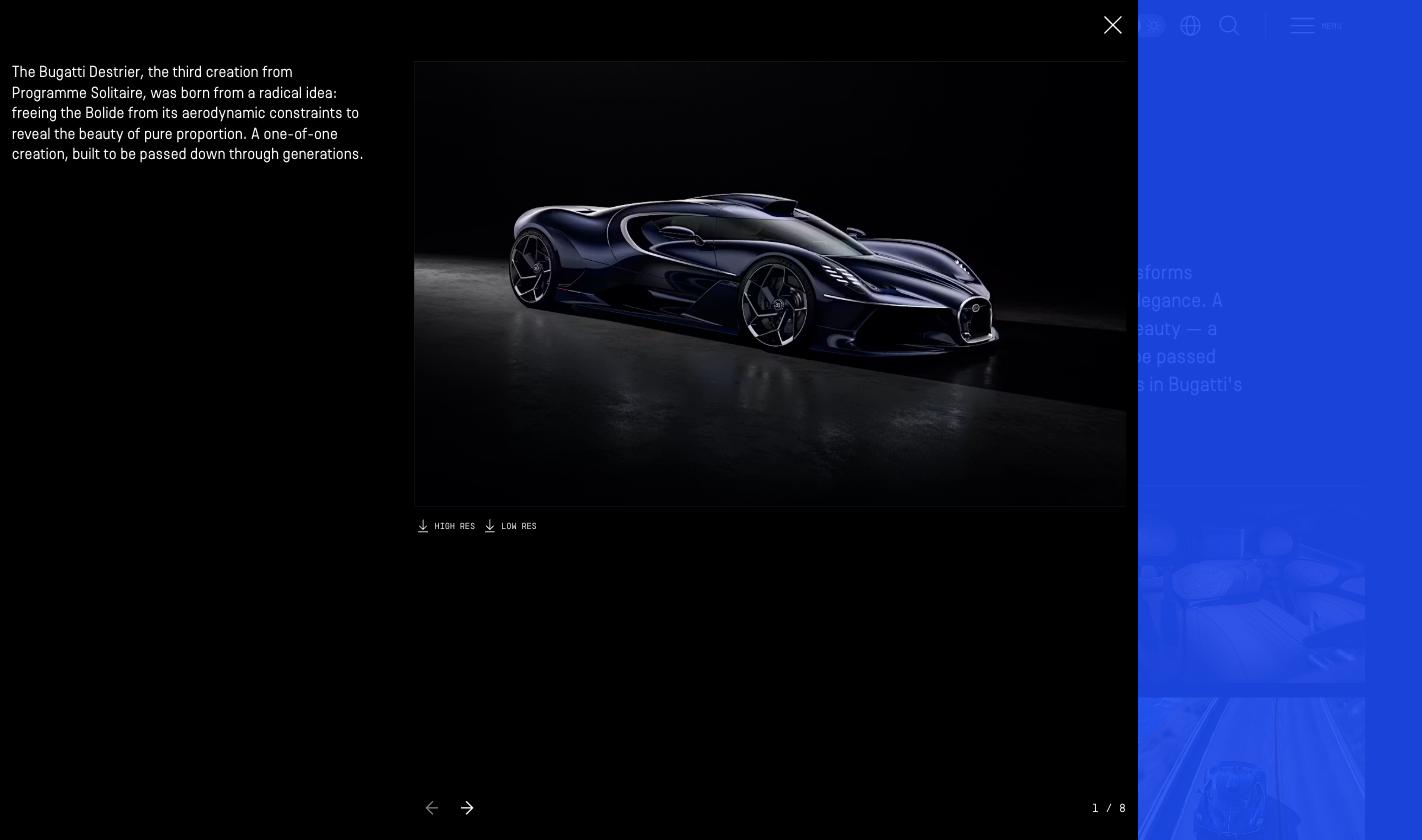
Bugatti spent years perfecting the Bolide as a downforce machine, a track-only weapon dressed in wings, dive planes, and vents to keep it planted at triple-digit speeds. Its answer to “what’s next” was to build a second Bolide, then strip off every piece of that aerodynamic hardware.
The result is called Destrier, named for the biggest and strongest breed of medieval war horse, and it’s the third car to come out of Bugatti’s Programme Solitaire — the marque’s invitation-only commission arm for clients who already own a Chiron, a Bolide, and probably a Tourbillon, and want something with just their name on the build sheet. It’s set to make its public debut at the Pebble Beach Concours d’Elegance on August 16, 2026, the closing weekend of Monterey Car Week.

Undressing a Race Car on Purpose
The Bolide’s downforce package exists because at speeds north of 300 km/h, a car needs serious aerodynamic help to stay glued to the road. Destrier keeps the Bolide’s carbon-fiber monocoque and its 1,600-PS quad-turbo W16, but deletes the front splitter, dive planes, massive rear wing, and underbody venturi tunnels that gave the Bolide its cornering grip. What’s left standing is a car just one meter tall, the lowest roofline Bugatti has ever produced, riding on 20-inch front and 21-inch rear wheels, a jump up from the Bolide’s 18-inch units. Against bodywork pared down to bare volumes, those wheels look enormous, which is precisely the point.
Worth sitting with that for a second, because it’s a strange flex. Removing downforce hardware from a car engineered around downforce is harder than bolting more of it on — every panel that used to manage airflow now has to just look right, with no vents to hide behind. It also tells you exactly what this car is for. Without the Bolide’s aero, Destrier isn’t going to lap a circuit anywhere near its potential; it’s a static sculpture built on a race car’s bones, destined for garages and concours lawns rather than apexes.
The Same Chassis Trick Bugatti Pulled in the 1930s
Bugatti has actually done this before. The Type 57 chassis of the 1930s underpinned both the streamlined Type 57G and 57C “Tank” racers that won Le Mans outright in 1937 and 1939, and the Type 57SC Atlantic, the car most often nominated as the most beautiful automobile ever built. One rolling chassis, a Le Mans winner and an art object. Destrier and the Bolide repeat that split personality with modern hardware, and Bugatti isn’t shy about the connection: a hand-laser-engraved plate above the windscreen depicts both the Tank racer and the Atlantic, permanently linking the new car to the old story.
That heritage isn’t just sentimental copy for a press kit. Pre-war Bugattis with pedigrees like the Atlantic’s routinely top collector-car valuations, and even Bugattis without a Le Mans win attached to their history have shown how much value the badge alone can carry once the right buyer notices.
Where the Sculpture Gets Specific
Bugatti’s signature C-line — the chrome sweep that usually runs unbroken along each flank — actually pauses just ahead of the front wheel well on Destrier, letting bare, unadorned bodywork show through before the line picks back up and runs into a horseshoe grille that’s noticeably wider than the Bolide’s. Around back, a slim blended wing borrows its shape from the Chiron Profilée rather than anything track-focused. Because the Bolide’s cabin already sits low and pinched between the front fenders, Destrier’s flanks can pull in sharply behind the doors before flaring back out over the rear wheels, giving the car a waist-and-hip stance you’d normally only see in a designer’s sketchbook, not on a certified road-legal shape.

The paint carries its own history lesson. Destrier wears a bespoke, multi-layered color called “Sapphire Celeste,” mixed with a diamond-inspired sparkle and created exclusively for this car and its owner. It’s a deliberate nod to chassis 57591, the so-called “Pope” Atlantic, which originally wore blue paint before its current owner had it repainted black. The exposed carbon fiber is limited to the front splitter and rear diffuser and tinted to match, while brightwork in the engine bay gets a hammered surface finish — a wink at the hand-beaten armor worn by an actual medieval destrier.
Inside, It Trades the Race Suit for a Tailored One
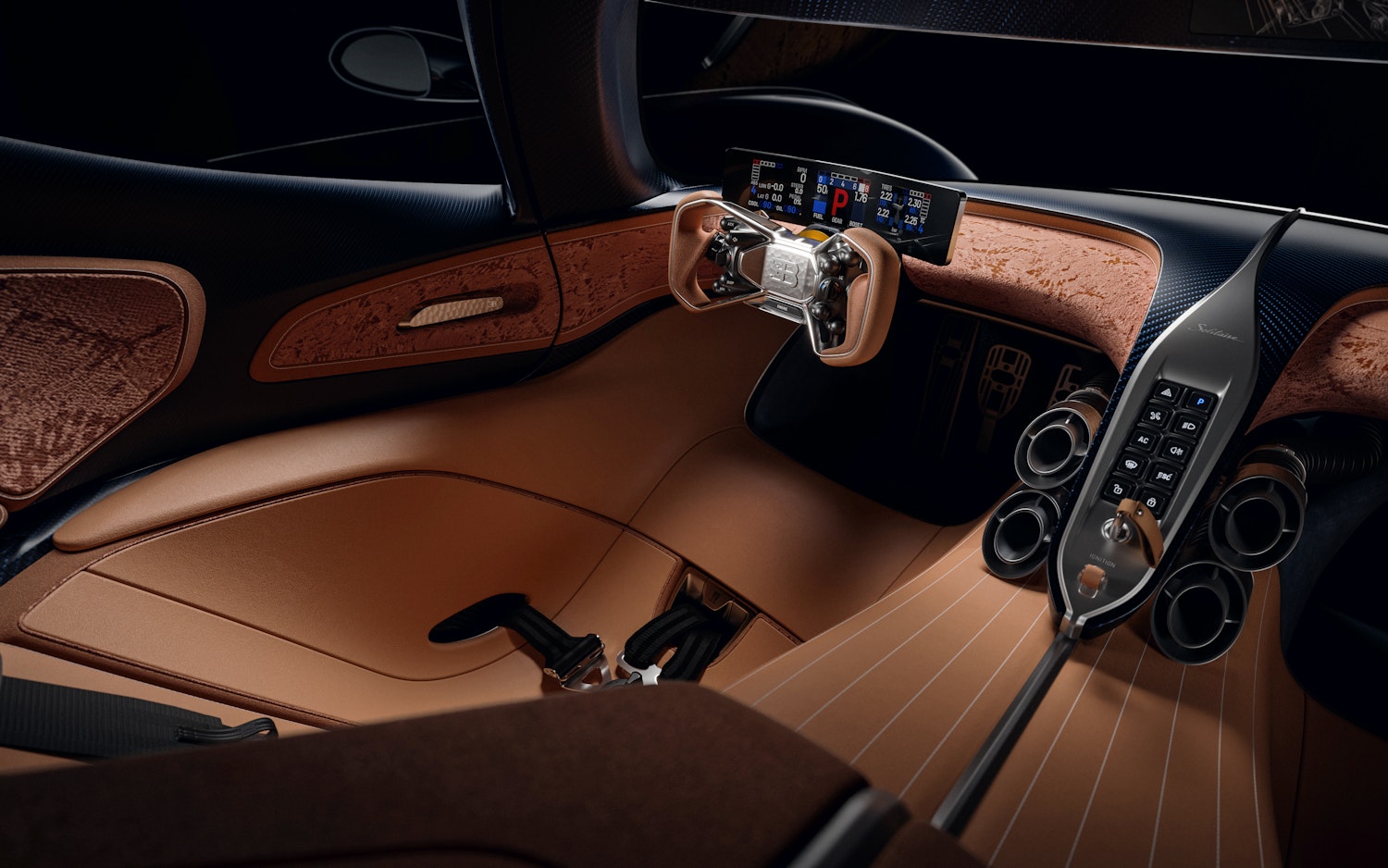
The Bolide’s cockpit is stripped-down and motorsport-focused. Destrier’s is not. Three materials define the cabin: leather and nubuck in a warm brown called “Ambre Voyageur,” plus a 3D-knitted textile borrowed from haute couture and performance sportswear, shot through with copper yarns woven into a circular “halo-line” pattern that wraps around the interior. Contrast stitching repeats the theme on the headrests and center console, and the hammered brightwork finish from the engine bay returns on the door opener, air vents, steering wheel hub, and entry plate. A small French flag sits at the center of the cabin, and the oil filler cap — visible proof this is Bugatti’s third Solitaire build — carries the Destrier emblem alongside a “1/1” designation.
The 1,600-PS Detail Bugatti Almost Buries
That output comes straight from the Bolide’s existing quad-turbocharged 8.0-liter W16, and Bugatti mentions the number almost as an afterthought — evidence of how little the brand thinks its buyers care about a spec sheet on a rolling sculpture. It’s also one of the last new applications of an engine on its way out. Bugatti’s new flagship, the Tourbillon, dropped forced induction and the W16 altogether for a naturally aspirated V16 hybrid, which makes Destrier something of a farewell lap for the powerplant that built the modern Bugatti legend. Demand for that new V16 car is already tight enough to have caused real friction at the dealer level.
Why One Rich Buyer’s Toy Is Worth Watching
Bugatti doesn’t publish a price for Programme Solitair commissions, and it doesn’t have to — these builds are quoted privately to clients who already own most of the rest of the lineup. What’s more useful for everyone else to notice is the pattern behind it: rather than engineer an entirely new platform for a showpiece, Bugatti is stretching an existing hypercar chassis into a second, radically different car. It’s a cheaper, faster way to manufacture exclusivity, and Bugatti isn’t the only manufacturer leaning on that playbook to keep ultra-wealthy clients interested between full model cycles.
Gordon Murray Automotive is running a version of the same strategy from the other direction, building small-batch hypercars fast enough to show up at events with multiple examples in tow rather than a single concept. Destrier’s debut lands during a Monterey Car Week already stacked with reveals competing for the same collector attention, including a low-volume American hypercar teasing its own headlights ahead of an August 3 unveiling. Bugatti picked a very specific weekend to remind everyone who still sets the bar for automotive theater.
Bugatti’s design director, Frank Heyl, summed up the intent bluntly: “Destrier is not a car you understand with your head, it is a car you feel with your heart.” Whether that lands depends entirely on whether you’re the kind of buyer who commissions a seven-figure sculpture off a race car’s chassis in the first place. Everyone else gets their first look at Pebble Beach on August 16, 2026 — parked, presumably, a very safe distance from anything resembling a curb.
About the Author