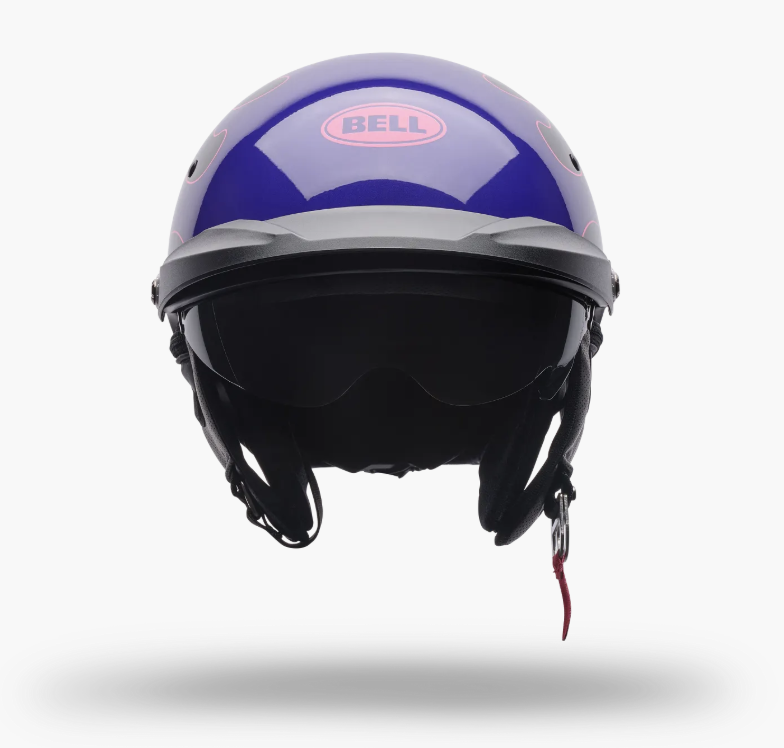
Bell Sports has told federal regulators that a batch of its Pit Boss half helmets can’t pass the one test that actually matters. The company filed a noncompliance recall with NHTSA on Aug. 26 covering 400 helmets in size medium, built between Jan. 1, 2025 and Jan. 31, 2026, because they don’t meet the impact protection requirements of Federal Motor Vehicle Safety Standard No. 218. Bell will replace the helmet or refund the purchase price, owner letters were slated to go out Sept. 7, and the customer service line is 1-800-216-9446.
NHTSA tagged the campaign with a “do not drive” advisory, which reads a little strangely on a piece of headgear. That field exists because the recall database was built around cars. Translated into rider English: stop wearing it.
What “size medium” actually means here
The recall says medium, and that’s worth unpacking, because half helmets rarely have a one-to-one relationship between labeled size and molded shell. Manufacturers routinely spread two or three labeled sizes across a single shell, varying the thickness of the expanded polystyrene liner to change the fit. Bell currently lists the Pit Boss in XS/S, M, L, XL/XXL and XXXL, with the medium weighing 980 grams plus or minus 50, wrapped in the company’s TriMatrix aramid-carbon-fiberglass shell.
Related Articles
- Tom Cruise Just Confirmed the Days of Thunder Sequel, and the Teaser Car Says More Than the Trailer Does
- Martha Stewart’s Cozy Robotaxi Tour Left Out One Detail: Congress Wants to Ban Where It’s Built
For compliance purposes, though, NHTSA doesn’t care about shells at all. Its lab procedure assigns a headform based on the discrete size printed on the helmet: hat size 6-3/4 or smaller gets the small headform, anything above that up to 7-1/2 gets the medium, and above 7-1/2 gets the large. Here’s the part most riders never think about — the headform assemblies weigh different amounts. Small is 3.4 to 3.6 kg, medium jumps to 4.9 to 5.1 kg, large to 6.0 to 6.2 kg. Drop them at the same velocity and the medium arrives with roughly 40 percent more kinetic energy than the small. A liner geometry that comfortably clears the limits on one headform can run out of crushable foam on the next one up. That’s exactly how a single size fails while its siblings pass.
The test that killed it
FMVSS 218’s impact attenuation protocol is unforgiving in a way that surprises people. Four helmets are conditioned four different ways — ambient, soaked in water, baked at 45 to 55 degrees Celsius, and frozen at minus 15 to minus 5 — then each one is struck at four sites, twice per site, on both a flat steel anvil at 5.8 to 6.2 m/s and a hemispherical anvil at 5.0 to 5.4 m/s. That’s 32 impacts across the set.
The double hit at the same location is the real filter. EPS is a single-use energy absorber; it crushes, and crushed foam doesn’t spring back. The second impact lands on partially spent material. A helmet fails if peak acceleration exceeds 400 g, or if the trace spends more than 2.0 milliseconds above 200 g, or more than 4.0 milliseconds above 150 g. Thin-liner half helmets live closest to those numbers by design, because there simply isn’t much room between your skull and the anvil.
Worth remembering that FMVSS 218 classifies a half helmet as “partial coverage” — it protects the top of the skull and explicitly not the ears, base of the skull, lower face or chin. Even a compliant one is the least protective legal option on the shelf.
This is Bell’s second helmet recall in nine months
In December, Bell filed a similar report covering 150 Scout Air helmets — smalls from November 2022 and larges from December 2023. That one started when NHTSA bought helmets off the open market and tested them. Bell reviewed batch data and customer service records, called it an isolated manufacturing error, and told regulators current production had been recertified at the factory and at two third-party labs. The helmets came from Strategic Sports Limited in Hong Kong and were purchased through Bell’s Rantoul, Illinois operation.
Whether the Pit Boss shares any of that supply chain isn’t stated in the public NHTSA summary, and Bell hasn’t said. As of this writing, Bell’s own recall landing page still lists only the Scout Air, Slope, Soquel and the Axle/Cadence/Rev/Passage/Frenzy bike helmets. No Pit Boss. In the Scout Air filing Bell committed to posting the notice the same day dealers were notified, so expect that page to be updated.
What owners and buyers should do
Check the date code first. FMVSS 218 requires the month and year of manufacture to be permanently labeled where you can read it without pulling padding; on the Scout Air, Bell pointed customers to the chin strap. If yours falls in the January 2025 through January 2026 window and it’s a medium, it’s in scope.
Related Articles
- Truck Repair Bills Just Hit an All-Time High — and Congress Might Decide Who’s Allowed to Fix Yours
- Top Gear Is Coming Back. The Lawsuit From the Crash That Nearly Killed Freddie Flintoff Isn’t Over
Expect the remedy to require destruction. Helmet makers almost universally ask for the strap to be cut and photographed before issuing a refund, both to keep the unit off the resale market and to satisfy their obligation under 49 U.S.C. § 30112(a), which makes it illegal to sell equipment that doesn’t meet a federal safety standard. That statute binds manufacturers, distributors and dealers — not you. Nothing about riding a recalled helmet is a citable offense, and a trooper in a helmet-law state checking for a DOT label will find one, because the label was never the problem.
The place it could actually bite is civil. In a comparative-negligence state, defense counsel in an injury suit has an obvious opening if the helmet you were wearing was under an open impact-protection recall. That’s speculative, but it’s free to avoid — the replacement costs nothing.
And there’s no repair path here. A helmet liner is a one-use crush structure. There’s no inspection, no reconditioning, no “have a shop look at it.” Bell’s only options are a new helmet or your money back, which tells you everything about how EPS works.
Images Via: Bell
About the Author