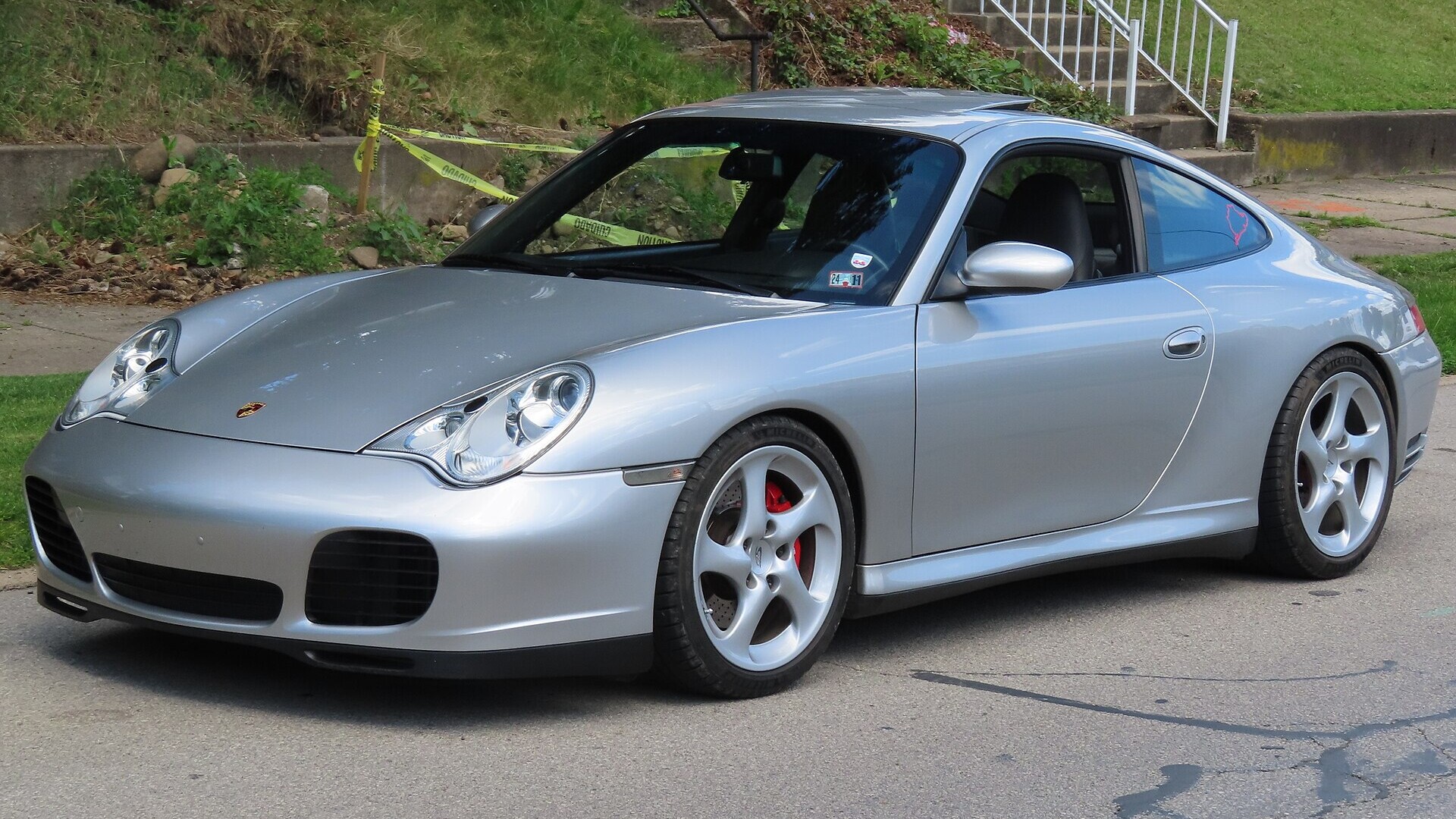
Photo: MercurySable99 / Wikimedia Commons (CC BY-SA 4.0)
Repco and the entertainment group ShowTime unveiled a Porsche 996 at Mount Panorama in Bathurst, New South Wales, on Oct. 7 with its engine moved from behind the rear axle to the front: a twin-turbo LSX V8 that ShowTime brand ambassador Gary Reid describes as a 427, poking through the bonnet of a car now called the ShowTime Repco-Mod 933. Repco’s release puts the output at more than 1,200 horsepower.
Reid started with what Repco calls a tired shell and boxes of parts. By Repco’s account, his team then spent more than 2,000 hours fabricating the firewalls, floor, transmission tunnel, roll cage and other structures, and the finished body uses more than 280 separately fabricated parts. Reid says “the plan was simple”: a big V8 in the front of a 911, wrapped in a one-off widebody kit.
The engine is up front and the radiator is in the back
A stock 996 carries its flat-six behind the rear axle, and that layout is a large part of why a 911 drives the way it does. The 933 reverses it. According to Repco, the V8 sits ahead of a full-height firewall, the handmade exhaust exits through the bonnet, and an eight-speed Bentley sequential gearbox sends power to a fabricated motorsport rear end. Two Turbosmart turbochargers supply the boost.
The cooling system went the opposite direction. Repco says it is mid-mounted on that firewall, behind the passenger compartment, and is reached through a single-piece rear window that combines with the former engine cover. Repco notes that this effectively makes the car a hatchback. The steering wheel works the front wheels, while a sequential shifter and a hydraulic rear handbrake, both carbon levers, work the rear.
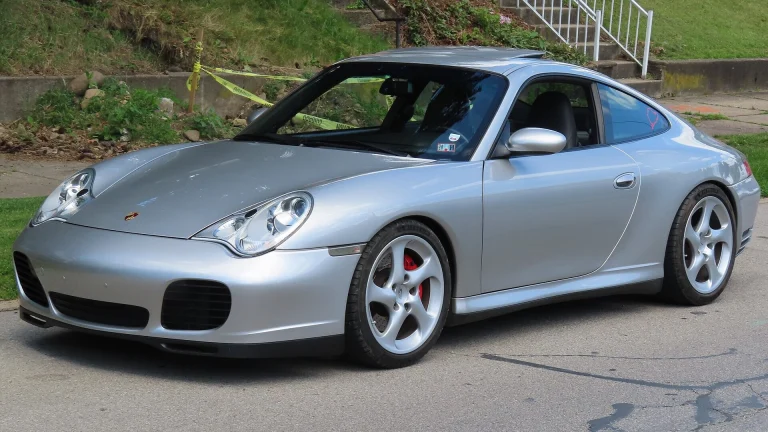
The 996 was the first water-cooled 911, introduced for the 1998 model year, and a stock Carrera of that generation makes roughly 300 horsepower. Repco’s figure is about four times that, and it is a claim. The release and the video description both say “more than 1,200 horsepower” and the spec table lists 0–100 km/h as a joke instead of a time. Porsche itself has sold a front-engine V8 coupe, the 928, which arrived in 1977, so the layout is not foreign to the brand. The turbos and the stunt duty are the additions.
A parts retailer’s stunt car
Repco is an automotive parts and accessories retailer, and its release presents the car as a tribute to the custom builders who shop there. The 33 comes from ShowTime’s traditional racing number, and the paint is a Toyota LandCruiser shade called Sandy Taupe. Repco says the car will soon begin work in the team’s stunt fleet, with appearances already scheduled at some of Australia’s biggest car-culture events. The reveal video on Repco’s YouTube channel went up Oct. 8.
The release does not give a build cost, does not say whether the car is registered for road use, and does not list dates for those appearances. Reid thanked a long list of suppliers, among them Haltech, Turbosmart, Rotiform Wheels and Hoonigan. A stunt car is judged by whether it survives repeated use, and a 1,200-horsepower claim means little until someone puts the car on a dyno.
Plenty of builders swap engines. This one flipped the layout end for end. Backfire News covered a Fiero dressed as a Ferrari F40 in California, and the opposite approach, keeping the flat-six and adding boost, shows up in Gunther Werks’ 860-hp 911. In the 933 the engine layout itself is what changed, and the car is headed for crowds rather than a garage.
A tired 996 gets a 1,200-hp V8 up front and a radiator in the back. Is that a better 911, or just a louder one?
About the Author