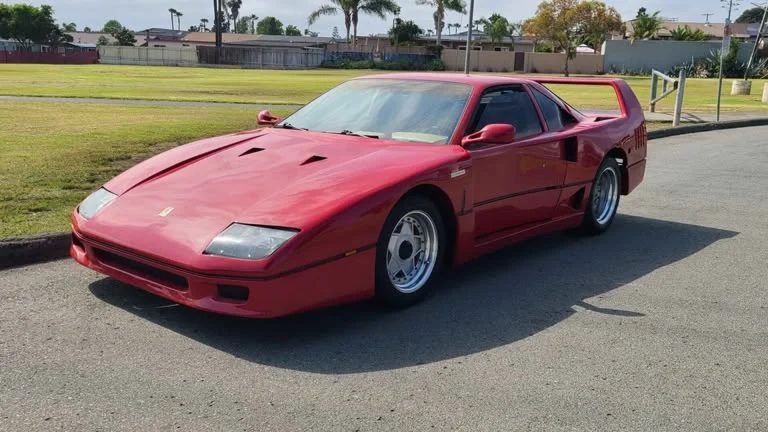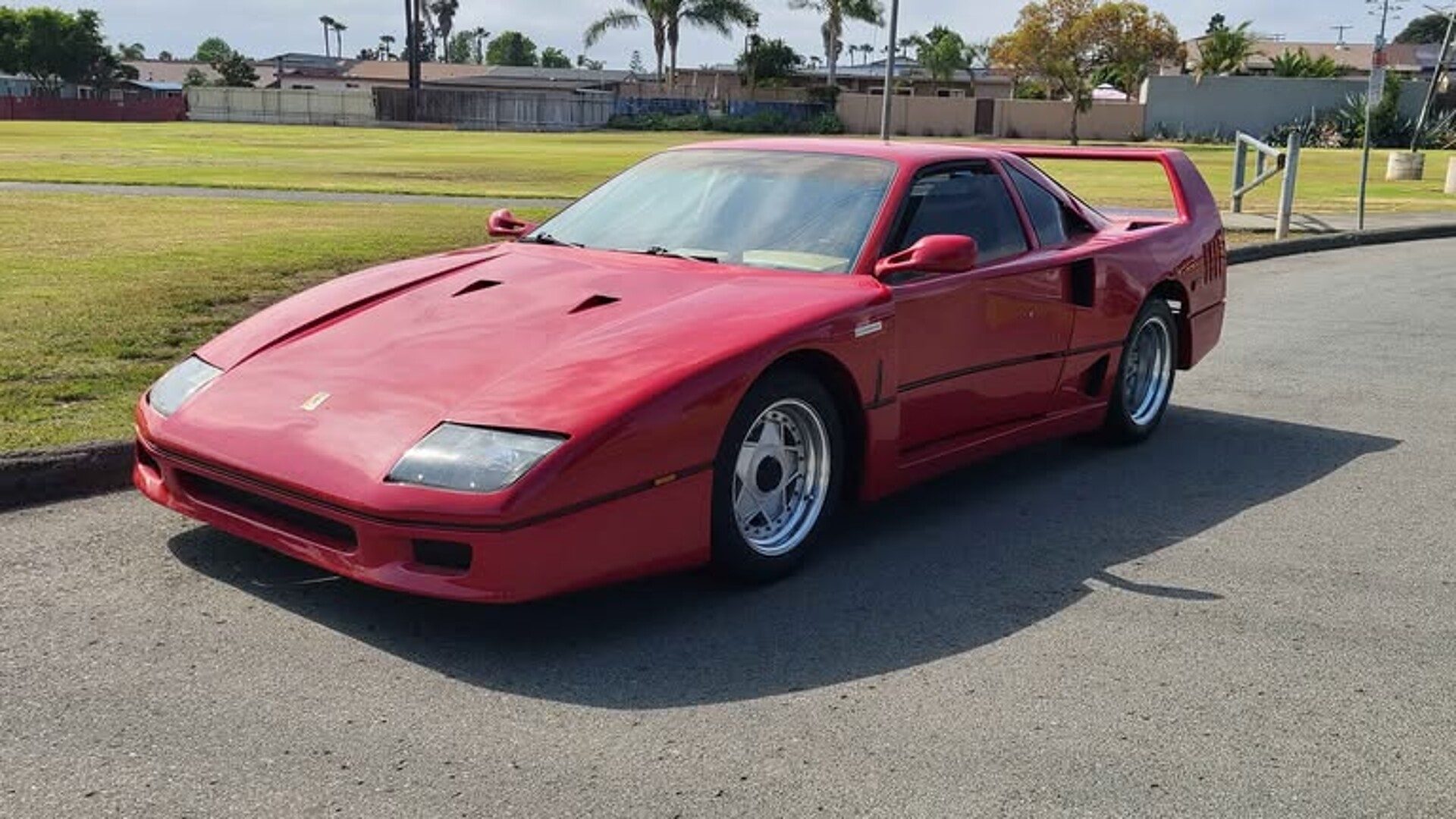
Photo: seller's Facebook Marketplace listing, Chula Vista, Calif.
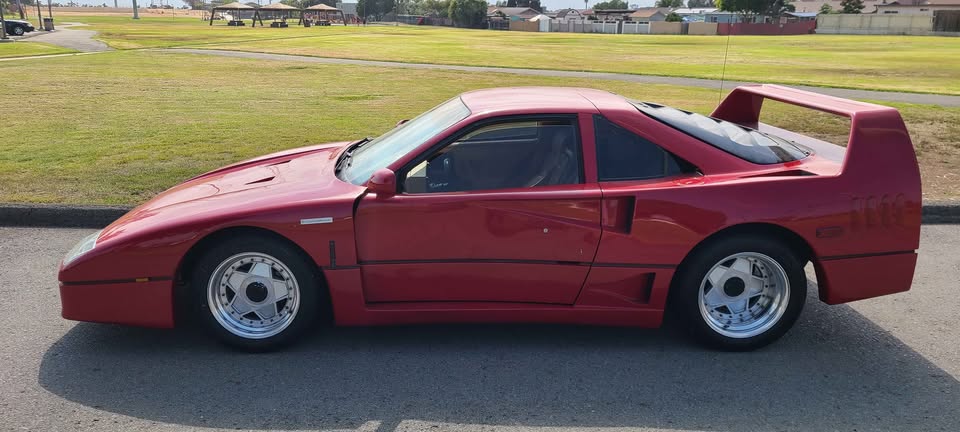
A private seller in Chula Vista, California, has a red Ferrari F40 listed on Facebook Marketplace for $35,000, and the entire description is one line: “F40 kit car, base off Fiero v6. Automatic.” The condition box reads “Used – like new.” In January, RM Sotheby’s put an estimate of $2.8 million to $3.2 million on a genuine 1991 F40 for its Arizona sale, which puts this car’s asking price at between 1.1% and 1.25% of the real thing.
Nobody shopping at that price thinks they are buying a Ferrari. The legal question is who owns the shape, and the law answers it two different ways. California’s Department of Motor Vehicles will keep calling this car a Pontiac for as long as it’s registered. A federal appeals court, ruling on a Fiero-based Ferrari replica business 35 years ago, decided the shape belongs to Ferrari.
A Pontiac Fiero under an F40 body in Chula Vista
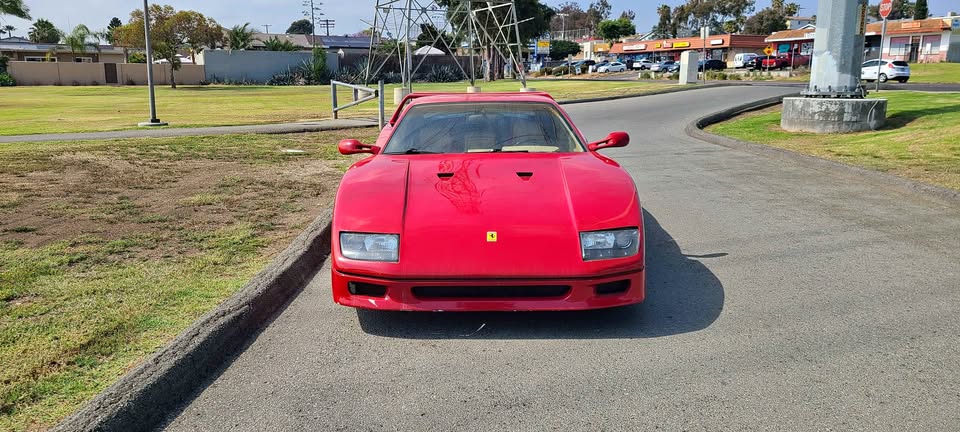
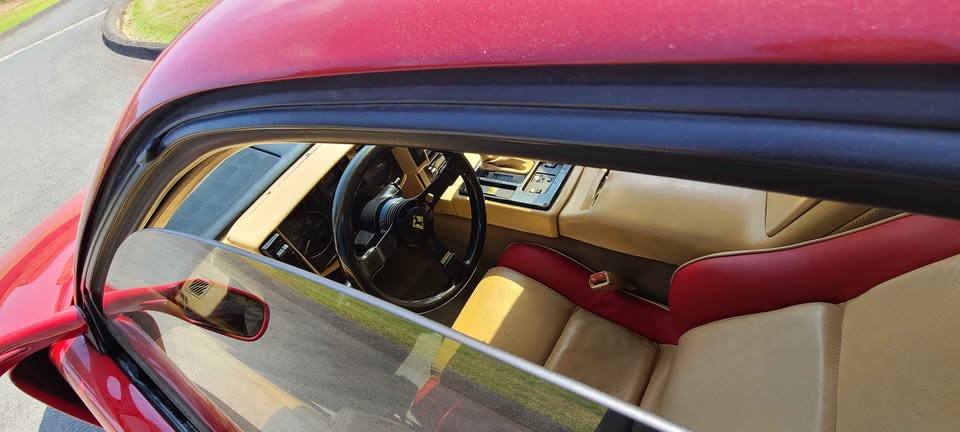
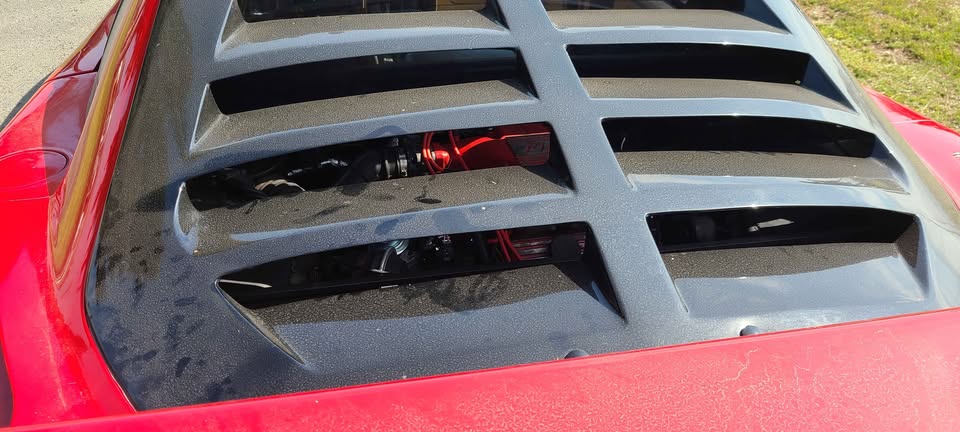
The seller’s photos show the F40’s low nose, slatted engine cover and full-width rear wing, parked on pavement beside a grass field and sitting on polished aftermarket wheels. Through the engine-cover louvers you can see red-painted engine parts. The open driver’s door shows tan and red seats. The listing gives no model year, mileage, builder or body maker, and no price for the kit or the build.
Ferrari’s own history page says the F40 was announced in mid-1987 to mark the company’s 40th year of building cars and was the last new car presentation Enzo Ferrari attended before he died in August 1988. Ferrari lists a 2,936cc turbocharged V8 with a claimed 478 bhp at 7,000 rpm, and production of 1,311 cars that ended in 1992. The Chula Vista car uses the V6 that Pontiac put in the Fiero and, according to the listing, an automatic transmission.
Ferrari v. Roberts: the 1991 ruling against a Fiero-based replica maker
Fiero-based Ferraris have been in federal court before. Carl Roberts, doing business as Roberts Motor Company, sold fiberglass replicas of Ferrari’s Daytona Spyder and Testarossa under the names Miami Spyder and Miami Coupe. According to the U.S. Court of Appeals for the Sixth Circuit’s opinion, the body was “usually bolted onto the undercarriage of another automobile such as a Chevrolet Corvette or a Pontiac Fiero.” Most were sold as kits for about $8,500, and a turnkey car cost about $50,000.
Ferrari sued under Section 43(a) of the Lanham Act, the federal law that protects trade dress: the look of a product that buyers associate with the company that makes it. Its claim rested on unregistered trade dress. Ferrari argued that the shapes themselves told the public who made the car. A federal trial court in Tennessee agreed and permanently barred Roberts from making or selling the Miami Spyder, the Miami Coupe and “all versions thereof.” On September 5, 1991, the Sixth Circuit upheld that order.
Roberts’s buyers knew they were not getting Ferraris. The court held that didn’t matter. The protection “is not limited to confusion at the point of sale,” the majority wrote, because “consumers care that they are purchasing a Ferrari as opposed to a car that looks like a Ferrari.” The opinion also noted evidence that “members of the public, but not necessarily purchasers, were actually confused” by the replicas. The confusion the court counted could happen when other people saw a replica parked or driving past.
Judge Cornelia Kennedy dissented. In her view, the majority was protecting Ferrari’s design, not protecting consumers from confusion. “The appropriate remedy is not to prohibit the copying of a particular article, but to require adequate identification,” she wrote. Her alternative, a requirement that replicas be clearly identified, did not carry the panel.
The ruling doesn’t automatically reach the Chula Vista seller. The Sixth Circuit covers Kentucky, Michigan, Ohio and Tennessee, not California. The order bound one company that was building and selling new kits, not a private owner reselling a finished car. And Ferrari’s enforcement record is uneven: Backfire News covered an F40-inspired build that Ferrari’s lawyers did not shut down. The case still matters to anyone building or selling new bodies, because the Sixth Circuit treated the shape itself as Ferrari’s whether or not the buyer was fooled.
Why California’s DMV still calls it a Pontiac
California has a separate registration category for home-built cars, called specially constructed vehicles, or SPCNS. The DMV’s fact sheet says the first 500 applicants each calendar year get a certificate of sequence, and an SPCNS car’s first smog certification has to come from a Bureau of Automotive Repair referee center. Kit cars can qualify, often with “kit” recorded as the make. A rebodied production car does not qualify. The fact sheet says: “A vehicle modified by a body change, with a title showing the correct vehicle make, cannot be registered as SPCNS.” Its example is a Toyota with a Rolls-Royce-style grille, which stays a Toyota “because it still resembles a Toyota.”
The listing says this car is built on a Fiero. If its title matches, the buyer is registering a 1980s Pontiac, and that decides the paperwork. The Bureau of Automotive Repair requires a smog check on gasoline vehicles from model year 1976 and newer when they change hands. The seller has to get the inspection before the sale, and a car bought from a private party must have passed within the last 90 days. Every Fiero falls inside that rule, so this car must pass smog on the Fiero side of its paperwork even though it looks like an F40.
The vehicle identification number matters too. Under California Vehicle Code Section 10751, no one may knowingly buy, sell or possess a vehicle whose manufacturer-applied identification number has been “removed, defaced, altered, or destroyed” unless the DMV has assigned or approved a replacement. If such a car comes into a peace officer’s custody, the statute allows a court to order it destroyed, sold or otherwise disposed of after a hearing. A rebody can bury or remove the panels that carried the original number. A buyer paying $35,000 cash for a Pontiac with a Ferrari body has a direct interest in finding the Fiero’s VIN on the car and matching it to the title.
Fiero-based exotic replicas from Tennessee to Arizona
The Fiero keeps turning up under these bodies because it’s a cheap American car with the engine behind the seats, the same layout as the F40, the F50 and the Testarossa. Roberts was using Fieros before the 1991 ruling. In December, Backfire News covered a Fiero-based Ferrari F50 replica listed for $9,500 in Yuma, Arizona. Fiero owners have also gone the other direction and swapped in Cadillac V8 power while keeping the Pontiac body.
A turnkey Roberts replica cost about $50,000, according to the 1991 opinion. The Chula Vista F40 asks $35,000 decades later, with no builder named and no build records mentioned in the listing. A real F40 trades in another market entirely. Backfire News covered a 1,771-mile F40 headed to auction with no reserve earlier this year, and RM Sotheby’s estimated its January F40 at up to $3.2 million.
What the $35,000 buys in California
Whoever buys this car gets an F40 silhouette on a San Diego County street, a Pontiac V6 and automatic to drive it, and a title that, if it matches the listing, says Pontiac. They will also get a smog check under the Fiero’s rules, a VIN to verify before any money changes hands, and a body shape that Ferrari has successfully defended in federal court against the people who make them. The listing was still marked “In stock” when Backfire News reviewed it.
The 1991 court sided with Ferrari, and Judge Kennedy argued a clear label should be enough. Should a carmaker be able to stop builders from copying the shape of its cars when every buyer knows the replica is a Pontiac, or did the dissent have it right?
About the Author