Photo: chuckteschke / Instagram
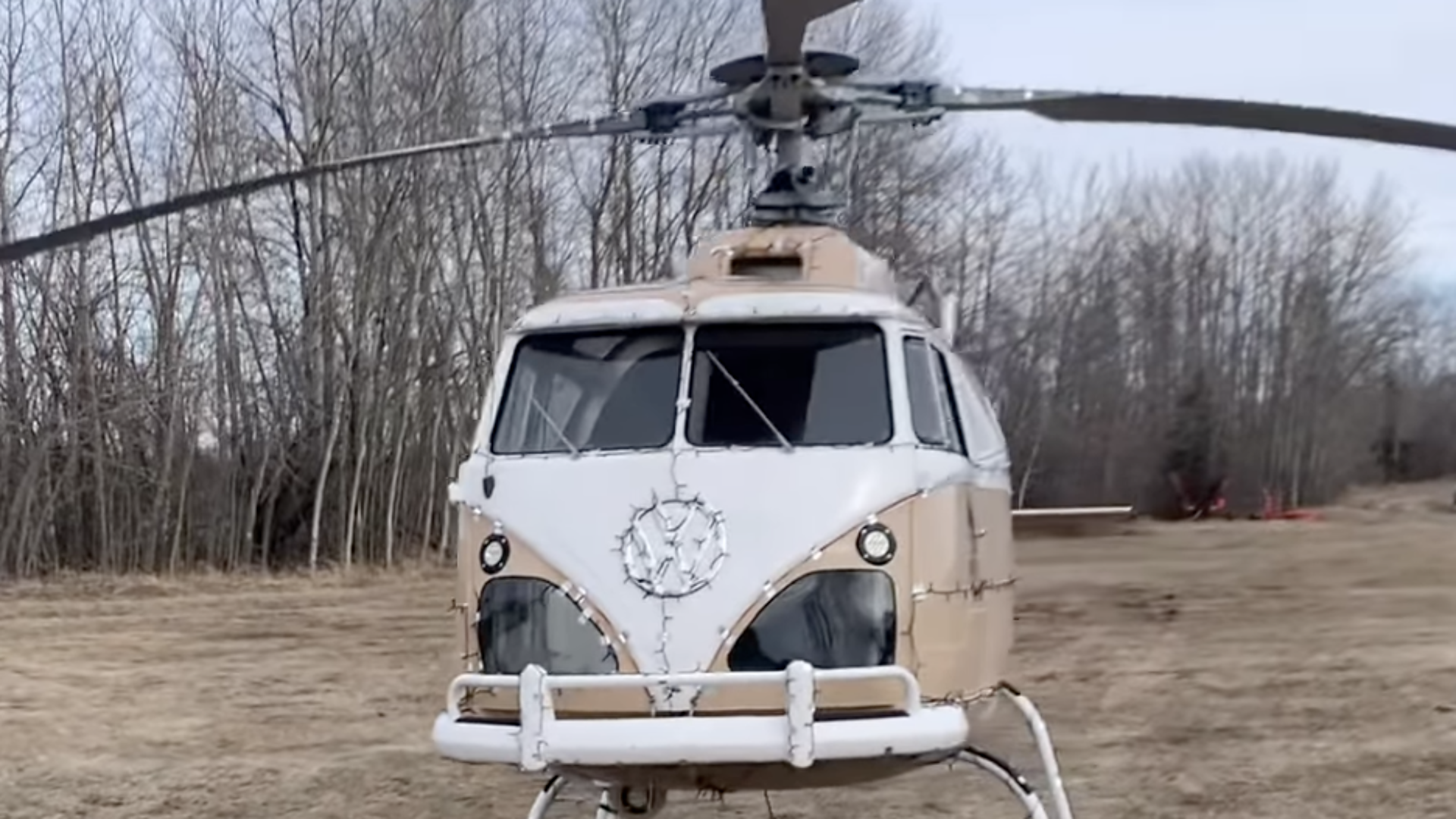
Most rotten split-window Volkswagen buses meet one of two ends. They get a six-figure rotisserie restoration, or they slowly sink into an Alberta field. One got a third option: it became the cockpit of a helicopter that will never fly.
It was built by Chuck Jurgen Teschke, an aircraft maintenance engineer from Spruce Grove, Alberta, who has made a sideline of welding retired helicopters to things that were never meant to be near them. He calls them Frankencopters. On his Instagram account and on his LinkedIn, he has posted the VW build as another Frankencopter “VW Airbus”. In a fundraising appeal, he described the series as installation art that fuses otherwise unrelated forms of transportation with helicopters.
What it is, and what it isn’t
The name isn’t a reference to Mary Shelley’s monster. Teschke has explained it’s a nod to Eddie Van Halen’s Frankenstein guitar, which was built from mismatched parts. That fits. The rear half is a donated Airbus airframe. The front half is a Type 2 bus that had already lost its engine. verticalmag
Related Articles
- A 2,700-HP Corvette Boat Reportedly Outran the Coast Guard, but Federal Law Lets Officers Board Any Boat ‘At Any Time’ Without Suspicion
- German Tourist Returning a Rental McLaren Is Hit by Gunfire in Downtown LA Shootout
Teschke has said the helicopter was an Airbus AS350 chassis donated by High Alpine Helicopters, a Prince George, B.C., maintenance shop. Calling it an H125 is close enough. Airbus says the H125 is the current designation for the AS350 B3e Écureuil (called AStar in North America). Same squirrel, new badge. It’s also one of the most common light helicopters flying: Airbus says over 7,200 members of the Ecureuil family have been delivered. That large fleet is why scrap airframes turn up at all. ‘Frankencopter’ metal art gives new life to scrapped rotorcraft – Vertical Mag
The bus came from a field near Edmonton. Teschke has explained why he felt fine cutting it up: “This one had no metal roof; it had a fibreglass recreation, so it was a perfect candidate for this.” For VW people, that settles the argument. A bus with a fake roof and a rotten floor was never going to be a concours restoration. As a parts car, its best donations were the split windshield and the V-shaped nose, which are exactly the parts you see here. verticalmag
The bits that look real because they are
A lot of the hardware is genuine aviation scrap. The rotor blades are hail-damaged AStar rotor blades that aren’t serviceable but work well as showpieces. The skids are welded from corroded landing gear cross tubes donated by an MRO shop. verticalmagverticalmag
That detail matters. In aviation, scrap doesn’t necessarily mean wrecked. It often means a part has reached its hour or cycle limit, or has damage beyond what’s allowed, and it’s retired even if it looks fine. Teschke describes his supply chain as “decommissioned, time-expired, basically byproducts of the usual attrition.” That’s also why the result looks so convincing. verticalmag
He has said the build took about 10 months and 900 man-hours, done by himself on his family’s acreage, for roughly $10,000. That’s about $11 in parts for every hour of work, with his own labor billed at nothing. Try getting a restoration shop to quote you that. verticalmagverticalmag
Why it stays on the ground
The obvious question is whether it could fly. The answer is no, and even a spare turbine wouldn’t change that. Canada’s homebuilt route has a rule that works against this kind of project. Transport Canada says a special certificate of airworthiness for amateur-built aircraft can’t be issued if an amateur did not perform or personally oversee the major portion of the construction and assembly tasks. Its major portion guidance puts the burden of proof on the builder. canada
An airframe built in a factory in France and bolted to a German van doesn’t meet that rule. You could argue it’s the least amateur-built aircraft ever assembled by an amateur. Teschke accepts that and works within it. He has said that by surrendering the desire to fly his machines, he opens up a world of creative possibilities. verticalmag
What it’s worth
Teschke has said the finished pieces aren’t officially for sale, but he would listen to a serious offer. He’s considering selling the bus build to an investor who might turn it into an Airbnb, at a tentative price of C$75,000. verticalmagverticalmag
Related Articles
- The Team Owner Whose Crew Jumped Corey Heim Is Suspended Indefinitely. NASCAR’s Fine Was $2,000, and the Anger Management Isn’t Optional.
- Ford Sent Up to 4,000 F-150 Workers Home for a Week Over a Part It Won’t Name. Its Explanation Fits on a Post-it Note.
That’s about seven and a half times his outlay, which is a slightly awkward thing for the classic VW market to hear. A rotten bus that wasn’t worth restoring may now be worth more as sculpture than many restored ones are as vehicles. Anyone who rents it out will have the same problem anyone with unusual property has: insurance. A short-term rental that’s half aircraft and half antique van doesn’t fit any standard policy, so the owner should expect to pay for a specialist one.
The series isn’t finished. Teschke’s earlier Heli-Harvester combined a grain harvester cab with a Bell 406 chassis. The next build will pair a retired Aérospatiale SA 315B Lama with the front of a vintage VW Beetle. He has also offered to buy unwanted parts publicly, posting that if anyone has any unserviceable helicopter stuff you want to dispose of consider selling it to me. verticalmaglinkedin
Somewhere in Alberta, a Lama and a Beetle are about to become one vehicle. If you had a time-expired helicopter and a long winter, what would you weld to the front of it?
Images Via: chuckteschke on Instagram
About the Author