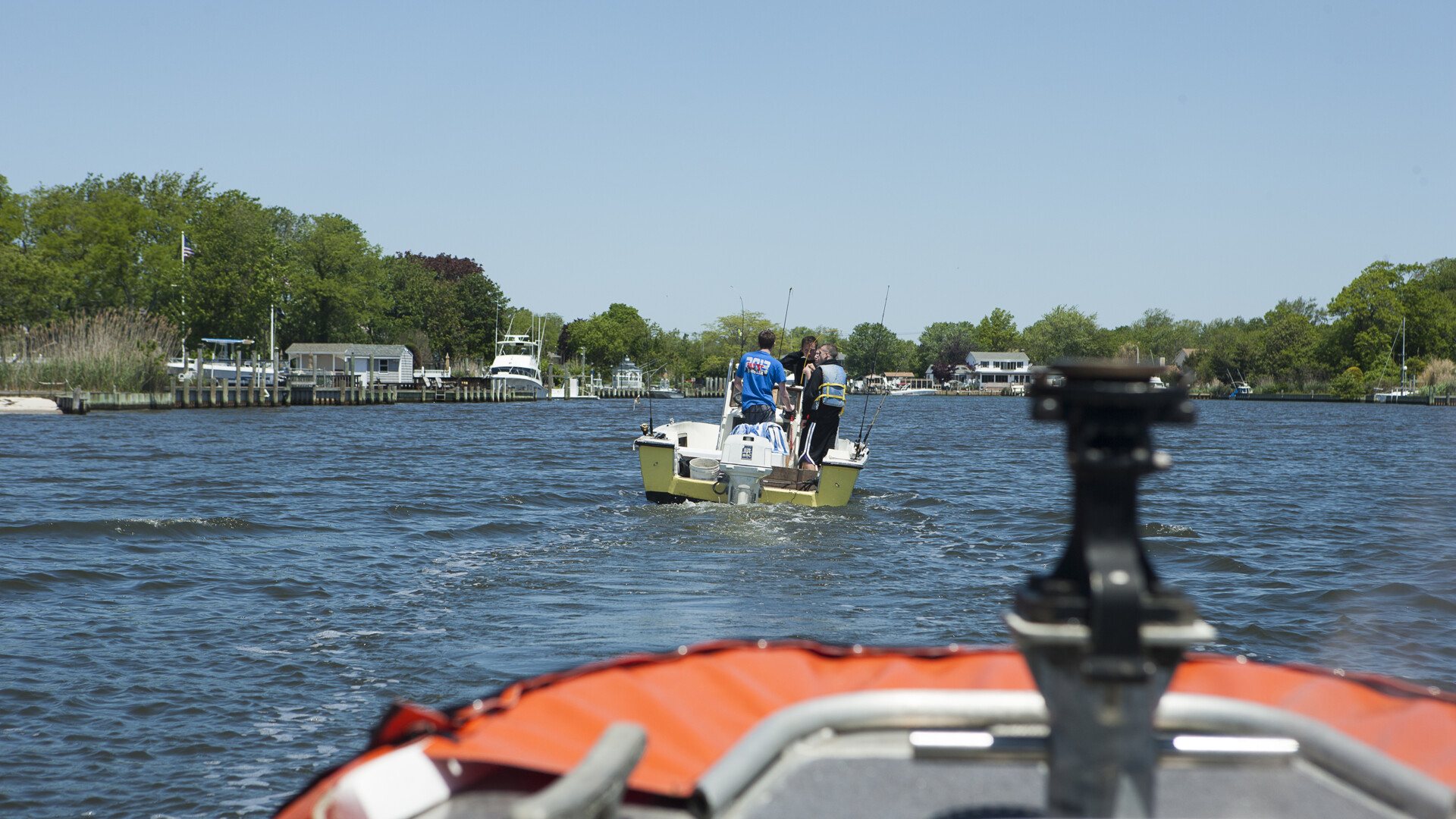
Coast Guard Station Fire Island crews end a recreational boater's trip near Fire Island, N.Y., on May 27, 2013, after a boarding found worn life jackets and an undercharged fire extinguisher. (U.S. Coast Guard photo by Petty Officer 2nd Class LaNola Stone, public domain)
A Corvette-styled offshore catamaran known as the ZR48, billed at 2,700 horsepower from a pair of Mercury Racing 1,350-hp V8s, keeps resurfacing online in a clip captioned as the boat outrunning the Coast Guard. I looked for the paper trail a real federal pursuit leaves behind and found none: no Coast Guard release, no U.S. Attorney’s announcement, no charge I could tie to the boat, and no date or location for the video from the person who shot it. Backfire News has already covered the hardware.
The law behind that caption is worth more to anyone who owns a boat, or tows one to the ramp behind a pickup, than the clip is. Police can’t pull a car over at random to check its paperwork. The Coast Guard can board a boat with no reason at all, and an operator who runs from that stop turns a life-jacket check into a federal felony.
The Coast Guard can board a boat without suspicion
Title 14, Section 522 of the U.S. Code lets Coast Guard officers “at any time go on board of any vessel” subject to U.S. jurisdiction, question the people aboard, examine the boat’s papers, search it, and “use all necessary force to compel compliance.” The statute contains no probable-cause requirement and no reasonable-suspicion requirement.
Cars get more protection. In Delaware v. Prouse, decided March 27, 1979, the Supreme Court ruled 7-1 that police may not stop a car at random just to check the driver’s license and registration; officers need at least a reasonable suspicion of a violation. Four years later, in United States v. Villamonte-Marquez, a 6-3 Court reached the opposite result on the water. Customs officers had boarded a vessel in Louisiana’s Calcasieu River Ship Channel with no suspicion to check its documents. Justice William Rehnquist wrote for the majority that waterborne commerce with ready access to the open sea is different enough from highway traffic that the alternatives police use on land, such as fixed checkpoints, would be less likely to work. That case involved Customs officers acting under a separate statute, 19 U.S.C. 1581(a), and its reasoning is the backdrop for the Coast Guard’s own at-any-time boarding power.
A routine safety boarding looks like one on May 27, 2013, when a crew from Coast Guard Station Fire Island in New York ended a recreational boater’s trip and escorted the boat back to the pier after the boarding team found life jackets in poor condition and a fire extinguisher that didn’t hold a proper charge, according to the Coast Guard’s caption for its photo of the stop.
Refusing to heave to is a five-year federal crime
The penalties start when the operator won’t stop. 18 U.S.C. 2237 makes it a crime for the operator of a vessel subject to U.S. jurisdiction “to knowingly fail to obey an order by an authorized Federal law enforcement officer to heave to that vessel.” The statute defines heaving to as slowing, stopping, or adjusting course or speed to allow a law enforcement boarding. The base penalty is up to five years in federal prison. It rises to 15 years if the flight causes serious bodily injury and to life if someone dies.
States add their own charges, and the penalties vary. In Florida, Section 843.18 makes it a third-degree felony for a boat operator who knows an officer has directed him to stop to willfully refuse, or to stop and then flee. A third-degree felony in Florida carries up to five years in prison and a fine of up to $5,000. Subsection (2) reaches the boat itself: any violation makes the vessel contraband that police may seize and that is subject to forfeiture under the state’s forfeiture act, sections 932.701 through 932.704. For the owner of a custom 2,700-hp catamaran, the most expensive part of a Florida conviction could be losing the boat.
Coast Guard helicopter crews shoot out the engines of boats that keep running
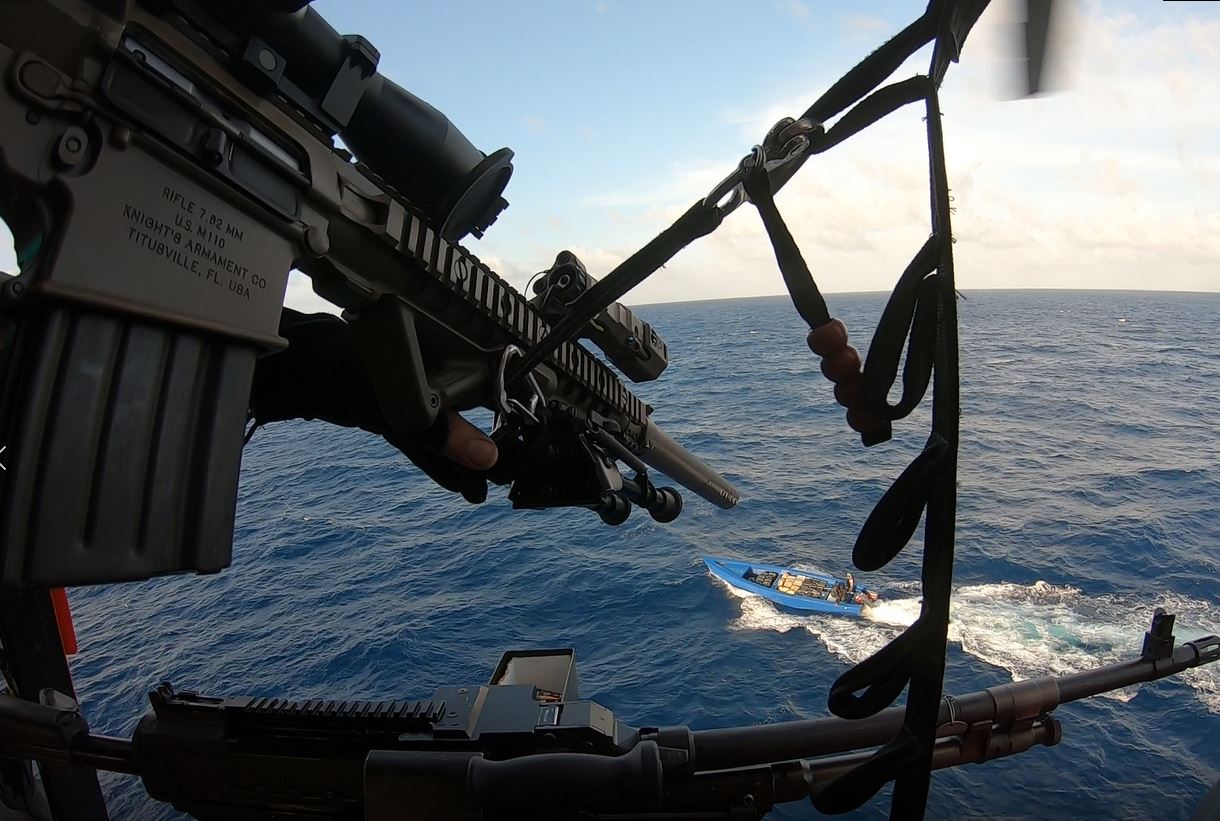
The Coast Guard’s Helicopter Interdiction Tactical Squadron, based in Jacksonville, Florida, flies MH-65 Dolphin helicopters with precision marksmen aboard. A May 7, 2026, Coast Guard feature lays out the sequence: warning shots on command, and “When the vessel doesn’t stop, he fires again to disable the engines.” In an August 25, 2025, release, the Coast Guard said the squadron had completed its 1,000th interdiction and credited it with $33.2 billion in illicit drugs interdicted since it was founded in 1999.
Those tactics are aimed at drug-smuggling go-fast boats far offshore, not at a pleasure boat near a public beach. The go-fasts, though, are built on the same idea as the ZR48, big power on a light hull, and the Coast Guard answers them with helicopters and rifles rather than a faster boat.
Fleeing boat operators in federal court
The prosecutions on record show how these cases end. Around 9 p.m. on Oct. 31, 2022, Customs and Border Protection Air and Marine agents spotted a boat running without navigation lights near Coral Bay, St. John, in the U.S. Virgin Islands. The U.S. Attorney’s Office said the operator, a 22-year-old from Tortola in the British Virgin Islands, kept accelerating and maneuvering evasively despite repeated warnings until agents disabled the boat, and that six people aboard were trying to enter the U.S. illegally. He was sentenced in June 2023 to eight months for failure to heave to and making a false statement.
The worst of these cases cost a Coast Guardsman his life. In December 2012, near Santa Cruz Island in California’s Channel Islands National Park, the driver of a smuggling panga rammed a Coast Guard small boat, and a propeller struck Senior Chief Petty Officer Terrell Horne III, 34, who died of his injuries. The driver was convicted of murder, failure to heave to, and assault and was sentenced to life without parole; a second man convicted of failure to heave to and assault received 10 years, the U.S. Attorney’s Office in Los Angeles announced on May 12, 2014.
What the ZR48 clip means for a boater waved over on the water
Under Section 2237, an order to heave to means slow down, stop, or change course so a boarding team can come aboard, and Section 522 doesn’t require the officers to give a reason first. Registration or documentation, life jackets, and a charged extinguisher are the kind of items a safety boarding checks, the same kind of rules that follows anything floating on public water, as Mercedes found when it patented a floating SUV. Running carries felony exposure on the water just as it does on a city street, where Baltimore police say the driver of a stolen Elantra fled officers and then hit a city bus.
No public record I found identifies the person driving the ZR48 in the clip, and neither the Coast Guard nor any prosecutor has tied the video to a case. If the footage shows what its caption claims, the operator’s exposure isn’t a speeding ticket. It’s a federal count carrying up to five years, and in Florida, possible forfeiture of the boat.
Should boats get the same Fourth Amendment protection as cars, with officers needing reasonable suspicion before they climb aboard, or does open water justify letting the Coast Guard board any boat at any time?
Lead image: U.S. Coast Guard photo by Petty Officer 2nd Class LaNola Stone, public domain
About the Author